Window replacement in Fort Worth in 2026: the county line decides the paperwork
By the ClearView editorial team · Sources read on 2026-10-19
Read time about 12 minutes
The short answer
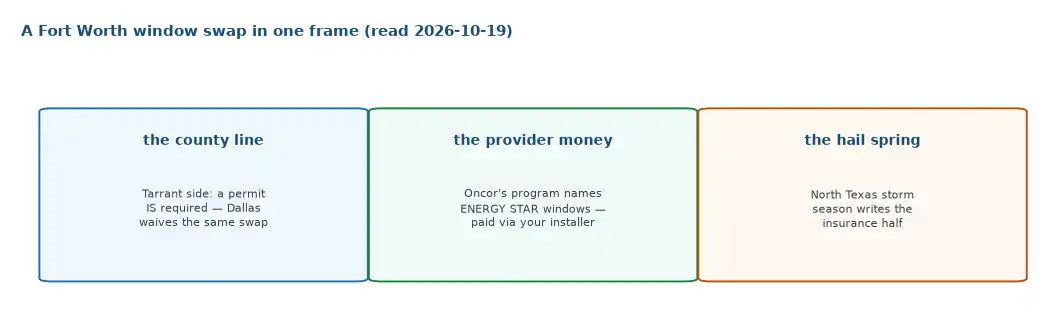
Fort Worth answers this job's paperwork question differently from its famous neighbor. On the Tarrant side of the metroplex, replacing an exterior window takes a building permit, always, even like-for-like, while Dallas waives the same swap. The permit is cheap ($168.95 as a one-trade residential remodel under the fee ordinance that took effect October 1, 2026) but it changes who can touch the job: a registered contractor, or you as a homestead owner. The money has its own local shape too: Oncor's efficiency program names ENERGY STAR windows as an eligible measure, paid through the installer rather than to you. Below: the programs with their empty lines named, the four-city permit map, the glass the North Texas sun demands, and the checks that work in a state that licenses nobody to install windows.
On this page (12 sections)
- The money map: Oncor's provider-paid measure
- The county line: four cities, four answers
- What it costs in Fort Worth
- Glass for the North Texas sun
- Historic districts: the commission first
- Repair or replace
- Choosing a company in a no-license state
- Arlington, Grapevine, Keller
- The Fort Worth calendar
- What we read, and how
- FAQ
- Sources
The money map: Oncor's provider-paid measure
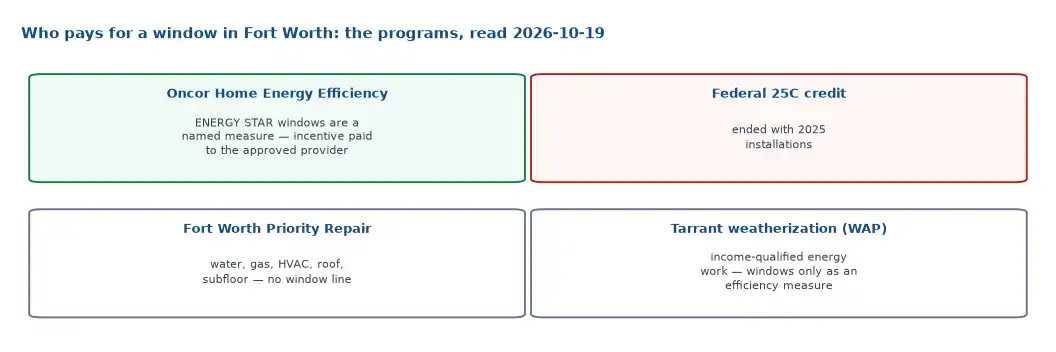
Fort Worth sits in Oncor's wires territory, and Oncor's Home Energy Efficiency program does something most utility programs do not: it names ENERGY STAR windows as an eligible measure for single-family homes. The catch is the plumbing. The incentive is calculated from measured demand and energy savings, paid to an approved service provider, and reaches you as a discount on the invoice, never as a check you file for. Budgets are annual and first-come, so the measure exists only while this year's fund does. Around it, the honest empty lines: the federal 25C window credit ended with 2025 installations, and the city's own Priority Repair Program, the thing behind the "city window program" searches, covers water lines, gas, HVAC, roofs and subflooring, not windows.
| Program | Window measure? | The shape of it |
|---|---|---|
| Oncor Home Energy Efficiency | Yes: ENERGY STAR windows are a named measure | Paid to the approved service provider; arrives as an invoice discount; annual first-come budget |
| Federal 25C credit | Ended | Not available for installations after 12/31/2025 |
| Fort Worth Priority Repair | No window line | Emergency/mechanical repairs for income-qualified owners: water, gas, HVAC, roof, electrical, subfloor |
| Tarrant weatherization (WAP) | Sometimes, indirectly | Income-qualified energy audit; windows only where the audit makes them the cost-effective measure |
How the provider money actually moves
Because the incentive flows through the contractor, it can hide inside a bid. Three habits keep it honest: ask whether the bidder is an approved Oncor service provider and get the answer in writing; ask which line of the quote is the incentive; and collect three bids, because an incentive folded into an inflated base price is a discount in name only. The program's own manual is the arbiter of what counts: a bidder who cannot show the measure list has not read it.
The county line: four cities, four answers
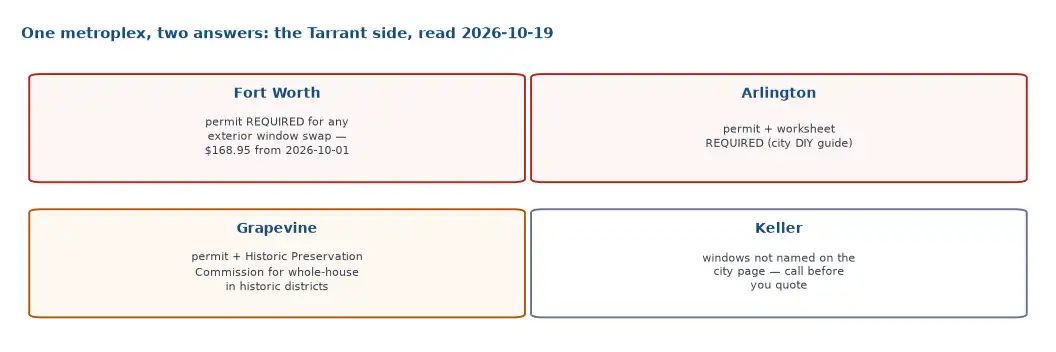
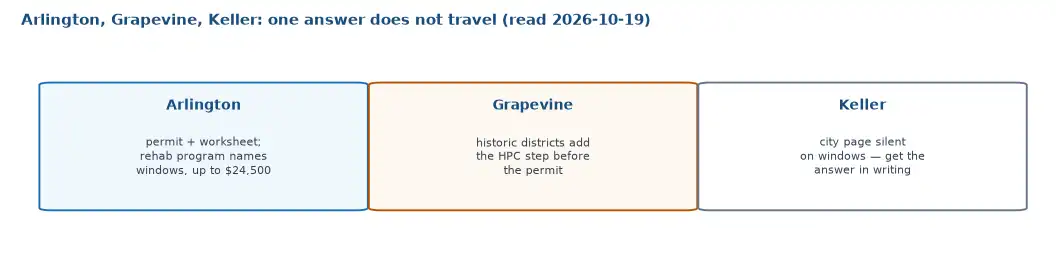
The metroplex shares weather, soil and labor. It does not share permit desks. Fort Worth's residential permit page names the work outright (replacement or addition of exterior doors, windows or burglar bars requires a building permit), while Dallas, fifteen miles east, waives the same like-for-like swap (we mapped the Dallas side separately in our Dallas guide). Arlington wants the permit plus a worksheet. Grapevine adds the Historic Preservation Commission for whole-house work in its historic districts. Keller publishes no window answer at all, which is itself an answer: call Community Development and get it in writing.
What the permit costs and who may pull it
Fort Worth prices residential remodels by the number of trades, not by project value. A window swap is one trade: $119.00 under Table 1A-1, plus the $33.08 application fee and $16.87 technology fee from Table 1-B: $168.95 total under Ordinance 26-28781, effective October 1, 2026. And the applicant is constrained: a registered building contractor, or a homeowner with a homestead exemption working on their own primary residence. That rule makes "we handle the permit" testable: either the company is registered, or the paperwork lands on you.

Exempt is not the word here: code still applies
A permitted swap keeps the code attached: the new unit must meet the current energy bar, bedroom egress sizing still governs, and safety glazing rules hold near doors and tubs. The inspection that closes the permit is also the only outside pair of eyes your install will ever get; in a state with no installer license, that inspection is worth the $168.95.
What it costs in Fort Worth
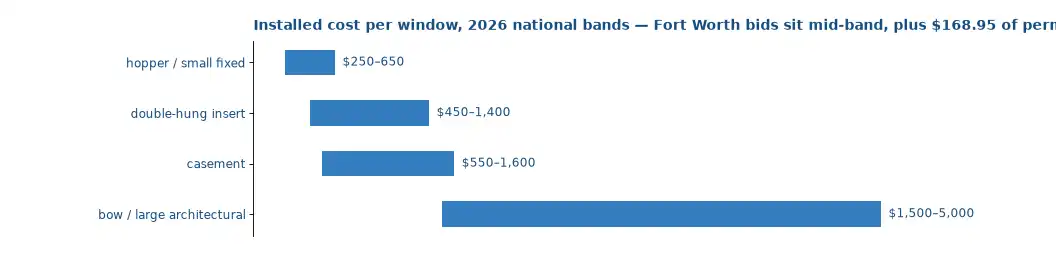
Use the 2026 national bands as the floor of the conversation: a standard double-hung insert installs around $450 to $1,400, casements a step higher for the operator hardware, and bow or large architectural units beyond the per-window range because they carry structure. Fort Worth pricing sits in the middle of the band: a deep installer bench across the metroplex keeps it there, and nothing coastal is baked in. Add the local lines: $168.95 of permit on the Tarrant side, minus any Oncor measure your provider files.
What moves the number here
Five levers do the moving: how many openings, insert or full-frame, which glass package, second-story reach, lead-safe handling on pre-1978 paint. Then three local twists. A historic address adds the commission calendar before any installer sets a ladder. A hail claim can move the job onto the insurer's rails entirely. And the glass spec is not a taste question under the South-Central sun: the low-SHGC package earns its premium nine months a year. Our installation cost guide lists labor hours per opening; what actually binds your house is its own itemized, written quote.
Shapes and their prices
Shape sets the base rate before glass talk starts. A four-panel bay tops the residential range because it is a small building project; a bow prices beside it for the curve; a fixed accent unit (an octagon over a tub, a picture flanker) prices small but custom; a basic hopper sits at the bottom. Searches for the complete cost of a swap land here: the answer is shape times scope, and structure is what writes past the bands.
Glass for the North Texas sun
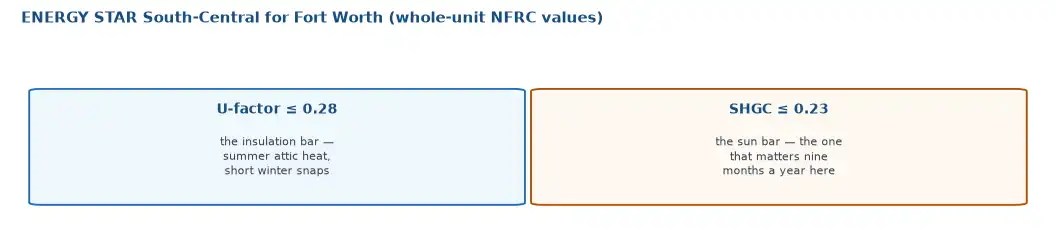
Fort Worth is ENERGY STAR's South-Central zone, where a certified unit must show whole-unit U-factor at or under 0.28 and SHGC at or under 0.23 on its NFRC label. The SHGC bar is the one that pays here: nine months of cooling season make the sun, not the cold, the enemy. Hail adds a second local spec conversation: laminated and higher-design-pressure glass cost more and survive more; ask how the quoted unit reads on both before the spring storms test it for you.
The label, not the brochure
Each brand invents its own package names; the NFRC label is the only vocabulary they share. A bid that never writes down the unit's whole-unit U-factor and SHGC is buying whichever glass the distributor discounted that month. Our vinyl-versus-wood page approaches the same truth from the frame direction: efficiency lives in the glass package, not the sash material.
Historic districts: the commission first
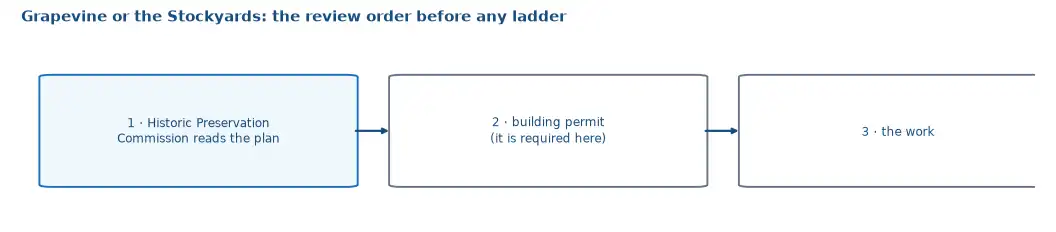
Grapevine's historic districts put it in writing: any whole-house window replacement goes before the Historic Preservation Commission before the city permits the work. Fort Worth's own historic stock (the Stockyards, Fairmount, Ryan Place) runs the same instinct through its preservation review: keep the original sash where it can be kept, and where it cannot, match the profiles and materials on anything the street can see. Interior work and true in-kind upkeep sit outside review. The commission calendar adds weeks, not days; plan it before the units are ordered, not after.
Repair or replace
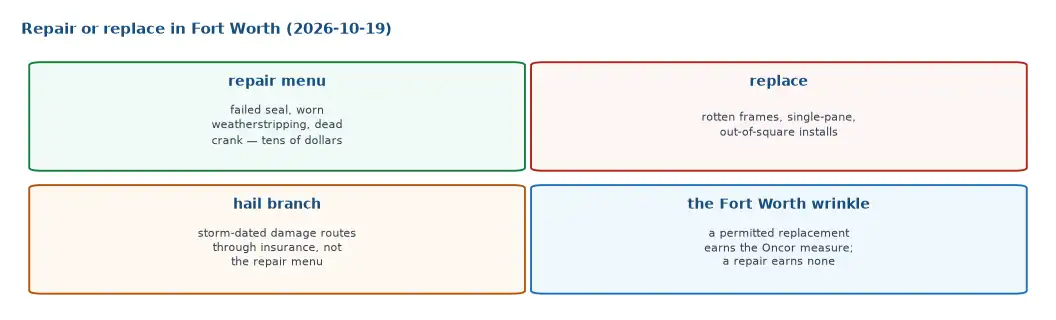
Fogged glass, worn weatherstripping, a dead crank: those are repair-menu items priced in tens, against the thousands a new window costs. Frame rot, single-pane glass and crooked original installs end the debate in favor of new units. Two Fort Worth branches sit outside the usual fork. Hail-dated damage is an insurance conversation, not a repair quote: document before cleanup. And the money map tilts the fork: only a permitted, full-unit replacement can carry the Oncor measure, so on a borderline opening the incentive belongs in the comparison. Our when to replace windows page walks each signal through a quick test, and the drafty windows page takes the leak half.
Choosing a company in a no-license state
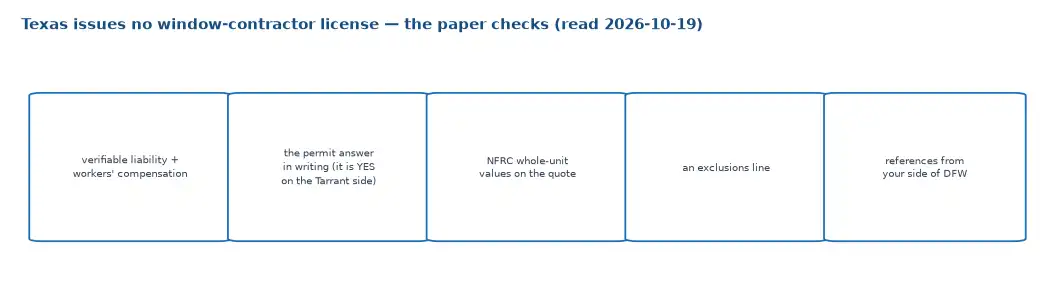
Texas licenses plumbers and electricians. It does not license the crew replacing your windows: no state exam, no state card, no lookup that separates a careful installer from a pickup with a magnet sign. The filter has to be documentary. Insurance you can call back and verify. The permit answer in writing: on this side of the county line it is yes, and the applicant must be a registered contractor or you. The quoted unit's NFRC whole-unit ratings spelled out in the bid. An exclusions line naming what the price leaves out. References from your part of DFW, because crew quality here is local, never brand-level.
After hail weeks
Every spring outbreak pulls out-of-area crews into Tarrant County. In storm weeks the insurance check doubles in weight, and no countdown printed on a door hanger has power over a legitimate claim, nor does it pull the permit the city requires.
The mobile-crew caveat
Searches for a mobile repair crew spike after every storm. A crew whose entire footprint is a truck and a phone number fails the document check instantly: no callable policy, no workers' compensation, no address that exists in January. Small outfits are not the problem; undocumented ones are.
Arlington, Grapevine, Keller
The weather is shared; the desk is not. Arlington matches Fort Worth (permit required) and adds its own worksheet for window and door replacement; its housing rehabilitation program even names windows among eligible repairs, up to $24,500 for income-qualified owners (terms change, so verify before counting it). Grapevine permits too, and layers the preservation commission on whole-house work in its historic districts. Keller's permit page names fences, carports and trees, not windows; the honest instruction there is to get the city's answer in writing before the quote assumes one.
The Fort Worth calendar
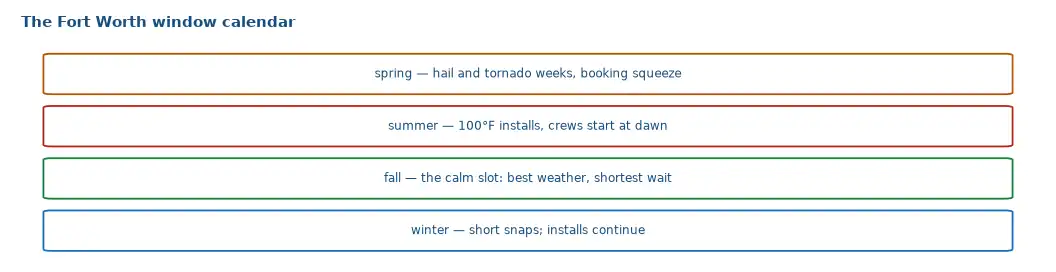
Installs run year-round here; the question is what you share the calendar with. Spring is hail and tornado weeks: crews, insurers and adjusters all book out at once. Summer means hundred-degree afternoons and dawn start times. Fall is the calm slot: the best working weather and the shortest wait. Winter snaps are short and rarely stop a same-day seal. What the calm season really buys is a steadier crew and a nearer date, not a smaller number on the quote. The full measure-to-walkthrough timeline lives on the replacement process page.
What we read, and how
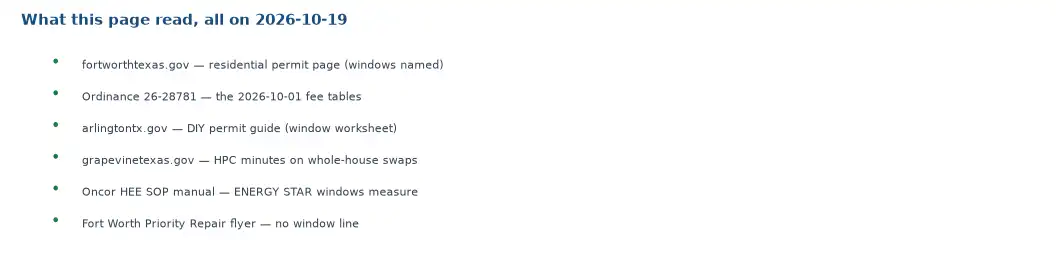
This page is built on primary reads, all dated 19 October 2026: Fort Worth's residential permit page, where windows are named; the text of Ordinance 26-28781 with its fee tables; Arlington's DIY permit guide; Grapevine's preservation minutes on whole-house swaps; Oncor's program manual, where ENERGY STAR windows appear as an eligible measure; the Priority Repair flyer, where they do not. Where a city publishes no window rule, Keller, the page says so rather than guessing.
The limits of this read
City pages change without notice, program budgets close early, and the fee arithmetic here follows the ordinance tables rather than a survey of your quote; the written bid is the version that counts. For longevity expectations, the window lifespan page sizes up how long the new units should serve.
The rest of the wave: Dallas on the other side of the county line, Charlotte with its compass rebate, Austin, Atlanta and its empty money map, and Seattle with the one rebate that pays the owner directly, and Orlando where the grant inspects first and pays after.
The questions Fort Worth actually asks
How much does window replacement cost in Fort Worth?
Per opening, 2026 national bands put a standard double-hung insert near $450 to $1,400 installed, and Fort Worth quotes land mid-band: the metroplex holds a deep installer bench with no coastal premium. Two Fort Worth lines adjust the arithmetic. First, the permit: the city requires one for any exterior window swap, billed as a one-trade residential remodel at $168.95 from October 1, 2026; small, but it belongs in the quote. Second, the Oncor incentive on ENERGY STAR units reaches you only as a discount through an approved provider, so a cheap window replacement quote that silently skips either line is not cheaper, it is shorter. For the per-opening labor hours behind the bands, our installation cost guide carries them; the binding number for your house is the itemized written quote.
Do I need a permit to replace windows in Fort Worth?
Yes, and this is where Fort Worth parts from Dallas. The city's residential permit page names the work directly: replacement or addition of exterior doors, windows or burglar bars requires a building permit. Dallas, fifteen miles east, waives the same like-for-like swap. The permit is a one-trade residential remodel at $168.95 under the fee ordinance effective October 1, 2026, and the applicant must be a registered contractor or a homestead homeowner working on their own primary residence. Arlington wants a permit plus a worksheet, Grapevine adds a historic review for whole-house work, and Keller's page does not name windows at all: call before you assume.
Is there a city of Fort Worth window replacement program or free windows?
No city window program exists, despite the searches. What Fort Worth runs is the Priority Repair Program, emergency and mechanical repairs for income-qualified owners, covering water and gas lines, water heaters, HVAC, roofs, electrical and subflooring; windows are not on its list. Weatherization through Tarrant County's WAP can touch windows, but as one efficiency measure inside an energy audit, not as a handout. The live money for a standard swap is Oncor's Home Energy Efficiency program, which lists ENERGY STAR windows as an eligible measure, paid to the approved service provider and passed to you as an invoice discount.
Who are the best window replacement companies in Fort Worth?
We don't rank companies; this guide is independent. The Texas wrinkle: the state issues no general-contractor or window-installer license, so a license lookup filters nothing. What filters instead: insurance you can verify by phone, the permit answer in writing (on the Tarrant side it is yes, and only a registered contractor or homestead owner can apply), the NFRC whole-unit ratings of the quoted unit spelled out in the bid, a line listing what the price leaves out, and references from your part of DFW. The bidder whose documents survive all five has earned its price.
Should I repair or replace my windows in Fort Worth?
Run the test before collecting bids. Fogged glass from a failed seal, tired weatherstripping or a dead crank is repair-menu work: tens of dollars where a new unit prices in thousands. Frame rot, single-pane glass and crooked original installs end the debate in favor of new units. Two local branches: hail-dated damage routes through your insurer, not the repair menu; and only a permitted full-unit replacement can carry the Oncor incentive; a glass-only repair earns none.
Is window replacement worth it in Fort Worth?
For comfort, from the first afternoon the west rooms stop baking. For money, honest fractions: part of the spend returns at resale, the bills drop some in a nine-month cooling season, and the Oncor measure trims the net if the job is specced and filed by an approved provider. Nobody can quote you full payback without selling you something. The tilt-in cleaning and quieter rooms you feel daily; the appraisal bump you feel once.
Does insurance cover window replacement after Texas hail?
Hail is exactly what the policy is for: sudden, dated, documented damage. Wear, fogged seals and age are maintenance and no policy pays for them. After a Fort Worth storm: photograph every sash, frame and screen before cleanup, log the storm date, and file with window locations listed. The spring hail weeks also pull out-of-area crews into Tarrant County, which is when verified insurance and a written permit answer matter double.
Do Home Depot or Lowe’s replace windows in Fort Worth?
Both sell and install across the metroplex, and both fulfill through subcontracted local crews, so run the crew through the same filter as any bidder: verified insurance, the Fort Worth permit pulled (ask who applies, since the city wants a registered contractor or the homestead owner), NFRC whole-unit values printed on the quote, an exclusions line, and local references. The logo on the receipt is not the crew at your window.
Can I replace windows in a Grapevine or Fort Worth historic district?
Yes, through a review that runs ahead of the permit. Grapevine's Historic Preservation Commission reads every whole-house window replacement in its historic districts before the city permits the work. Fort Worth's own districts (the Stockyards, Fairmount, Ryan Place) apply the same logic: repair the original sash where possible, and where replacement is unavoidable, match the profiles and materials on anything the street can see. Build the review into the timeline before the units are ordered.
Can you replace mobile home windows with regular windows?
Sometimes, with caveats. Manufactured homes often use non-standard rough openings and thinner wall panels, so a stock residential window may not fit the hole or the wall depth. Measure the exact opening, check the wall construction, and expect to re-frame or order a made-to-fit unit. In Fort Worth the permit rule is the same for the swap, and the homestead path applies only if the home is your primary residence on land you own.
What about Arlington, Grapevine or Keller?
Three suburbs, three paperwork answers. Arlington: permit plus the city's window-and-door worksheet; and an offset: Arlington's housing rehabilitation program names windows among eligible repairs, up to $24,500 for income-qualified owners (verify current terms before counting it). Grapevine: permit, and in historic districts the commission review first. Keller: the city's permit page names fences, carports and trees but not windows: get the answer in writing from Community Development before the quote assumes either way.
What do Fort Worth reddit threads say about window replacement?
Two findings repeat and both match our checks: quotes for identical openings vary by thousands (scope and glass package, not magic), and owners discover the permit requirement only when a bidder mentions it, or doesn't. Both are covered above with the documents attached: the cost bands, and the permit rule straight from the city's page and fee ordinance.
Can I replace my own home windows in Fort Worth?
Legally, yes: the homestead path exists precisely for that: the city lets an owner pull the permit for work on the home they own and occupy as a primary residence, no registered contractor required. Practically, weigh it honestly: a botched install voids the unit's warranty, fails the city's inspection, and forfeits the Oncor measure, which flows only through approved providers. DIY is realistic for a ground-floor insert; second-story full-frame work is where most owners hand it off.
How long does window replacement take in Fort Worth?
Measure to install typically runs two to six weeks, mostly unit fabrication; the on-site work is usually a day or two for a whole house, each opening sealed same-day. Add the Fort Worth steps: the permit application before work and the inspection after. Fall is the calm slot; spring fills with hail claims and summer books crews into dawn starts.
Other metro guides
Keep reading
Sources
- City of Fort Worth: residential permitting · window and exterior-door replacement requires a building permit; who may apply.
- City of Fort Worth: Ordinance 26-28781 fee schedule · the 2026-10-01 fee tables behind the $168.95 one-trade window permit.
- City of Arlington: Do I need a permit? A DIY guide · the permit-plus-worksheet answer for window and exterior-door replacement.
- City of Grapevine: Historic Preservation Commission minutes · whole-house window replacement in historic districts goes to the commission first.
- City of Keller: Do I need a permit? · fences, carports and trees named; windows not: the call-the-city answer.
- Oncor: Home Energy Efficiency program manual · ENERGY STAR windows listed as an eligible single-family measure, paid via service providers.
- City of Fort Worth: Priority Repair Program flyer · the emergency-repair list; windows are not on it.
- ENERGY STAR: windows, doors and skylights · South-Central zone caps: whole-unit U at or under 0.28, SHGC at or under 0.23.
- NFRC: the National Fenestration Rating Council · the whole-unit label behind the zone bar and the quote.
- US EPA: lead-safe work rules for pre-1978 homes · the lead layer on older housing stock.