Window replacement in Denver in 2026: the answer starts with your address
By the ClearView editorial team · Sources read on 2026-10-17
Read time about 10 minutes
The short answer
In the Denver metro, replacing windows is the national job with three local signatures. Your address decides the permit: the same untouched-opening swap is exempt inside Denver, in writing, and required one county over. Your climate zone decides the glass: the federal North-Central bar puts insulation first, and altitude adds its own terms. And hail decides the calendar and the insurance conversation. One correction before all of it: in 2026 no utility rebate and no federal tax credit touches window units here, so any quote that subtracts one needs a name. Below: the address map with quotes, Denver's own exemption word for word, the glass, the hail route, the money, and the checks that filter companies.
On this page (10 sections)
Denver's own rule, word for word
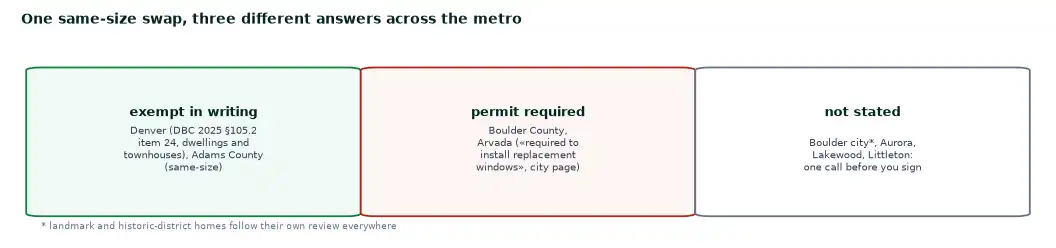
Most pages answer the permit question for "Denver" as if the metro were one city. It is not, and Denver's own answer is precise enough to quote. The 2025 Denver Building Code, the only code accepted for applications since 1 January 2026, lists the work that needs no permit. Item 24 of section 105.2 covers exactly this job: "replacement of windows and doors with no structural alterations and no change in size of opening in one- and two-family dwellings and townhouse units."
What the scope line means for your house
The exemption is not citywide blanket coverage: it names the building class (one- and two-family dwellings and townhouse units), and it names the job (same opening, no structural change). Enlarge the opening, touch the frame structurally, or change an egress window's effective size, and you have left item 24 and entered permit territory. Two named exceptions sit right under it: a designated preservation structure or a historic district needs a permit plus preservation approval, and a replacement window in a hazardous location follows the safety glazing rules of the residential code.
Historic Denver plays by a stricter book
Inside a designated historic district the exemption does not apply at all. The West Highland association's owners manual states it plainly: permits are required for window replacement, all of it, with Landmark Preservation review before work begins. If your block looks old enough to have a plaque, check the district map before you assume item 24 is yours.
The metro permit map, with quotes
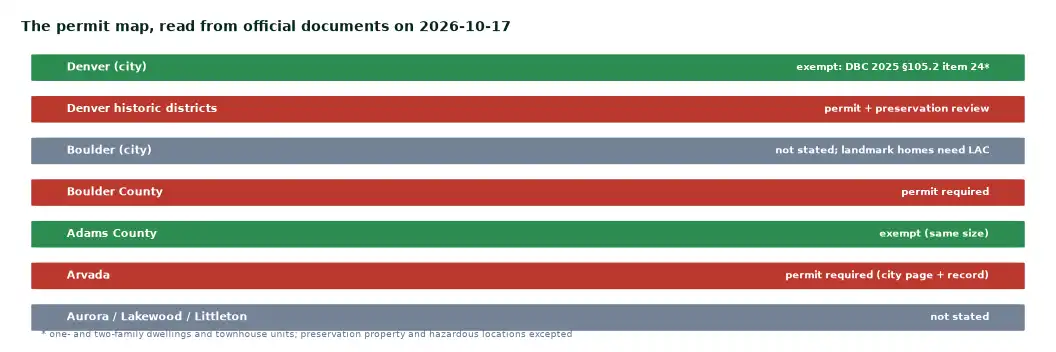
Cross one municipal boundary and the answer flips. Colorado has no statewide building code for this and no state general contractor license, so every jurisdiction writes its own page. We read them on 17 October 2026 and marked each by how solid the document is: a code section beats a web page, a web page beats silence, and silence is reported as silence rather than filled in.
| Where the house is | Same-size window swap | What the document says |
|---|---|---|
| Denver (city) | Exempt when opening and structure stay untouched, in one- and two-family dwellings and townhouse units; preservation property and hazardous locations excepted | 2025 Denver Building Code, §105.2 item 24, in force 01.01.2026 |
| Denver historic districts | Permit plus preservation review for every window replacement | West Highland owners manual, May 2024 |
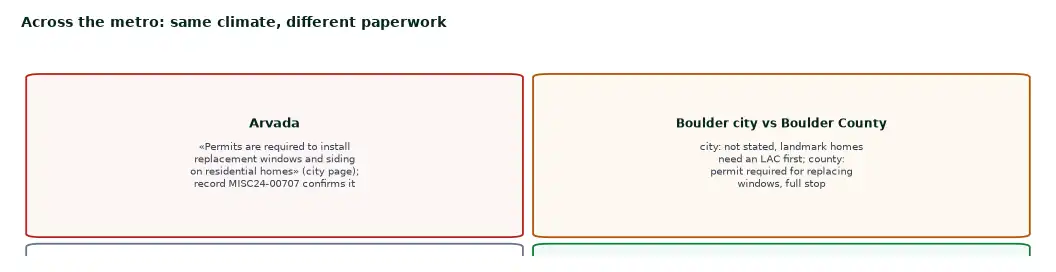
| Boulder (city) | Not stated for a plain swap; landmark and historic-district homes need a Landmark Alteration Certificate before any exterior change | bouldercolorado.gov permit page, LAC requirement |
| Boulder County (unincorporated) | Permit required; replacing windows sits on the alterations list | bouldercounty.gov building permits |
| Adams County | Not required for same-size windows and doors, listed as exempt | adamscountyco.gov exempt-work list |
| Arvada | Permit required, in the city's own words: "Permits are required to install replacement windows and siding on residential homes" | arvadaco.gov/525, plus live record MISC24-00707 |
| Aurora, Lakewood, Littleton | Not stated on the cities' public pages: one call to the Building Division before signing | honest gap, marked as such |
Two rules that survive every row
Enlarging an opening or changing an egress window's dimensions needs a permit everywhere on the map, exempt row or not. And the answer belongs in the quote: a contractor who writes your address's answer down owns it, while a contractor who waves the question off owns nothing. The suburb cards below compress the same table for the driveway conversation.
Glass for a Front Range winter
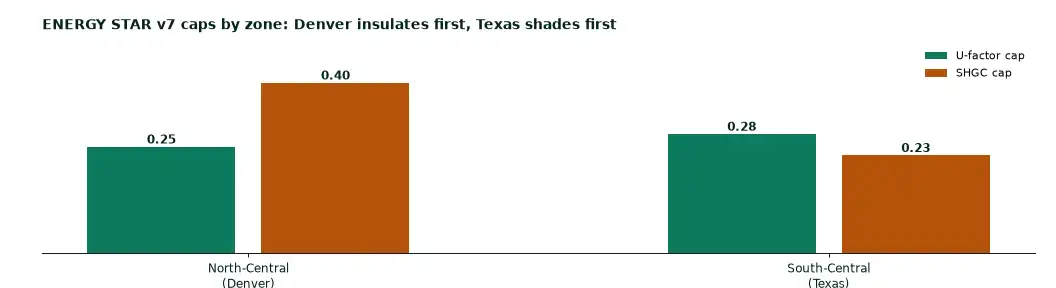
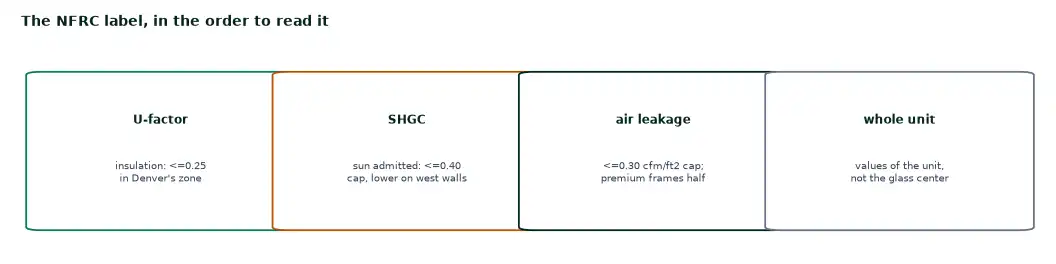
ENERGY STAR splits the country into four climate zones, and Denver sits in North-Central, where the Version 7 criteria cap a certified window at U-factor 0.25 and SHGC 0.40 as whole-unit NFRC values. The U-factor is the number that tightened in 2023, so a unit that carried the label on an older display may not pass today. The 0.40 solar cap is loose on purpose: in a heating-led climate you want January sun working for the south rooms, while the west walls get deliberately lower values so August evenings stay livable.
Altitude is the quiet third input
At 5,280 feet, ultraviolet load is stronger and the day-night temperature swing wider than in the cities window marketing is usually written for. The metro's working baseline is a low-E double-pane with argon fill; triple-pane earns its premium on north elevations and in bedrooms where cold glass is the comfort complaint, not the energy one.
Read the NFRC label, whole unit, on the quote
Whatever the package, the numbers that matter belong to the whole unit, not the center of the glass, and they belong on the quote itself: U-factor and SHGC as the NFRC label certifies them, because that is also what the energy code reads. In a windy February, air leakage counts as much as either of them: the certified cap is 0.30 cfm per square foot, and premium frames test under half of that.
Hail season and the insurance route
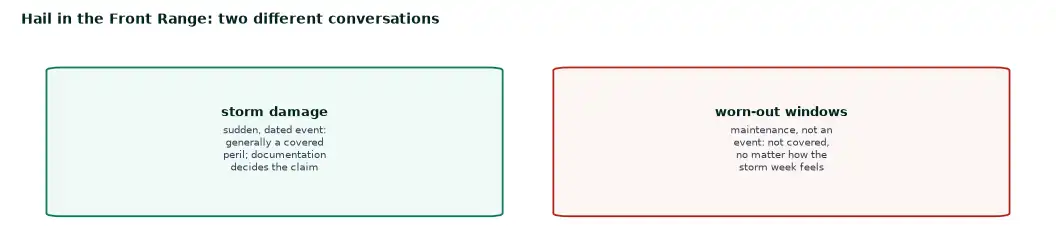
The Front Range is one of the country's reliable hail corridors, with a season that runs roughly May through September. That makes hail a design input here rather than bad luck. On the product side, laminated or impact-rated glass on the most exposed walls is the answer many owners pick, and the paperwork from a rated install is useful later. On the money side, hail damage is a sudden, dated event, which is exactly the kind of event homeowners insurance is built for; worn-out windows are maintenance and stay yours.
If a storm just hit your house
Sequence beats speed. Date the storm, photograph every damaged sash, frame and screen before anything is cleaned up, and have the damage described in writing with the window locations. The full claim route, including what adjusters ask for and where window claims stall, is on our insurance and window replacement page.
The money: drivers, and what is not subsidized
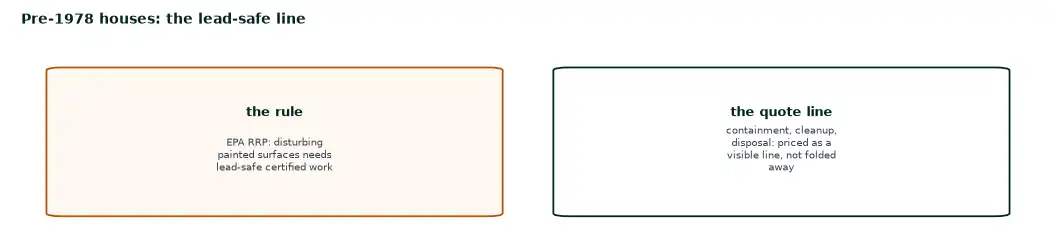
A Denver quote moves on five drivers: how many openings, insert versus full-frame, the glass package, second-story access, and lead-safe handling in the metro's many pre-1978 houses. Shape taxes sit on top: bow window replacement cost and large window replacement cost run at the top of the per-window range because of unit size and glass area, a standard casement window replacement cost tracks the base rate, and double pane window replacement cost is the baseline every package is measured against. For the measured arithmetic, per-window labor hours and whole-house math, see our installation cost guide; the written, itemized quote is the only number that binds your house.
No Xcel rebate, no federal credit, and what that quote line really is
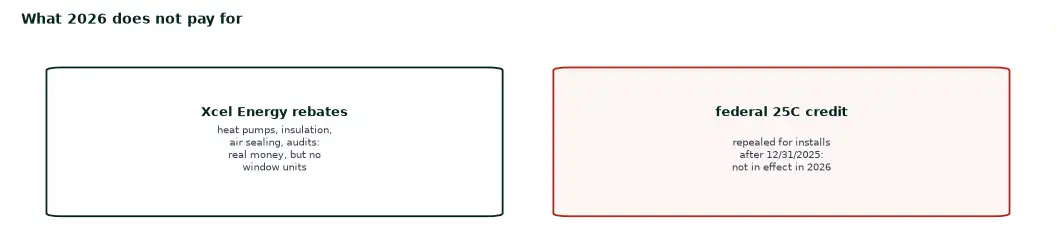
Read Xcel Energy's 2026 Colorado rebate list line by line and you find heat pumps, attic and wall insulation, air sealing and energy audits. Window units are not on it; the nearest honest use of the program is the 60 percent rebate on a pre-and-post energy audit, capped at $100 to $200, which documents what your windows actually do. The federal 25C credit for energy-efficient windows was repealed for anything installed after 31 December 2025. So when a quote shows an "energy rebate" line, ask which program it names: the honest answers are a whole-house insulation or sealing measure, or a Boulder County energy program tier for income-qualified homes, and everything else is a marketing discount wearing a rebate's clothes.
The calendar, and repair versus replace
Why winter is a schedule play, not a price play
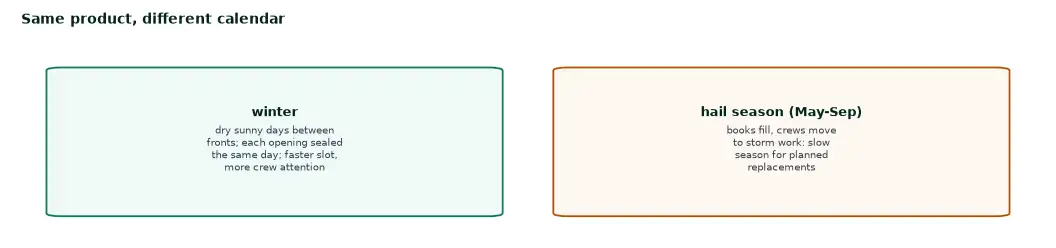
Is it cheaper to replace windows in the winter here? Neither the product nor the labor rate moves with the season. What moves is the calendar: Denver winters are dry and sunny between fronts, each opening stays open for a short planned interval and is sealed the same day, so a January project is routine rather than risky. Hail season fills books with storm work from May through September, which makes that the slow season for planned replacements even though it is the pleasant one to stand outside in. Broken glass or a dead seal outranks the calendar and should not wait for it.
Test before you quote: what repairs cost versus what replacements cost
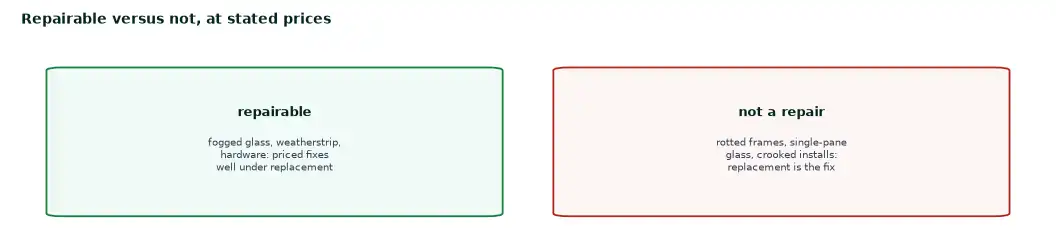
Fogged insulated glass, tired weatherstripping and tired hardware are repairable at stated prices well under replacement, and a good share of the metro's draft complaints end there. Rotted frames, single-pane glass and crooked installations are not repairs. The signal-by-signal map, with five-minute tests for each, is on our when to replace windows page, and the leak-chasing half of the question is on the drafty windows page. Run them before the first quote, because a company that sells replacements will rarely run them for you.
Choosing a company without a state license to check
Colorado has no statewide general contractor license, which moves verification from the state to the municipality and to documents. Denver licenses contractors through its Community Planning and Development department; other cities register them. Whether you typed window replacement companies near me into a search box or asked the neighbor whose house just got done, the list mixes national brands, Denver-local shops and big-box programs, and the same five checks filter all of them:
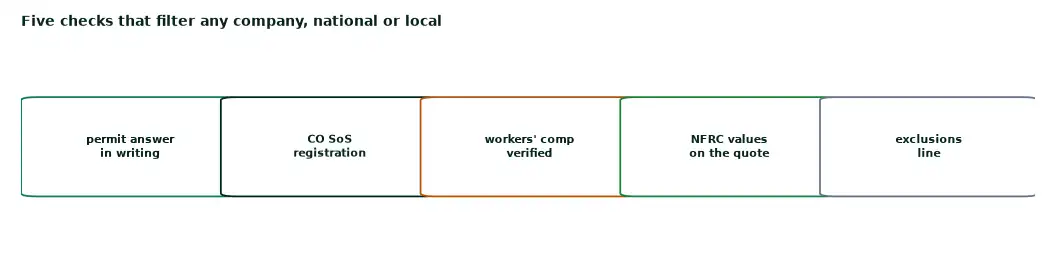
- A written permit answer that names your city or county, from the map above.
- Colorado Secretary of State registration, active and in good standing, checked by you in two minutes.
- Workers' compensation verified in the state's public coverage system, not a certificate photo.
- NFRC whole-unit U-factor and SHGC values printed on the quote for the exact unit.
- An exclusions line that says what the price does not cover: rot repair, lead-safe work, permit fees, disposal.
National brands, local shops, big-box crews
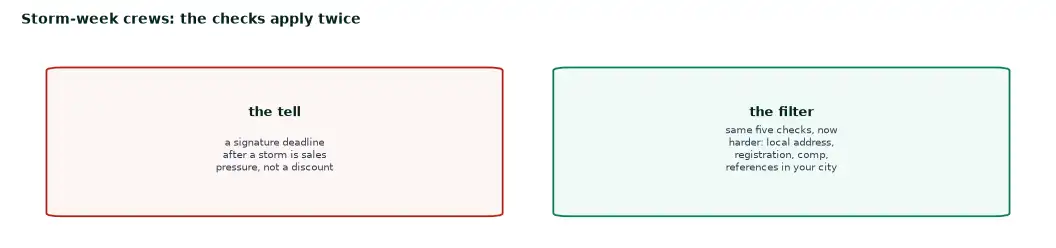
On the store question people actually ask: yes, Lowe's sells window replacement and Costco runs a program, and both fulfill through subcontracted local crews, which means the checks apply to whoever shows up at your door rather than the logo on the receipt. National window brands and Denver-local manufacturers install across the metro on the same terms. And if a quote arrives after a hail storm with a signature deadline attached, the deadline is the tell, not the discount.
Keep reading
What we read, and how
The one record that turns a claim into a document
This page is built on primary reads, dated 17 October 2026: the official 2025 Denver Building Code PDF, where section 105.2 item 24 exempts same-size window and door replacement in one- and two-family dwellings and townhouse units, quoted word for word; the West Highland historic district owners manual; Boulder's permit page, which does not state the swap answer and is reported that way, while its Landmark Alteration Certificate requirement for landmark homes is stated; Boulder County's alterations list; Adams County's exempt-work list; Arvada's city page at arvadaco.gov/525, which requires permits for residential replacement windows in the city's own words; and one live public permit record in Arvada's eTRAKiT, MISC24-00707, subtype WINDOWS, "replace windows like for like", finalized December 2024 at a job value of $6,514. For the money section: Xcel Energy's 2026 Colorado rebate list read line by line, and the repeal date of the federal 25C window credit. For the glass section: ENERGY STAR Version 7 criteria by climate zone. Cities whose pages do not state the answer are marked as such rather than guessed.
Common questions, Denver edition
Do you need a permit to replace windows in Denver?
Usually no, with two exceptions. The 2025 Denver Building Code, in force since January 2026, exempts replacing windows and doors when there are no structural alterations and no change in the size of the opening, and that exemption is scoped to one- and two-family dwellings and townhouse units (section 105.2, item 24). The exceptions: designated preservation structures and historic districts need a permit plus preservation review, and a window in a hazardous location follows safety glazing rules. Historic districts are tighter than the rest of the city: West Highland's own manual requires a permit for every window replacement.
How much does window replacement cost in Denver?
The quote moves on five things: opening count, insert versus full-frame, glass package, second-story access, and lead-safe handling in pre-1978 houses. Shape taxes sit on top: bow and large windows price at the top of the per-window range, casements at the base rate. What it is not reduced by in 2026: Xcel Energy has no rebate for window units, and the federal 25C credit ended with 2025 installs. The measured arithmetic lives on our installation cost page; your written quote is the only number that binds your house.
What windows work best for Colorado winters?
Denver is in ENERGY STAR's North-Central zone: certified windows cap at U-factor 0.25 and SHGC 0.40 as whole-unit NFRC values. At 5,280 feet add stronger UV and wide day-night swings, so low-E double-pane with argon is the baseline and triple-pane earns its premium on cold north elevations. Ask for the quoted unit's NFRC numbers on paper and check them against both caps; a label from before 2023 may fail today's bar.
Who are the best window replacement companies in Denver?
We are an independent guide and do not rank companies. What works here is a five-part filter, because Colorado has no statewide general contractor license and checking is documentary: a written permit answer naming your city or county, an active Colorado Secretary of State registration, workers' compensation verified in the state system, NFRC values printed on the quote, and an exclusions line naming what the price leaves out. A company that passes all five is worth its bid, whatever its size.
Should I repair or replace my windows?
Test before you quote. Fogged insulated glass, tired weatherstripping and tired hardware are repairable at stated prices well under replacement; rotted frames, single-pane glass and crooked installations are not. Our when to replace windows page maps the signals with five-minute tests, and the drafty windows page covers the leak-chasing half of the question.
Is it cheaper to replace windows in the winter in Denver?
The price does not move with the season; the schedule does, and schedule is the real currency. Denver winters are dry and sunny between fronts, and each opening stays open for a short planned interval before being sealed the same day, so January work is normal practice. Hail season fills calendars with storm jobs from May through September, which makes winter the easier slot for planned work even though it is not a discount.
Does insurance cover window replacement after hail?
Hail damage is a sudden, dated event, and homeowners policies generally treat it as a covered peril; worn-out windows are maintenance and are not covered. The claim stands on its record: date the storm, photograph every damaged sash, frame and screen before cleanup, and have the damage described in writing with window locations. The full route, including what adjusters ask for, is on our insurance and window replacement page.
Is it better to repair or replace windows, and does it raise home value?
Repair first when the problem is glass, seal or hardware; replace when it is frame, single-pane or installation. On value: new windows can increase home value, but buyers and appraisers pay full attention only to documented, permitted, NFRC-labeled work. The honest expectation is partial recoup at sale plus lower bills and comfort while you live there; anyone quoting full recoup is selling, not appraising.
Does Lowes do window replacement, and what about Costco?
Yes: Lowes sells and installs replacement windows, and Costco runs a window program, but both fulfill through subcontracted local crews. The five checks therefore apply to the crew that shows up, not the logo on the receipt: written permit answer, state registration, workers' compensation, NFRC values on the quote, and an exclusions line.
What about homes in Aurora, Lakewood, Arvada, Boulder or Littleton?
Same climate and hail belt, different paperwork. Arvada requires a permit for replacement windows on residential homes, stated on its own city page. Boulder city does not state the answer for a plain swap, but landmark and historic-district homes need a Landmark Alteration Certificate first. Unincorporated Boulder County requires a permit for replacing windows. Aurora, Lakewood and Littleton do not publish the answer, so it is one call to the Building Division before you sign, and one written line in the quote.
Sources
- City and County of Denver: 2025 Denver Building Code (official PDF) — §105.2 item 24, the window and door replacement exemption
- City of Boulder: Building Permits and Inspections — Landmark Alteration Certificate requirement
- Boulder County: Building Permits, alterations that require one
- Adams County: Apply for a Building Permit, exempt work list
- City of Arvada: Windows & Siding Installation — permits required for residential replacement windows
- Arvada eTRAKiT public permit record MISC24-00707, WINDOWS, like-for-like swap
- ENERGY STAR: windows, doors and skylights criteria by climate zone, Version 7
- US EPA: lead-safe work rules for pre-1978 homes
- Xcel Energy: Colorado programs and rebates, 2026 list read for what it does not cover