When to replace windows in 2026: the 12 signals and their tests
By the ClearView editorial team · Sources read on 2026-10-15
Read time about 11 minutes
The short answer
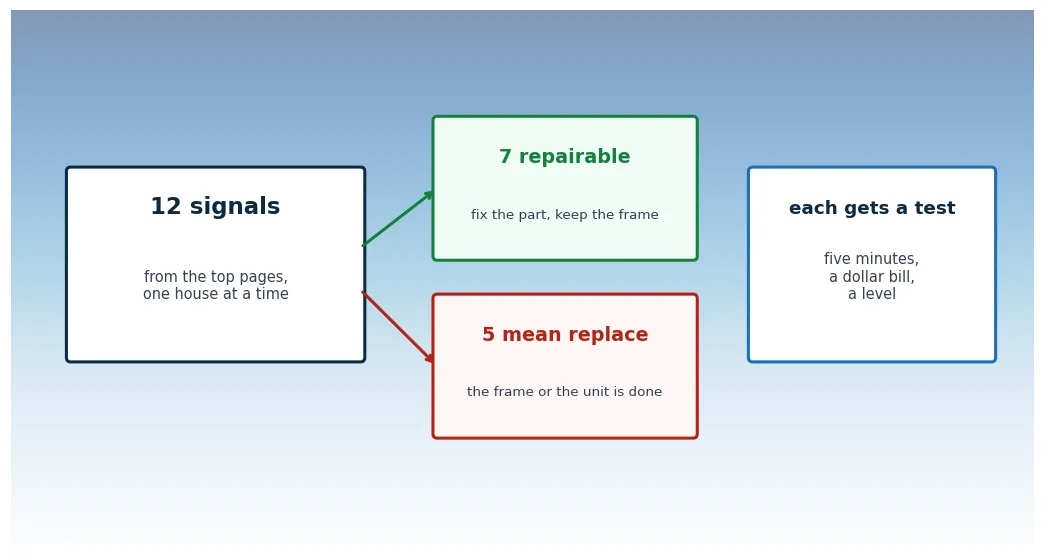
You replace a window when the frame or the unit is done, not when a list says so. The top pages for this question list about twelve signals between them, and every one of those lists ends at the same place: buy new windows. We read all of them and rebuilt the answer the other way. Each signal below comes with the part that is actually broken, a five-minute test you can run with a dollar bill or an awl, and the honest branch: seven of the twelve are usually a repair with a stated price under $600. Five mean replacement. The tests decide which house you live in.
On this page (11 sections)
The twelve signals, gathered in one place
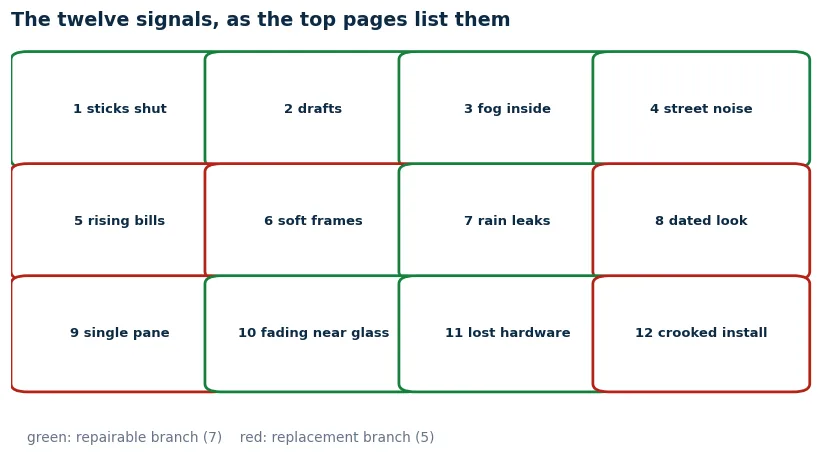
Search this question and you get list articles: six signs from one manufacturer, seven from a warranty company, a forum thread where homeowners ask each other how they knew. We read the pages that rank on both search engines, pulled every signal out of them, and merged the duplicates. The combined set has twelve entries. Nobody publishing the list carries all twelve, and nobody sorts them by what is physically broken, which is the only thing about a signal that decides anything.
Where the list comes from
Seven pages: two window manufacturers, one national warranty company, two home-improvement publishers, one dealer blog, one seasonal guide. Each list is honest about what it sees and biased about what it sells. The manufacturer lists end at replacement because manufacturers make windows; the forum thread ends at "it depends" because nobody in it measured anything. Both are incomplete in opposite directions.
The signal is not the decision
A signal is a symptom: the sash sticks, the glass fogs, the sill feels soft. The decision depends on which component produced the symptom, and most components of a window can be swapped without touching the rest. That is the sorting this page adds. If drafts are what brought you here, the full diagnostic sequence for air leaks lives on the drafty windows page; this page is the fork after the diagnosis.
The five-minute tests
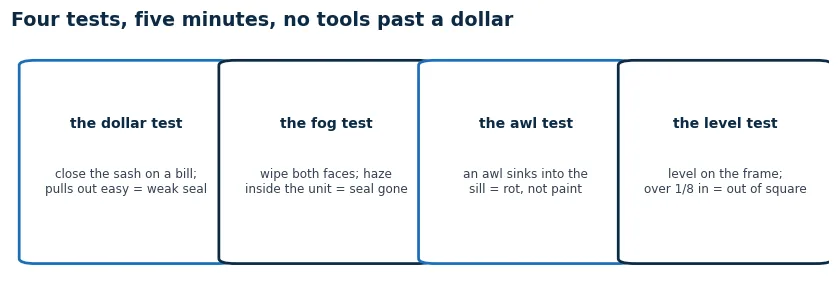
Every signal on the list has a test that converts it from a feeling into a measurement. None needs more than a dollar bill, an awl, a level and five minutes. Run them before you read any further; the rest of the page reads differently once you know which branch your windows are in.
The dollar test, for seals and drafts
Close the sash on a dollar bill and pull. Resistance means the weatherstripping still compresses; a bill that slides out freely means the seal is done. Work around the whole perimeter, because seals fail at corners first. On a cold day the back of your hand finds the same leaks moving air.
The fog test, for sealed glass units
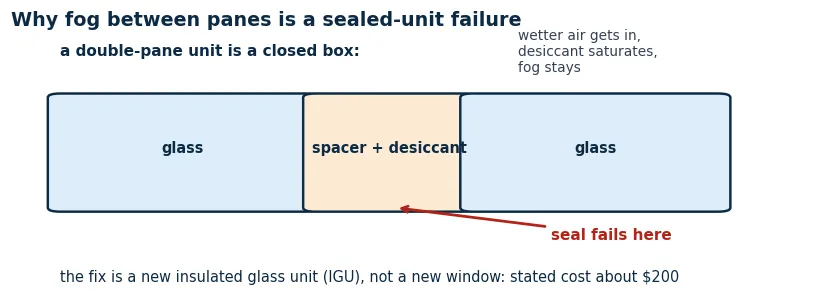
Wipe the haze from both faces of the glass. If it stays, the moisture is inside the insulated glass unit, and the unit's perimeter seal has failed: wetter air entered, the desiccant in the spacer saturated, and the fog is permanent. This is the most mis-sold signal on the list. The broken part is the glass package, not the window, and the stated fix runs around $200 for a new unit, not $700 for a new window.
The awl test, for rot
Press an awl or a screwdriver into the sill and the bottom corners of the frame. Sound wood resists; rotted wood takes the point like cork. Paint hides rot for years, so a good-looking sill is not evidence. Rot in the frame is the signal that closes the repair branch: patches hold a season or two, and the water that caused the rot keeps its path.
The level test, for the opening
Lay a level across the sill and against the jamb. A frame out of square by more than about an eighth of an inch makes every sash in it fight: sticking, drafts, locks that miss. Settlement can move an opening; so can an installation that was never level. Either way, the problem lives in the opening, and no new insert fixes it.
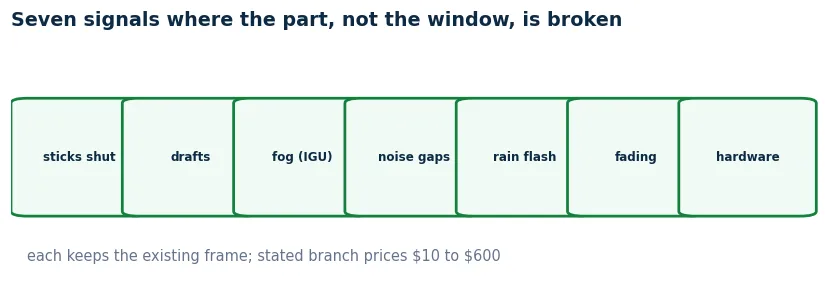
Seven signals you can repair
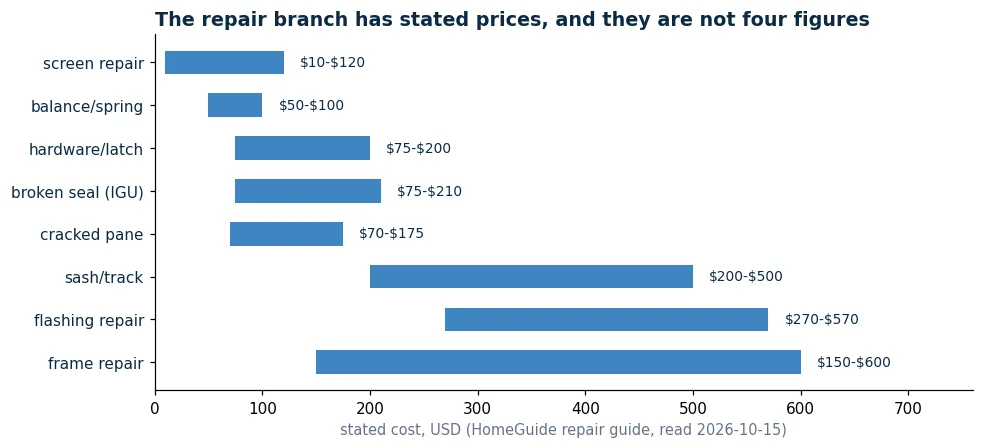
Here is the finding the signal lists leave out. Seven of the twelve signals describe a broken part inside a sound window, and parts have stated prices. The numbers below are from HomeGuide's repair cost guide, read in full for this page; they are stated ranges from reported projects, not our quotes. Read them against the replacement range of $400 to $2,000 per window and the branch gets obvious.
The mechanics: balances, hardware, tracks
A double-hung window that will not stay up has a dead balance: stated repair $50 to $100. A latch that will not catch or a crank that strips is hardware: $75 to $200. A sash that grinds in its track is a track or sash problem: $200 to $500 with new parts. All three feel like "the window is done" and none of them is.
The sealed unit and the screen
The fogged unit from the fog test swaps out for a stated $75 to $210, with a full IGU replacement around $200; the frame never moves. Torn screens are $10 to $120 to repair. Even a cracked pane is $70 to $175. These are the signals that list articles use to sell whole windows, and they are the cheapest items on the repair menu.
The leak that is really flashing
Water at the opening after rain reads as a dead window and is often a dead flashing or perimeter seal instead: stated repair $270 to $570. The test of the test is the recurrence. A leak that returns after proper flashing work is telling you the opening itself has moved, and that crosses into the replacement branch below.
Five signals that mean replacement
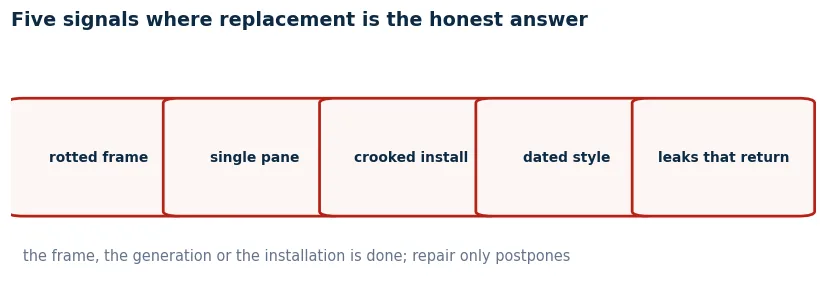
The other five signals describe the window itself: its frame, its generation, or the way it went into the wall. Repair money spent here is postponement money.
Rot and out-of-square frames
A sill that takes an awl, or an opening that fails the level test, is structure. Frame repair exists ($150 to $600 stated) and buys time on a windowsill with a soft spot; it does not un-rot a frame or square an opening that has moved. These windows go to replacement, and the quote should include rebuilding the opening, not just dropping a unit into it.
Single-pane and the dated look
A single-pane window is a whole generation behind: no sealed unit, no low-e coating, no gas fill, and there is nothing to repair because nothing is broken. The same logic covers curb appeal. Nobody can test a window into being better looking; if the style is what bothers you, replacement is the only branch, and that is a legitimate reason all by itself.
The install that was never right
Some windows were never level, never flashed, never insulated at the perimeter, and have leaked and stuck since the day they went in. Re-hanging the same unit in the same bad opening repeats the problem. When the tests point at the installation itself, full-frame replacement with the opening rebuilt is the fix. What proper work looks like on the day is on the replacement process page.
Repair or replace: the deciding line
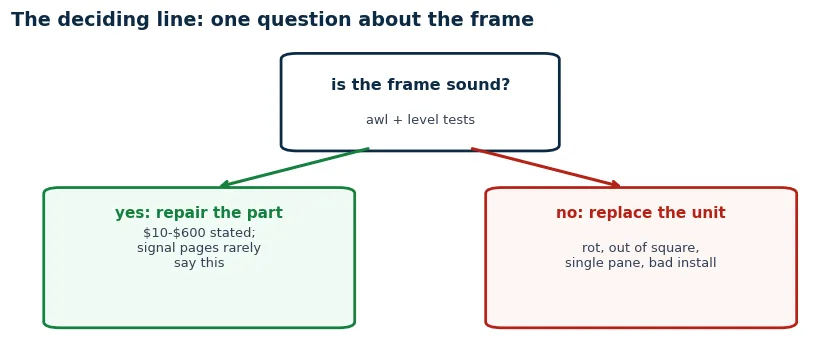
After the tests, the whole question compresses into one: is the frame sound. A sound frame with a failed part is a repair, and the repair menu tops out where replacement starts. A dead frame with healthy parts is a replacement, because the parts cannot stay healthy in a frame that leaks or racks.
The money on both branches
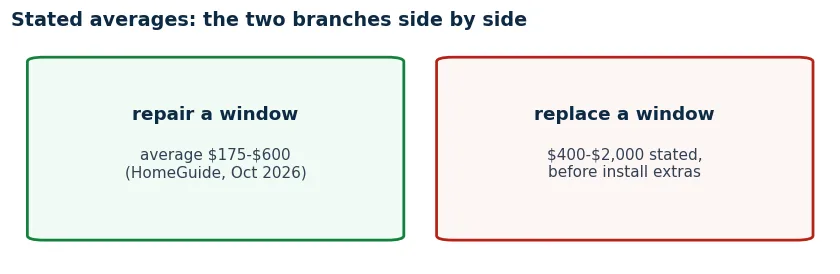
The stated averages: repair $175 to $600 per window, replacement $400 to $2,000 before installation extras. The ranges overlap at their edges, which is where judgment lives: a $500 sash-and-track rebuild on a twenty-year-old window is buying time, not value.
| Signal | What is broken | Test | Branch |
|---|---|---|---|
| Sticks, will not lock | balance, hardware, track | operate it three times | repair $50 to $500 |
| Drafts | weatherstripping, caulk | dollar test | repair; diagnosis on the draft page |
| Fog inside the glass | insulated glass unit | fog test | repair: IGU about $200 |
| Street noise | gaps, or single glass | open versus closed | repair gaps; replace single-pane |
| Rising energy bills | the sum of the above | bills plus the tests | fix fixable first |
| Soft or rotted frame | the frame itself | awl test | replace |
| Rain at the opening | flashing, or the opening | stains after a storm | repair $270 to $570; recurrence means replace |
| Dated style | nothing physical | your eye | replace, by choice |
| Single-pane glass | the whole generation | one sheet, no spacer | replace |
| Fading near the glass | no low-e coating | bleached fabric line | repair: coated glass swap |
| Hardware discontinued | a part, out of production | part number search | repair $75 to $200, else replace |
| Crooked installation | the mounting, not the unit | level test | reinstall; recurrence means replace |
The energy-bills signal
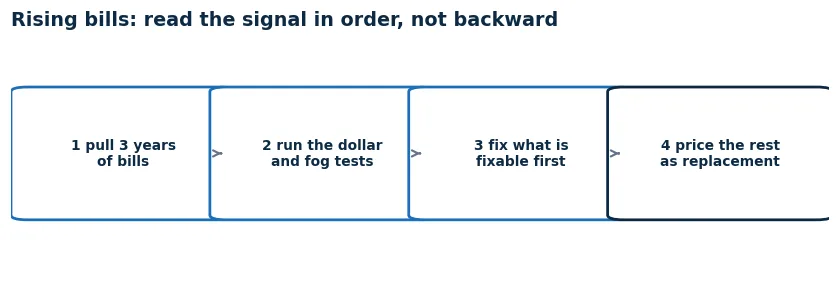
Rising bills are the signal that sends people to window quotes first, and it is the only signal that reads backward. A bill is the sum of every leak in the house, and windows are one leak among many. Read this signal in order: pull three years of bills, run the dollar and fog tests, fix what is fixable, and only then price replacement for what is left.
Read bills before products
The US Department of Energy's purchasing guidance ties window performance to rated U-factor and solar heat gain, not to marketing tiers, and ENERGY STAR certifies units by climate zone. Those ratings matter in the replacement branch. In the repair branch, a $60 weatherstripping kit on a window that fails the dollar test does more for next month's bill than a quote for ten new windows does.
What efficiency actually fixes
New glass packages help where glass is the problem: single-pane openings, failed units, rooms that bake or freeze at the window. They do not fix an attic hatch that leaks or a furnace from the last century. If the bills climbed while the windows passed every test, the windows are not the leak.
Age is one signal, not the verdict
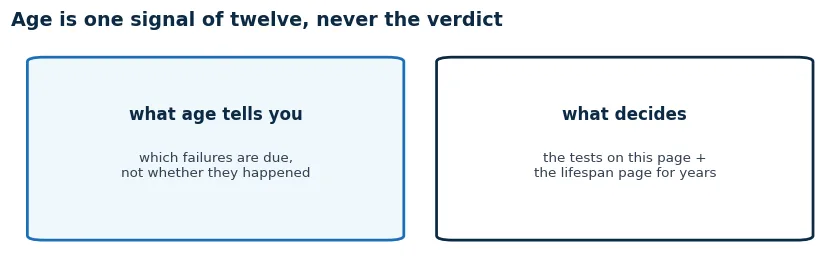
"The windows are twenty years old" appears on every list as if the number decided something. Age predicts which failures are due; it cannot tell you whether they happened. A maintained wood window at forty can pass every test on this page, and a badly installed vinyl unit can fail them at six.
What age predicts
Seal life in insulated glass units, hardware fatigue, and the odds that parts have been discontinued all track the calendar. So does the warranty clock, which matters when a covered failure shows up near its end. Those are reasons to test an older window sooner, not reasons to condemn it untested.
What the years actually look like
Service life by material, warranty language against field failure data, and what "lifetime" covers in writing: that is its own page, and it is the window lifespan guide. This page stays on the other half of the question: not how long windows last, but how you know yours are done.
Three scenarios that change the answer
The tests are universal; the context is not. Three situations reliably bend the decision, and all three come straight from the questions people actually ask.
Selling the house
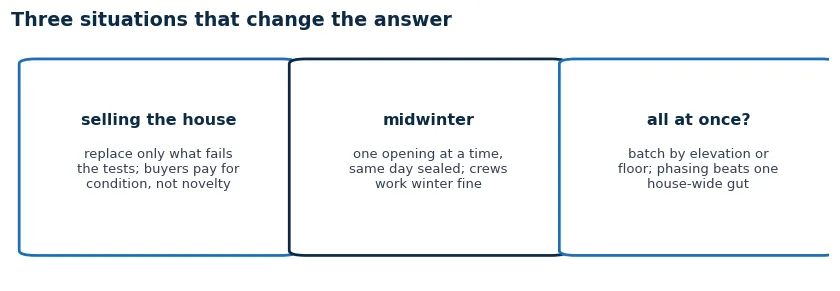
Buyers pay for condition, not novelty. A pre-listing inspection runs the same tests you just ran, so replace what fails them (fogged units, stuck sashes, soft sills) and keep the receipts. A whole-house replacement timed to a sale is a five-figure bet that the next owner shares your taste; the failed three windows are a smaller, safer one.
Midwinter
Crews replace windows in January routinely: one opening at a time, the room closed off, the new unit in the same day. Winter schedules are shorter and lead times friendlier, which is why the offseason is when the work gets easier to book. If a window fails the tests in December, the season is not a reason to live with it until May.
All at once, or one at a time
Batch by failure, not by fear. Openings on the weather side age together, so phase the project by elevation or floor: the south face this year, the street side next. The per-window price in a whole-house quote is better, and worth taking when most openings genuinely land in the replacement branch. When they do not, phasing beats volume. The price side of that arithmetic is on the installation cost page.
What we audited, and how
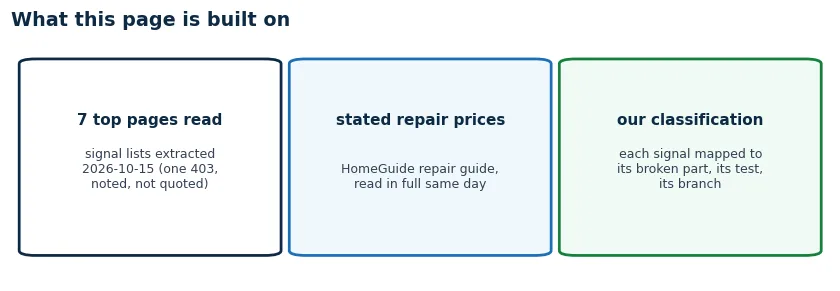
On 15 October 2026 we read the pages that rank for this question on both search engines: seven in full (two manufacturers, a warranty company, two home publishers, a dealer, a seasonal guide), with one trade publisher blocked to bots and noted rather than quoted. Their signal lists, extracted as published, merge into the twelve above. The classification layer is ours: each signal mapped to the component that produces it, the test that proves it, and the branch it belongs to. The branch prices are stated ranges from HomeGuide's window repair cost guide, read in full the same day.
The limits of this audit
The prices are one aggregator's stated ranges, not bids on your house. The classification is our expert table, not a lab protocol, and a few signals (a borderline frame, a recurring leak) only resolve on site. What we claim is narrower and more useful: the branch question is the frame, and the tests are printable, free and five minutes each.
The questions people actually ask
How do I know if my windows need to be replaced?
Run the tests, not the calendar. Close the sash on a dollar bill and pull: if it slides out easily, the seal is weak. Wipe both faces of fogged glass: haze that stays inside the unit means the sealed glass unit has failed. Press an awl into the sill: wood that takes it is rot. Lay a level on the frame: more than about an eighth of an inch out is a crooked opening. Four of the twelve signals fail these tests into the replacement branch; the rest are usually a repair.
Is it better to repair or replace windows?
It depends on which part is broken, and that is the question most signal lists skip. A failed seal, a dead balance, tired weatherstripping or missing hardware is a part: stated repair prices run about $50 to $600. A rotted frame, a single-pane unit, or an installation that was never square is the window itself: repair only postpones. The deciding question is whether the frame is sound.
Is it cheaper to repair or replace windows?
Repair, by a wide margin, when repair is possible. The stated average for window repair is $175 to $600 per window against $400 to $2,000 for replacement, per HomeGuide's repair cost guide. A fogged unit is the classic case: the insulated glass unit swaps out for a stated price around $200 while the frame stays. Repair stops being cheaper when the same window comes back for a second failure, or when the frame itself is gone.
How do you know when foggy windows need replacing?
Fog between the panes that cannot be wiped from either face is a failed insulated glass unit, and the unit, not the window, is what failed. The seal around the spacer has let moist air in and the desiccant has saturated. The stated fix is a new IGU at roughly $200, or a full sash swap. The frame only enters the conversation when it is also rotted or out of square.
Should I replace windows before selling my house?
Replace what fails the tests, and document it. Buyers and their inspectors check the same things on this page: operation, fog, soft sills. A house where every window opens, locks and shows clear glass reads as maintained; a house with three fogged units reads as deferred. Full-house novelty replacement before a sale rarely returns its cost; fixing the failing units usually does.
Can you replace windows in the winter?
Yes, and crews do it all season. Each opening is open to the weather for a short, planned window of time, typically well under an hour per unit, and the room is closed off while it happens. Winter is often when lead times and schedules are friendliest. The real constraint is sealant temperature ratings, which the crew manages with product choice.
Should I replace all my windows at once?
Only if all of them fail the same tests. Windows on the weather side of a house age faster than sheltered ones, and bathrooms and kitchens see more interior moisture. Phasing by elevation or floor spreads the cost and matches the actual condition. A whole-house quote is worth taking when most openings are genuinely in the replacement branch, not because the calendar says so.
Are replacement windows worth it?
When the tests put the window in the replacement branch, yes: you are buying back operation, sealing and a rated glass package. When the window is in the repair branch, the same money buys several years of service for a fraction of the price. The worth-it question answers itself once each window has been tested rather than guessed at.
Sources
- HomeGuide: window repair costs · the stated repair ranges ($175 to $600 average; seal, balance, sash, frame, flashing), read in full 15 October 2026.
- US DOE FEMP: purchasing energy-efficient residential windows · the performance terms a replacement unit should carry.
- ENERGY STAR: windows, doors and skylights · the climate-zone certification referenced in the energy section.
- EPA: Lead Renovation, Repair and Painting program · pre-1978 houses add the lead-safe layer to any opening work, repair or replace.
- Wikipedia: insulated glazing · the sealed-unit construction behind the fog test.
- NFRC: the National Fenestration Rating Council · the label that carries the ratings on a new unit.
- USA.gov: repairing your home · the federal doorway for doing this work safely and financing it sanely.
Prices are stated ranges from published guides, not bids; your quotes govern. ClearView is an independent guide, not a seller or installer; see the disclaimer.
When the tests say replace
The next questions are what it costs and how the work goes. Both have their own pages: the installation cost guide for the money, and the replacement process page for the sequence, measured in hours and weeks.