Window replacement in Los Angeles in 2026: the state writes your window spec
By the ClearView editorial team · Sources read on 2026-10-19
Read time about 11 minutes
The short answer
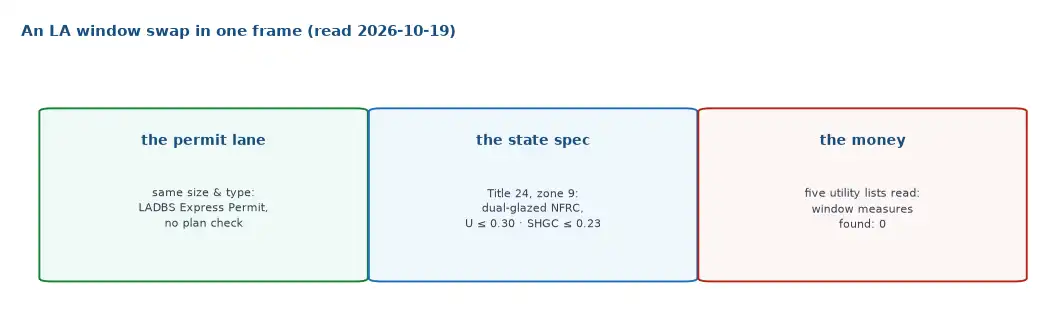
A window swap in LA is the national job with a California signature: the state energy code decides what glass you may buy. Title 24 turns every permitted replacement into a spec exercise, with hard caps on the NFRC numbers for climate zone 9. The permit side is friendlier than its reputation: a same-size, same-type change-out rides LADBS's Express Permit list, no plan check. And the money side, measured by us on 19 October 2026, is an honest zero: no utility in the metro rebates a window today, the federal credit ended with 2025, and California's whole-home rebate is funded but not launched. Below: the code numbers, the permit lanes, the five utility lists, the costs, the coastal caveats, and the license check that actually works here.
On this page (12 sections)
Title 24: the code that writes your window
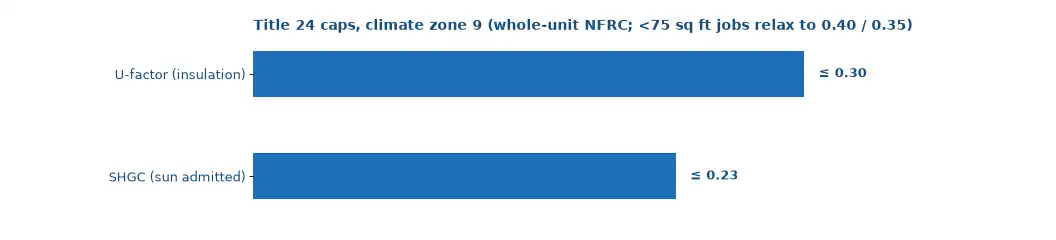
Most states let the market pick the glass. California does not. Title 24, Part 6, the state's building energy code, treats a window replacement as an alteration, and the replacement unit must meet the fenestration caps for the project's climate zone, certified on the NFRC whole-unit label. For the LA basin, climate zone 9, the prescriptive caps are a U-factor at or under 0.30 and an SHGC at or under 0.23. The 2025 code cycle has been in force since 1 January 2026, so those are the numbers a 2026 permit sees.
The 75-square-foot hinge
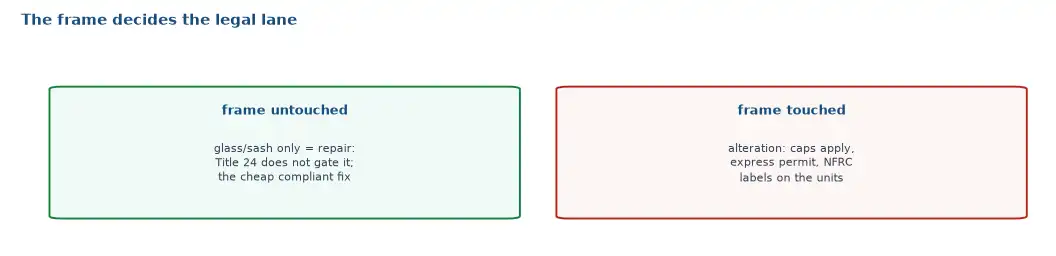
Small jobs get a softer bar. Replacing under 75 square feet of glazing relaxes the caps to U at or under 0.40 and SHGC at or under 0.35, which covers most single-window and two-window jobs. Past that area the full prescriptive caps apply. And the code's own boundary matters: swapping glass or sash only, frame untouched, is classed as a repair and generally does not trigger Title 24 at all, which is why the repair-versus-replace question on this page is partly a legal one.
Why the label beats the brochure
Every manufacturer names its glass packages differently; the NFRC label is the only common tongue, and the building inspector reads it, not the brochure. The two values that count are whole-unit: center-of-glass numbers always look better and are not the certified figure. A quote that cannot name the unit's whole-unit U and SHGC is selling whatever glass was cheapest that week.
The express permit, quoted
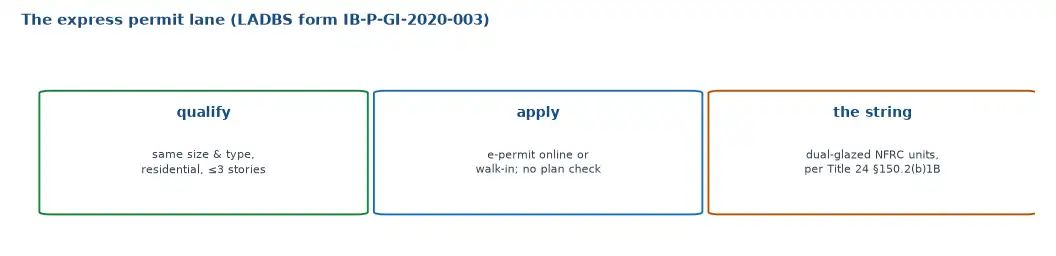
LA's permit answer is unusually direct, so we quote it. The LADBS Express Permit list, form IB-P-GI-2020-003, revised 28 May 2024, item one: "Window and door change-out (same size & type) for residential buildings. Dual glazing, labeled and certified by National Fenestration Rating Council (NFRC), is required for doors and windows replaced in all residential buildings, three stories or less, per Title 24, Part 6, Section 150.2(b)1B."
What the express lane means in practice
An express permit is an e-permit: apply online through the LADBS portal or walk in, no plan review, and the permit can issue the same day. What it buys is the record: the inspection trail a buyer or an insurer reads later, and a paper line on which the egress and safety glazing rules get checked instead of missed. Enlarge an opening or touch the frame's structure and the job leaves the express lane for a plan check, with drawings.
Who pulls it
A CSLB-licensed contractor can pull it, and a homeowner can too, under the owner-builder declaration. Either way the name on the permit owns the answer, so the quote should say whose name that is. A crew that will not put the permit in writing is telling you something about the rest of its paperwork.
The money: an honest zero
Every cost page says "check rebates." We read the programs instead. Metro Los Angeles splits across five electricity providers, and on 19 October 2026 we went through each one's residential list: LADWP, Southern California Edison, Pasadena Water & Power, Glendale Water & Power and Burbank Water & Power. Not one carries a window measure today; the live money in these catalogs sits with heat pumps, insulation, EVs and batteries. Above them, the federal 25C window credit ended with installations after 31 December 2025, California's HOMES whole-home rebate is funded but not launched as of this writing, and TECH Clean California's single-family incentives closed in November 2025.
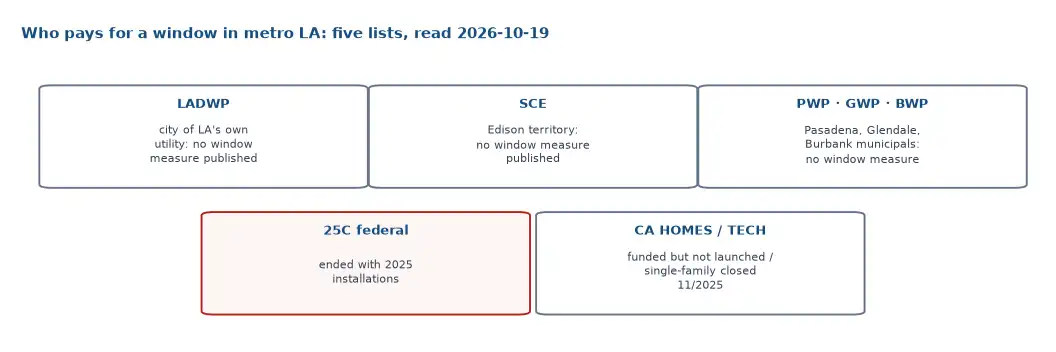
| Program | Window measure? | What the catalog actually pays for |
|---|---|---|
| LADWP | No window line | EV and charger rebates (up to $1,500), appliances, demand response |
| Southern California Edison | No window line | Marketplace appliances, HVAC-class incentives, income-qualified assistance |
| Pasadena Water & Power | No window line | Insulation to $0.15 per sq ft, heat pumps to $190 per ton, solar pilot $0.60 per watt |
| Glendale Water & Power | No window line | Smart Home rebates on ENERGY STAR appliances and HVAC (raised 11/01/2025) |
| Burbank Water & Power | No window line | EV chargers to $1,500, battery storage up to $530 per kWh |
| Federal 25C credit | Ended | Not available for installations after 12/31/2025 |
| California HOMES | Funded, not launched | Whole-home retrofits with 20 percent measured savings, when the state opens it |
What a rebate line on a quote means here
It means a question. A 2026 quote that subtracts money for window efficiency owes you the program's name, its administrator and its status for your address. Today, for a plain window swap in this metro, that name does not exist. If the answer comes back as "federal green rebate", that program ended with 2025; if it names HOMES, that program has not opened. Compare the gross price, and treat any rebate as found money only when the program document says so.
What it costs in LA
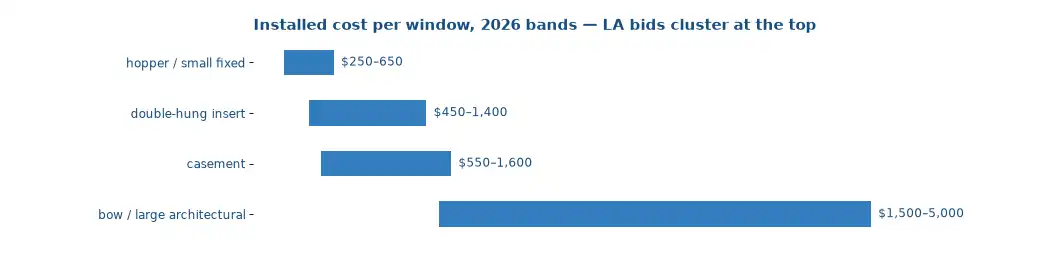
The honest bands first: a standard double-hung insert installed runs about $450 to $1,400 per window in the 2026 national data, casements a step above for the operator hardware, and bow or large architectural units well above the per-window range because they carry structure (the four-price anatomy of one is on our bay window cost page). LA bids cluster at the top of the band: metro labor and overhead run hot, and the basin's older housing stock adds full-frame scope.
What moves the number
The five drivers, unchanged by geography: how many openings, insert or full-frame, which glass package, second-story access, and lead-safe handling where the house predates 1978. LA adds two local lines: hillside and tight-lot access can tax a crew's day, and an HPOZ address adds the review layer before any installer sets a ladder.
Glass for zone 9 and the coast
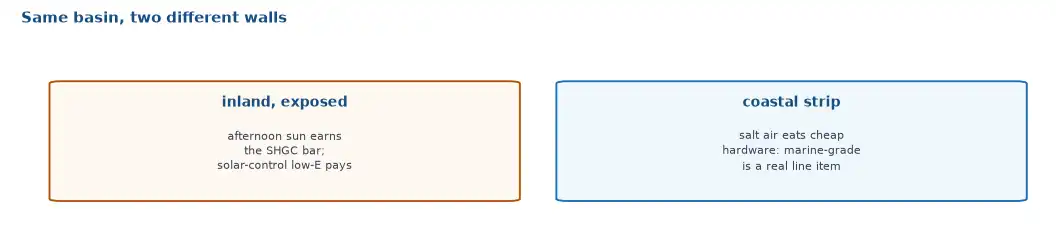
Zone 9 is a cooling climate with a marine edge. The certified bar is set by the code above, so the choice left to you is not whether to meet it but how far past it to go. West and south glass with afternoon exposure earns every point of the SHGC bar; shaded walls earn less. What the national guides miss is the salt: the coastal strip from Santa Monica down corrodes bargain hardware and screens, so marine-grade or coated hardware is a real line item there, not an upsell.
The pairing habit
The glass package, not the frame, carries the energy number — that pairing is measured on our vinyl versus wood page. Frame material still matters here for a different reason: ocean air is hard on finishes, and aluminum-clad or vinyl frames outlast bare wood within sight of the water.
HPOZ and historic review
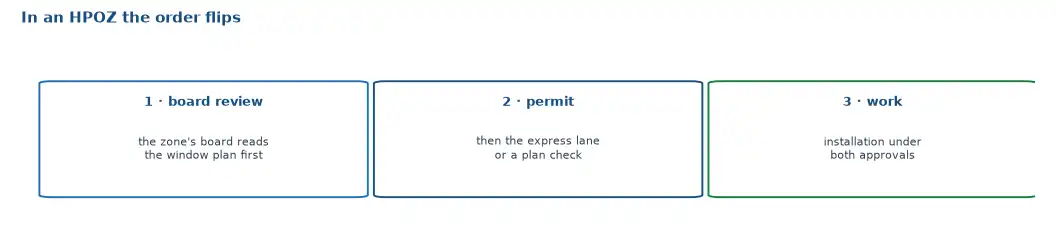
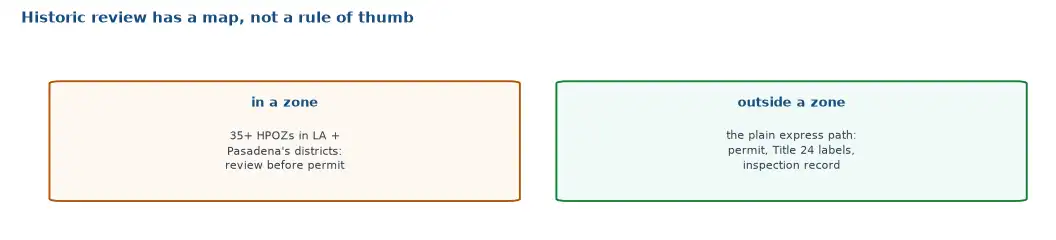
LA keeps more than 35 Historic Preservation Overlay Zones, and in them the first approval is not the permit. The zone's board reviews exterior changes visible from the street, and a street-facing window swap is one. Pasadena's historic districts, Bungalow Heaven among them, run their own review on the other side of the city line. The pattern is repair-first, then replacement matching original profiles and materials on visible elevations; interior-only work and true in-kind maintenance usually sit outside review.
The practical cost of the zone
The review adds weeks, not days, and it can set the material: wood or a convincing clad profile on the street face, with more latitude at the rear. Starting without the review risks undoing finished work at your expense. If the block has a historic name, check the zone map before you assume the plain express path is yours.
Repair or replace, with the glass-only trick
A fogged glass unit, worn weatherstripping or a failed crank is a stated-price repair, priced in tens where a new window prices in thousands; rotten frames, single-pane glass and crooked installs close the repair file. California adds a legal wrinkle worth money: because a glass-only or sash-only swap leaves the frame alone, it is a repair under Title 24 rather than an alteration, so the code's caps do not gate it. When the frame is sound, replacing the insulated glass unit alone is the cheap compliant fix.
The when to replace windows page tests each signal in five minutes; the drafty windows page owns the leak half. Do both before the first quote; a crew paid to sell windows rarely runs them for you.
Choosing a company: the C-61 check
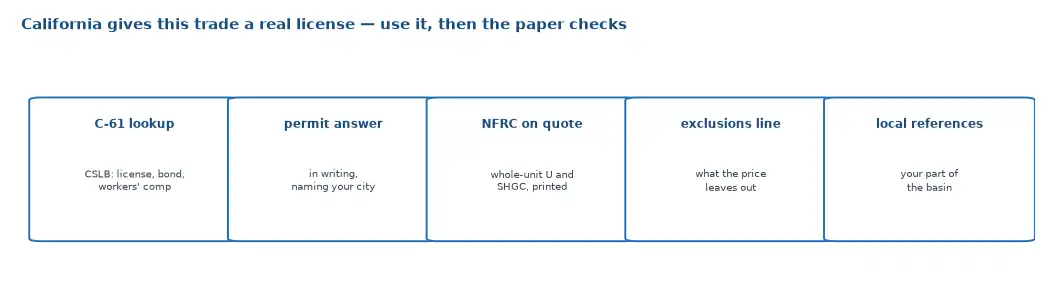
California hands you something most states do not: a real license for this exact trade. Glazing contractors hold the C-61 classification from the Contractors State License Board, and the CSLB lookup shows the license, its bond and its workers' compensation status in one search. It is the strongest single filter in this metro, and it takes a minute.
The checks after the license
A license is the floor, not the answer. After the CSLB search: the permit answer in writing, naming your city (a crew working the basin daily knows which counter it uses); the quoted unit's NFRC whole-unit values printed on the quote; an exclusions line naming what the price leaves out; and references in your part of the metro, because crew quality in this trade is local, not brand-level.
After wind and fire weeks
Santa Ana wind events and fire season pull out-of-area crews into the basin. The license check matters twice as much then, and a signature deadline tied to the emergency is sales pressure, not a discount. No storm deadline on a door hanger cancels your insurance claim.
The LA calendar
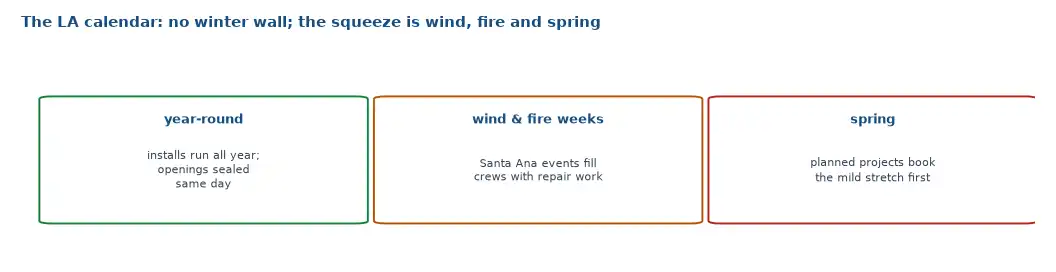
There is no winter problem here: installs run year-round, and each opening stays sealed same-day regardless of month. What moves is the booking calendar. Santa Ana wind weeks and fire season fill crews with repair work, and spring fills with planned projects catching mild weather. The honest seasonal discount is a faster, less rushed crew, not a lower number.
What we read, and how
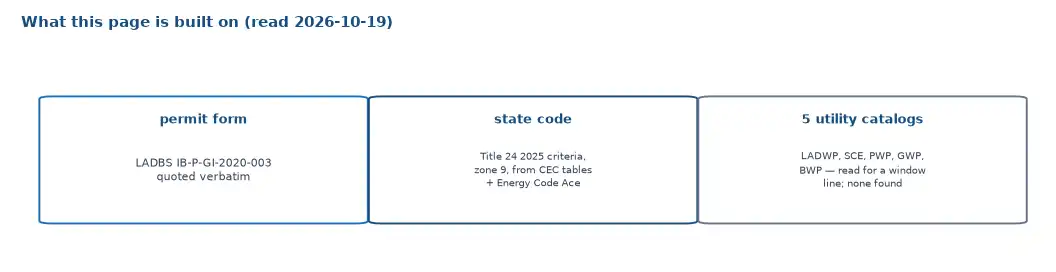
This page is built on primary reads, dated 19 October 2026: the LADBS Express Permit form IB-P-GI-2020-003 (revised 28 May 2024), quoted word for word; the Title 24 2025 criteria for climate zone 9, cross-read against the California Energy Commission's tables and Energy Code Ace's cycle summary; the residential rebate catalogs of LADWP, Southern California Edison, Pasadena Water & Power, Glendale Water & Power and Burbank Water & Power read for a window measure and found without one; the status of California's HOMES program and TECH Clean California as of this date. Where a city publishes no window-specific page, we say so rather than guess.
The limits of this read
Code cycles turn every three years and rebate catalogs turn faster; the date on every row is the answer to that. The zone-9 caps quoted here are the prescriptive figures a permit sees in the basin; a performance-path project models its own numbers. How long the next units should last — that is our window lifespan page.
The wave's other maps: Denver reads permits against hail, Dallas reads the Texas permit flip, and Atlanta reads its five-program money map.
The questions LA actually asks
How much does window replacement cost in Los Angeles?
Per window installed, the 2026 national bands run about $450 to $1,400 for a standard double-hung insert, and Los Angeles bids sit toward the top of the band: labor and overhead in the metro run hot, and older housing stock adds full-frame work. What decides the quote is the count of openings, insert against full-frame, the glass package, second-story access, and lead-safe handling in pre-1978 homes. The per-opening labor hours and the whole-house roll-up sit in our installation cost guide; no band binds your house — the written, itemized quote does.
Do I need a permit to replace windows in Los Angeles?
Yes, and it is the fast kind. The LA Department of Building and Safety lists window and door change-out, same size and type, on its Express Permit list, so a like-for-like residential swap gets an e-permit without a plan check. The condition the permit writes into your job is Title 24: replacement windows in residential buildings three stories or less must be dual-glazed units with an NFRC-certified label. Change the opening's size or structure and you leave the express lane for a plan check. In an HPOZ or historic zone, the design review comes first.
What is Title 24 for window replacement?
Title 24, Part 6 is California's building energy code, and it applies to window replacement as an alteration: the new units must meet the climate-zone caps for U-factor and solar heat gain, read off the NFRC whole-unit label. For the LA basin, climate zone 9, the prescriptive caps are U-factor at or under 0.30 and SHGC at or under 0.23; small jobs under 75 square feet of replaced glazing get relaxed thresholds (0.40 and 0.35). Replacing only glass or sash without the frame is classed as a repair and generally does not trigger the code. The 2025 code cycle has been in force since 1 January 2026.
Are there rebates for window replacement in Los Angeles in 2026?
Honestly, no, and we read the programs before saying it. On 19 October 2026 we checked the lists of LADWP, Southern California Edison, Pasadena Water and Power, Glendale Water and Power and Burbank Water and Power: none carries a residential window measure. The federal 25C energy credit ended with 2025 installations, California's HOMES whole-home rebate is funded but not launched as of this date, and TECH Clean California's single-family incentives closed in November 2025. A 2026 quote that subtracts a window rebate owes you a program name.
What windows work best for the Los Angeles climate?
Zone 9 is a cooling-climate with marine edges: the certified bar is dual-pane low-E with whole-unit U at or under 0.30 and SHGC at or under 0.23, which Title 24 makes mandatory on permitted swaps anyway. West and south glass earns the SHGC bar; shaded walls earn less from it. Near the ocean, Santa Monica and the coastal strip add salt air, which eats cheap hardware and screens, so marine-grade or coated hardware is worth the line item there. Read the NFRC label on the quote, not the brochure name of the glass package.
Who are the best window replacement companies in Los Angeles?
We are an independent guide and do not rank companies. California gives you a real license to check: glazing contractors hold the C-61 classification from the Contractors State License Board, and you can verify a license and its bond and workers' compensation status on the CSLB lookup in a minute. After that: a written permit answer naming your city, the quoted unit's NFRC whole-unit values printed on the quote, an exclusions line, and references in your part of the basin. A company that passes all five earns its price, whatever its size.
Can I replace windows in an HPOZ or a historic district?
Yes, with a review step first. LA's Historic Preservation Overlay Zones, more than 35 of them, review exterior changes visible from the street, and a street-facing window swap is one; Pasadena's historic districts, like Bungalow Heaven, run their own review. The pattern is repair-first, then replacement matching original profiles and materials on visible elevations. Work that never leaves the interior, and true like-for-like maintenance, usually sits outside review. Plan the review into the calendar before you order units.
Should I repair or replace my windows?
Test before you quote. A fogged glass unit, worn weatherstripping or a failed crank is a stated-price repair, priced in tens where a new window prices in thousands; rotten frames, single-pane glass and crooked installs close the repair file. California adds a legal wrinkle worth knowing: replacing only the glass or sash without touching the frame is a repair under Title 24 and generally skips the code entirely, which makes glass-unit replacement the cheap compliant fix when the frame is sound. The when to replace windows page holds a five-minute test per signal; leak-chasing belongs to the drafty windows page.
Is window replacement worth it in Los Angeles?
As comfort, yes on the day the drafts and the street noise stop; as money, honestly partial. The gains stack is real in a cooling climate: lower AC runtime, quieter rooms, tilt-in cleaning, and a documented, permitted job that reads well at sale. But buyers and appraisers pay full attention only to documented work, so expect partial recoup at sale plus the daily gains while you live there. Anyone quoting full recoup is selling, not appraising.
Does home insurance cover window replacement in California?
Insurance pays for sudden, dated events: a storm break, a fallen branch, a break-in. Worn-out windows are maintenance and are not covered. Here the live route is wind and fire season: record the date, photograph every damaged sash and frame before any cleanup, and put the damage in writing with window locations. Our insurance page for window replacement covers the claim end to end, including what adjusters ask for.
Do Home Depot, Lowe’s or Costco replace windows in Los Angeles?
Yes, all three sell and install replacement windows across the metro, and each fulfills through subcontracted local crews, so the five checks apply to the crew that shows up, not the logo on the receipt: CSLB license status, a written permit answer naming your city, NFRC values printed on the quote, an exclusions line, and local references. Store financing can be real money; it does not change who holds the nail gun.
What about Pasadena, Long Beach, Glendale, Burbank or Santa Monica?
The basin shares the climate zone; the desks and the meters differ. Pasadena, Glendale and Burbank run their own municipal utilities and their own permit desks, Long Beach and Santa Monica sit in Edison territory with their own building departments, and every city answers the permit question at its own counter. Title 24 covers all of them identically, because it is state law: the glass spec does not change at a city line. Historic review is the local variable: LA's HPOZ map and Pasadena's districts each carry their own.
Other metro guides
Keep reading
Sources
- LADBS: Express Permits, form IB-P-GI-2020-003 (rev. 2024-05-28) · the window change-out lane and the Title 24 dual-glazing mandate, quoted verbatim.
- Energy Code Ace (California Energy Commission program) · the 2025-cycle fenestration criteria by climate zone, in force since 01.01.2026.
- ENERGY STAR: windows, doors and skylights · the federal criteria read against the state caps.
- NFRC: the National Fenestration Rating Council · the whole-unit label the code and the inspector read.
- LADWP · the city's utility programs read for a window measure; none published.
- Southern California Edison · rebates and marketplace read for a window measure; none published.
- Pasadena Water and Power: residential rebates · read for a window line; none published.
- Glendale Water and Power: Smart Home Rebate Program · appliance and HVAC rebates; no window measure.
- Burbank Water and Power: residential programs · EV, battery and appliance rebates; no window measure.
- Contractors State License Board · the C-61 glazing classification and the license, bond and workers' comp lookup.
- US EPA: lead-safe work rules for pre-1978 homes · the lead layer on older housing stock.