Window replacement in Orlando in 2026: impact is not the law here, it is the money
By the ClearView editorial team · Sources read on 2026-10-19
Read time about 12 minutes
The short answer
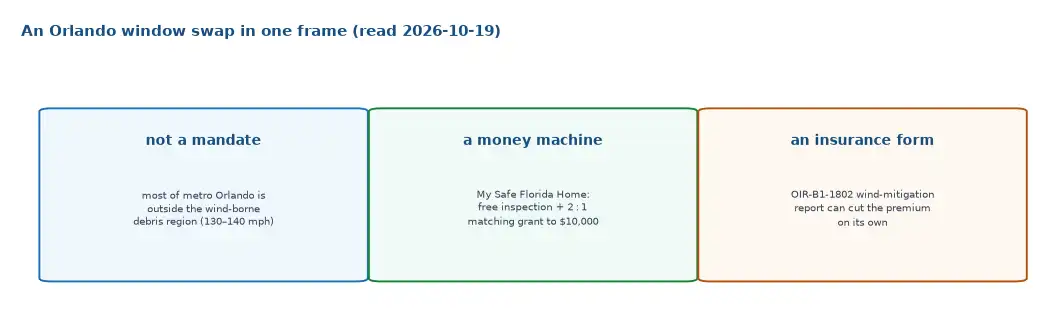
Orlando sits in a surprising spot on Florida's hurricane map: most of the metro falls outside the wind-borne debris region, so the building code does not force impact glass on a window replacement. Yet Florida built a money machine that pulls owners there anyway: a free wind-mitigation inspection whose report discounts your insurance, and a state grant that matches your spending two to one, up to $10,000, on approved impact windows. The permit is not optional anywhere in Florida, and the product's Florida approval number is checked at inspection. Below: where the mandate line actually runs, how the grant sequences, what the work costs, and the glass detail (clear impact units fail the energy bar) that brochures skip.
On this page (12 sections)
- Where the impact mandate actually runs
- The money machine: grant plus insurance form
- Permits: yes, everywhere in Florida
- What it costs in Orlando
- Glass: the storm axis and the energy axis
- Kissimmee, Sanford, Winter Park
- Repair or replace
- Choosing a company in Florida
- The Orlando calendar
- What we read, and how
- FAQ
- Sources
Where the impact mandate actually runs
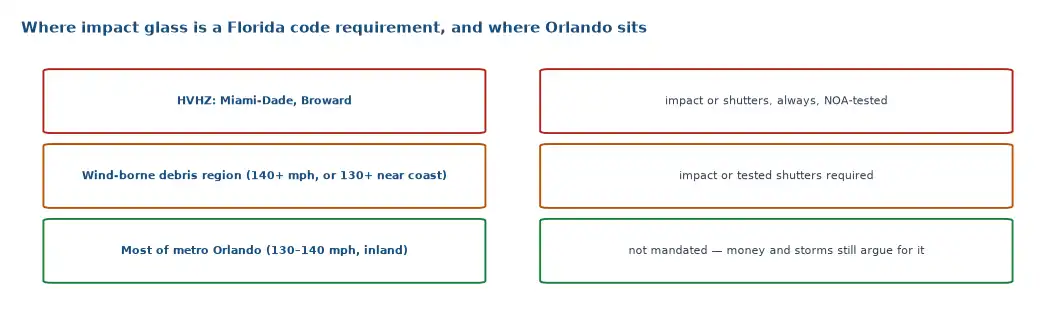
Florida does not regulate storm glass by city name; it regulates by wind contour. The Florida Building Code draws a wind-borne debris region: everywhere the ultimate design wind speed reaches 140 mph, plus the strip within one mile of the coast at 130 mph and up. Inside it, exterior glazed openings must be impact-rated assemblies or carry tested shutters. Metro Orlando maps at roughly 130 to 140 mph for standard homes and sits far inland, so most addresses fall outside the mandate. The line is parcel-specific: your building department answers for your address, not a countywide chart. Miami-Dade and Broward play a different sport entirely (the High-Velocity Hurricane Zone, NOA-tested products); Orlando is not that.
The 25 percent exception, and the Ian lesson
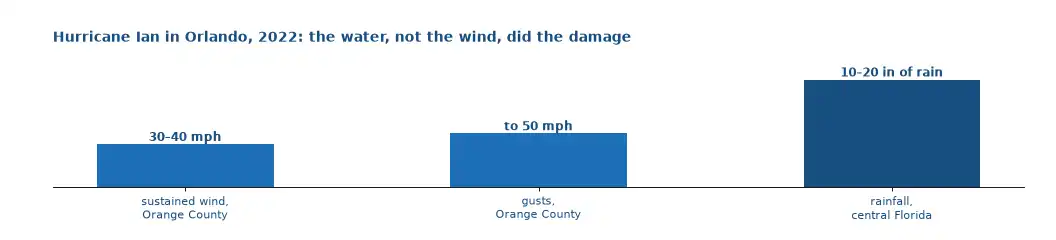
Even inside the debris region, pre-2002 homes get a valve: the Existing Building code lets you replace up to a quarter of the home's glazed area within 12 months without adding opening protection, provided the new units meet the wind pressures. And a 2022 reality check: Hurricane Ian's Orange County numbers were 30 to 40 mph sustained winds against 10 to 20 inches of rain and historic freshwater flooding. Impact glass addresses wind and debris. It does nothing about water rising from a lake basin, which was the damage mechanism here.
The money machine: grant plus insurance form
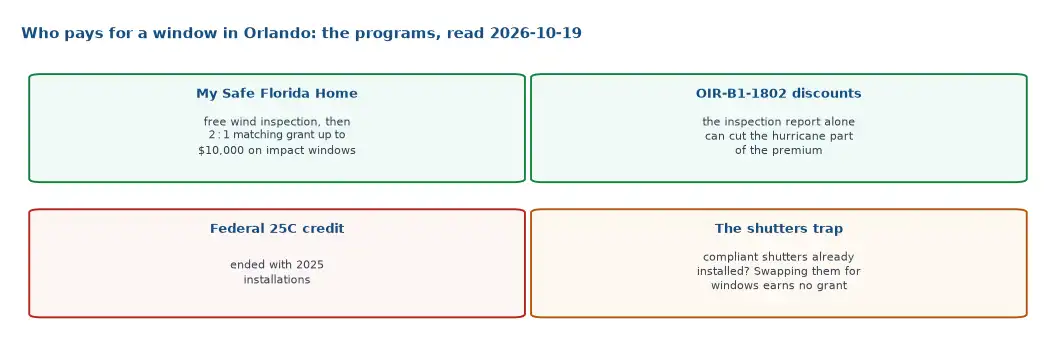
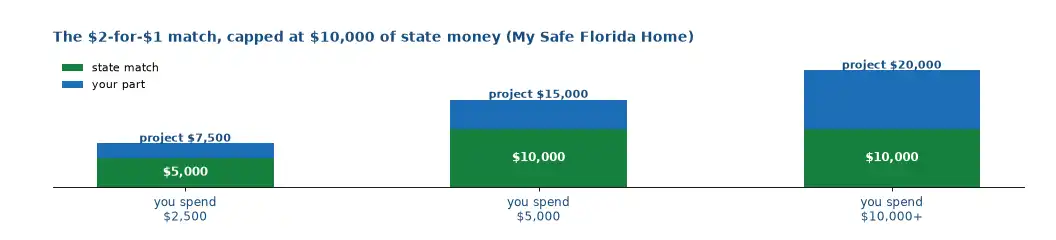
My Safe Florida Home, the state program under Statute 215.5586, does two things in sequence. The free wind-mitigation inspection produces the OIR-B1-1802 report, which your insurer uses to price the hurricane part of the premium; owners report real discounts from the report alone. Then, if the inspection recommends opening protection, the matching grant pays $2 of state money per $1 you spend, capped at $10,000, on approved impact windows, doors, shutters or roof work. Low-income owners skip the match. The 2025 cycle reopened with $352 million and widened eligibility (insured value up to $700,000, townhouses included). Funds are first-come each cycle. This is the closest thing to a window replacement program Florida runs: nothing else in the state pays for the units directly.
| Program | Window money? | The shape of it |
|---|---|---|
| My Safe Florida Home grant | Yes: impact windows are a named category | $2:$1 match to $10,000; inspection first, approved products, final inspection; first-come per cycle |
| Wind-mitigation insurance discounts | Indirectly | The OIR-B1-1802 report documents opening protection; recurring premium credit, no grant needed |
| Federal 25C credit | Ended | Not available for installations after 12/31/2025 |
| The shutters trap | A denial rule | Compliant shutters already installed: swapping them for windows earns no grant |
Permits: yes, everywhere in Florida
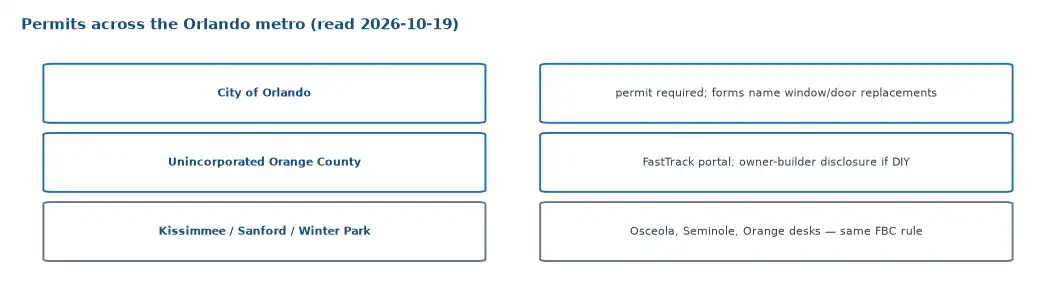
Unlike states where a like-for-like swap slides under the permit line, Florida treats window replacement as regulated work on the building envelope, full stop. Orlando's permit forms name window and door replacements; unincorporated Orange County runs the same requirement through its FastTrack portal; Kissimmee, Sanford and Winter Park answer to Osceola, Seminole and Orange desks under the same state code. At inspection, the paper that matters is the product's Florida Product Approval number or Miami-Dade NOA. Owners who occupy the home may pull the permit as owner-builders with a signed disclosure, and then the inspection grades their work directly.
What it costs in Orlando
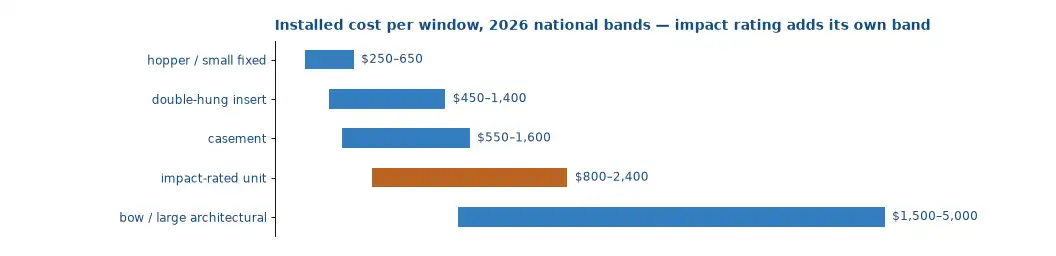
Anchor on the 2026 national bands: a standard double-hung insert installs around $450 to $1,400, casements a step higher for the operator hardware, and bow or large architectural units beyond the per-window range because they carry structure. Impact rating forms its own band, roughly $800 to $2,400 installed, for the laminated glass, heavier frames and the approval paperwork. Orlando labor sits mid-band nationally; the local swing factor is the grant, which can halve a qualifying impact project. The installation cost guide lists the labor hours behind the bands; the binding figure is always the written quote for your house.
What a good price actually is
Searches ask for the cheapest company, the best deal, the typical installation cost. The honest version: a good price is the itemized quote that survives comparison, and "window replacement offers" with a countdown are marketing, not pricing. The average Florida job lands mid-band on labor; what separates a fair Orlando quote from an expensive one is the written scope, the glass axis (standard or impact), and whether the grant sequence was priced in. Big-box programs (the Window World tier included) price the same openings through subcontracted crews, so compare the paper, not the ad.
What moves the number here
Six levers in this metro: opening count, insert or full-frame, glass package, second-story reach, lead-safe handling on pre-1978 paint, and the impact axis, which re-prices every opening it touches. A whole-house quote priced both ways (standard versus impact) tells you exactly what the storm protection costs before the grant answer arrives.
Glass: the storm axis and the energy axis
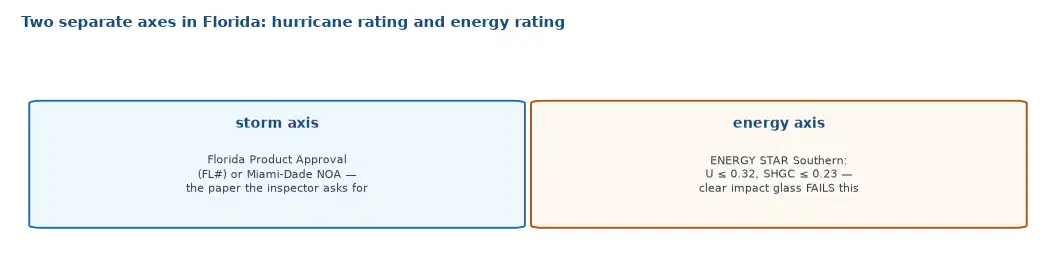
Florida sells windows on two axes that brochures blur into one. The storm axis is the approval paper: Florida Product Approval or a Miami-Dade NOA, checked at inspection. The energy axis is the NFRC label: ENERGY STAR's Southern zone caps whole-unit U-factor at 0.32 and SHGC at 0.23. The trap sits between them: standard clear laminated impact glass posts SHGC around 0.38 to 0.55, which passes the storm and fails the sun. What makes a window energy efficient here is precisely that SHGC number plus the seal around it: the coating rejects solar heat, the spacer and weatherstripping keep the AC air in. In a nine-month cooling season you want low-E impact glass that clears both axes; south and west faces pay it back first.
The label, not the brochure
Each brand invents its own package names; the NFRC label is the only vocabulary they share, and the FL# sheet is the only approval the inspector accepts. When a quote never states the unit's whole-unit U-factor and SHGC on paper, the glass inside it is whatever the distributor had on sale that month. The vinyl-versus-wood page argues the identical point from the frame side: the efficiency number lives in the glazing, not the sash.
Kissimmee, Sanford, Winter Park
The metro shares weather and the state code; it does not share permit desks. Kissimmee answers to Osceola County, Sanford to Seminole, Winter Park to Orange. The grant and the insurance form travel with the owner, not the city. What does change by address is the wind-borne debris boundary, drawn by wind contour rather than city limits: a Kissimmee parcel and a Winter Park parcel can carry different answers, so the building department's answer for your lot beats any countywide chart.
Repair or replace
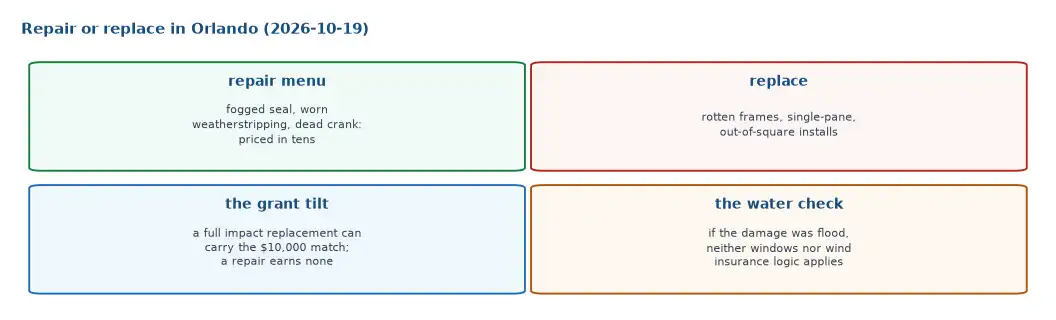
Fogged glass from a failed seal, worn weatherstripping or a dead crank is shop-priced repair work, tens of dollars against the thousands a new unit costs. Rotten frames, single-pane glazing and out-of-square original work point to new units. The Orlando tilt: only a full, permitted, impact-rated replacement can carry the state match, so on a borderline opening the grant arithmetic belongs in the repair-versus-replace comparison. And if the damage came from rising water rather than wind, neither the wind policy nor the window logic applies; that is a flood claim. The when to replace windows page tests each signal in five minutes, and the drafty windows page takes the leak half.
The signals that answer "when"
The question "how do you know when a window needs to be replaced" has a checklist, not a vibe: a sash stuck or refusing to stay open, a window not fully closing, fog between the panes, soft frame wood, and rising cooling bills with the thermostat unchanged. Screens are their own cheap category: screen repair and replacement in Orlando is screen-shop work, priced per panel, and never a reason to replace the unit. Broken glass in a sound frame is a glass-only repair; the same break after a named storm is an insurance line with a date attached.
Choosing a company in Florida
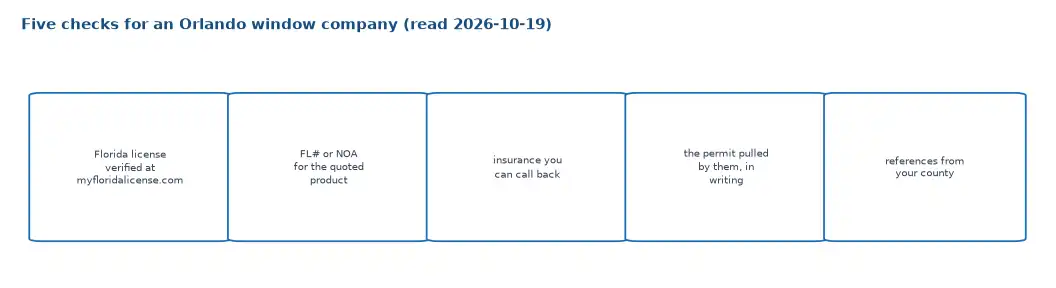
Florida actually licenses contractors, so the first filter is real: verify the license at myfloridalicense.com before the appointment, not after. Then the Florida specifics: the quoted unit's FL# or NOA on paper; insurance you can call back; the permit pulled by the company, in writing (an owner-builder permit pushed onto you is a red flag wearing a discount); and references from your county. If the grant is in play, ask how the company documents the job for the program's final inspection.
After named storms
Every named storm pulls out-of-area crews into the I-4 corridor. In those weeks the license check and the product paper matter twice over, and a countdown printed on a door hanger has no power over your claim, your grant sequence or the permit.
The Orlando calendar
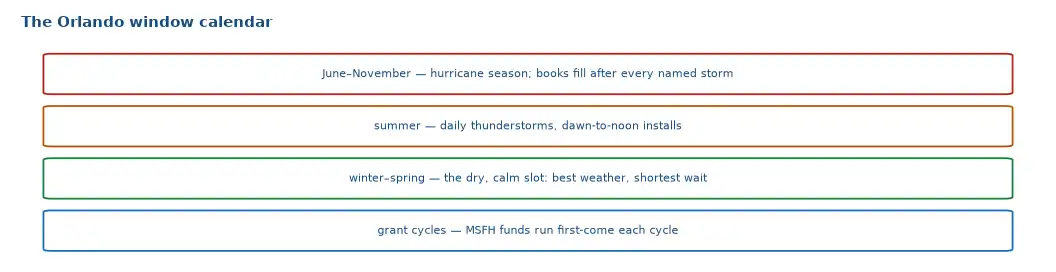
Installs run all year; the constraints are storms and grant cycles. June through November is hurricane season, and every named storm fills every book in town. Summer afternoons bring daily thunderstorms, so crews work dawn to noon. The dry season, late fall through spring, is the calm slot for weather and wait times. Over it all sits the grant calendar: My Safe Florida Home funds are first-come each cycle, and the inspection must precede the work. The full measure-to-walkthrough timeline lives on the replacement process page.
What we read, and how
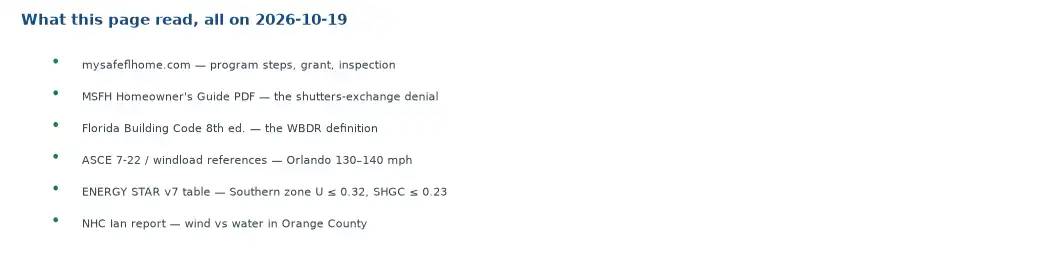
This page is built on primary reads, all dated 19 October 2026: the My Safe Florida Home site and its homeowner guide (including the shutters-exchange denial); the Florida Building Code's wind-borne debris definition; ASCE 7-22 wind references for the Orlando area; the ENERGY STAR v7 criteria table; and the National Hurricane Center's Ian numbers for Orange County. Where an answer is parcel-specific, like the debris-region boundary, the page says so instead of drawing a fake county line.
The limits of this read
Program cycles open and close by legislative appropriation, and eligibility tiers shift between them; the figures here are the 2025-26 cycle as published. The debris-region question is answered per address by the building department. On longevity, the window lifespan page gives the honest years for the units you are buying.
The rest of the wave: Fort Worth and its permit county line, Charlotte with its compass rebate, Dallas and the permit flip, Atlanta with an empty money map, and Seattle where the rebate pays the owner directly.
The questions Orlando actually asks
How much does window replacement cost in Orlando?
In the 2026 national data a standard double-hung insert installs around $450 to $1,400 per opening, casements a step higher, and impact-rated units form their own band near $800 to $2,400. Orlando quotes sit mid-band on labor; the variable is whether you specced impact glass. What changes the total locally is not the price list but the funding: My Safe Florida Home matches your spend $2 for $1 up to $10,000 of state money on approved impact work, and the free wind-mitigation inspection alone can discount the hurricane part of your insurance premium. Our homepage runs the estimator for your opening count, and the installation cost guide lists the labor hours behind the bands.
Are impact windows required in Orlando?
For most of the metro, no. Florida mandates tested opening protection inside the wind-borne debris region, which starts where the ultimate design wind speed reaches 140 mph (or 130 mph within a mile of the coast). Metro Orlando maps at roughly 130 to 140 mph for standard homes and sits far inland, so most addresses are outside the mandate. The boundary is parcel-specific, so confirm yours with the building department. Two forces still push Orlando owners toward impact: the My Safe Florida Home grant pays for it, and insurers discount for opening protection on form OIR-B1-1802.
Do I need a permit to replace windows in Orlando?
Yes. Florida treats window replacement as regulated work on the building envelope, and Orlando's own permit forms name window and door replacements explicitly. Unincorporated Orange County runs the same rule through its FastTrack portal. Expect the product's Florida Product Approval number (or Miami-Dade NOA) to be checked at inspection. Owners who occupy the home can pull the permit themselves under the owner-builder provision with a signed disclosure, though the inspection then grades your work directly.
How does the My Safe Florida Home grant work for windows?
Three steps, in order. First, the free wind-mitigation inspection: a state-approved inspector documents your openings and issues the report insurers honor. Second, if the report recommends opening protection, you apply for the matching grant: $2 of state money per $1 you spend, capped at $10,000, and low-income owners skip the match entirely. Third, an approved contractor installs Florida-approved products, and the state reimburses after the final inspection. One trap from the official guide: if compliant hurricane shutters already protect the home, swapping them for impact windows is denied, because the opening is already mitigated.
Who are the best window replacement companies in Orlando?
This guide is independent and ranks nobody. Florida, unlike Texas, actually licenses contractors, so the first filter is real: verify the license at myfloridalicense.com. Then: the quoted product's FL# or NOA on paper, insurance you can call back, the permit pulled by the company in writing, and references from your county. A company that cannot show the product approval number for the exact unit it quoted has not read the Florida playbook.
Should I repair or replace my windows in Orlando?
Fogged glass from a failed seal, worn weatherstripping or a dead crank is shop-priced repair work, tens of dollars against the thousands a new unit costs. Rotten frames, single-pane glazing and out-of-square original work point to new units. The Orlando tilt: a full impact-rated replacement can carry the $10,000 state match, while a repair earns nothing from the program, so on a borderline opening the grant arithmetic belongs in the comparison.
Is window replacement worth it in Orlando?
As comfort, immediately: west rooms stop baking and the AC runs shorter. As money, the Florida stack is unusually honest: part of the cost returns at resale, the insurance discount recurs every year the opening protection is documented, and the state match can halve a qualifying project. Anyone promising full payback is quoting a wish. And one caution from 2022: Ian's damage in Orange County came from freshwater flooding, not wind, so impact glass is storm hardening, not flood insurance.
Does insurance cover hurricane window damage in Orlando?
Wind damage from a named storm is what the wind policy pays for; document the date and photograph every opening before cleanup. The Orlando lesson from Ian is the split: rising water is a flood claim, a separate policy, and neither impact glass nor the wind deductible logic covers it. For the premium side, the wind-mitigation report (OIR-B1-1802) is the document that earns recurring discounts for opening protection.
Do Home Depot or Lowe’s replace windows in Orlando?
Both sell and install across the metro, fulfilled by subcontracted local crews. Run the crew, not the logo, through the Florida filter: a verifiable state license, the quoted unit's FL# or NOA on paper, insurance, a permit they pull in writing, and county references. If you are chasing the My Safe Florida Home grant, also ask whether the installation paperwork will satisfy the program's final inspection.
Hurricane shutters or impact windows: which should I choose?
Both satisfy the same protection logic where the code demands it. Shutters cost less up front but require you to be home and able to deploy them before the storm. Impact glass protects permanently and helps daily with sun and noise, at several times the shutter price. The grant nuance decides for some homes: the state will not fund windows where compliant shutters already do the job, while a home with neither is exactly what the grant was written for.
Can you replace mobile home windows with regular windows in Florida?
Carefully. Manufactured homes run under the federal HUD wind-zone map, and every Florida county is Wind Zone II or III, so the unit and its anchoring must match a harsher spec than a site-built house next door. Openings and wall depths differ from stock residential sizes, so measure the rough opening and expect made-to-fit units. The permit rule follows the home, not the chassis: replacing the window still goes through the local building desk.
What about Kissimmee, Sanford or Winter Park?
Three suburbs, three counties, one code. Kissimmee answers to Osceola County, Sanford to Seminole, Winter Park to Orange; each runs its own permit desk under the same Florida Building Code, so the permit answer travels but the portal and fees do not. The wind-borne debris boundary is drawn by wind contour, not city limits, so a suburb address can sit on either side of the 140 mph line; check the parcel, not the city name.
What do Orlando reddit threads say about window replacement?
The local threads repeat two findings that our documents confirm: identical openings get quotes thousands of dollars apart (scope, glass axis, impact rating), and owners hear about the My Safe Florida Home grant only after their job is finished, when the inspect-first sequence is already impossible. Both are answered above with the source documents: the cost bands, and the grant mechanics from the program's own guide.
When is the best time to replace windows in Orlando?
Weather-wise, the dry season from late fall through spring: afternoon thunderstorms pause and crews work full days. Money-wise, the calendar that matters is the grant cycle: My Safe Florida Home funds are first-come each legislative cycle, and the inspection must precede the work, so the sequence is inspect, apply, then sign the contract. After a named storm, every book in town fills at once.
How long do impact windows last?
The insulated-glass seal is the part with a clock: quality units carry 15 to 25 years before fogging risk rises, same as any dual-pane. The laminated interlayer and the frame do not wear on a schedule. In Florida's sun the practical answer for how long house windows last is set by seals and hardware, not by the glass itself; impact rating does not shorten the interval, and the approval paperwork outlives the warranty.
Do replacement windows need flashing?
Yes, and in Florida's rain it is the layer that decides whether the opening stays dry. An insert relies on the existing frame's flashing; a full-frame replacement rebuilds it: sill pan, flashing tape lapped shingle-style, and sealed fasteners per the manufacturer's Florida-approved instructions. At inspection, water management is part of what the product approval covers, so skipped flashing can fail the job, not just the window.
Are windows that don’t open cheaper?
Yes: fixed picture units cost less than operable ones of the same size, because there is no hardware, balancer or weatherstripping to engineer. A fixed picture window runs near the bottom of the price bands, and it is also the tightest unit for air and water. The trade is ventilation and egress: bedrooms need an operable egress unit, so the cheap fixed answer applies only where code and airflow allow it.
Other metro guides
Keep reading
Sources
- My Safe Florida Home (Florida DFS) · free wind-mitigation inspection, the $2:$1 matching grant to $10,000, opening protection as a named category.
- MSFH Homeowner's Guide (official PDF) · the shutters-to-windows exchange denial and the approved-product rule (FL# or NOA).
- Florida Building Code, 8th edition (2023) · the wind-borne debris region definition: 140 mph anywhere, or 130 mph within a mile of the coast.
- ASCE 7-22 wind references for Orlando · metro design wind 130 to 140 mph, Risk Category II; not HVHZ.
- ENERGY STAR: windows, doors and skylights · the Southern-zone ceilings: whole-unit U-factor 0.32, SHGC 0.23.
- National Hurricane Center: Ian report · Orange County winds 30 to 40 mph against 10 to 20 inches of central Florida rain.
- Florida DBPR license verification · the contractor license lookup that Texas does not have.
- Florida Statute 215.5586 · the statute the My Safe Florida Home program runs under.
- NFRC: the National Fenestration Rating Council · the whole-unit label behind the energy axis.
- US EPA: lead-safe work rules for pre-1978 homes · the lead layer on older housing stock.