Bay window cost in 2026: one window, four prices
By the ClearView editorial team · Sources read on 2026-10-15
Read time about 9 minutes
The short answer
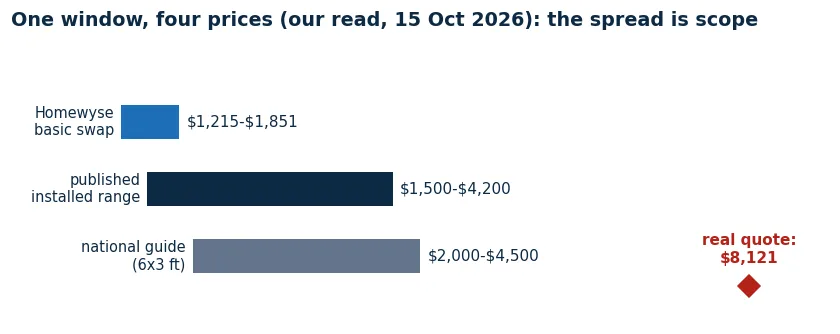
A bay window installed runs $1,200 to $7,900 in the 2026 national data, with the cross-type average near $3,600. That band is honest but useless without its lesson: we priced the same window four ways and got $1,215 at the bottom and a real $8,121 quote at the top, a 6.7x spread that lives almost entirely in scope, the structural work over and under the projection that basic estimates exclude in fine print. The sections below give you the type and size tables, then teach you to read a quote by its scope lines.
On this page (11 sections)
The honest ranges by type and size
Start with the published bands, because they are the map the quotes will be drawn on. Two national datasets cover this ground, and they agree in shape if not in every figure.
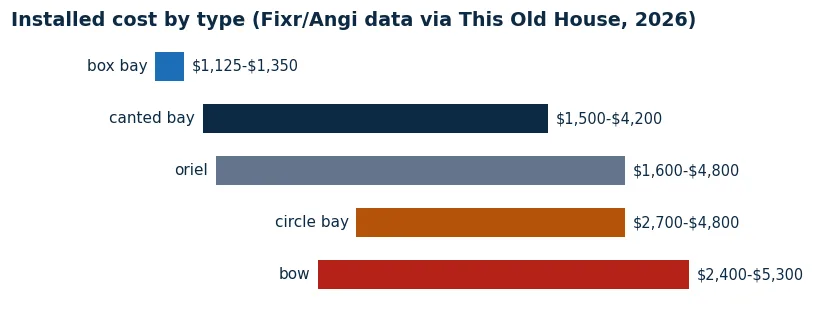
| Type | Unit | Installed | The shape |
|---|---|---|---|
| Box bay | $750 to $1,200 | $1,125 to $1,350 | 90-degree sides, the simple box |
| Canted bay (the classic) | $1,050 to $2,800 | $1,500 to $4,200 | three panels, 30 or 45 degrees, the window seat shape |
| Oriel (upper floor) | $1,125 to $3,250 | $1,600 to $4,800 | floats on brackets, no ground contact |
| Circle bay | $1,800 to $3,200 | $2,700 to $4,800 | Victorian semicircle, usually custom |
| Bow | $1,600 to $4,800 | $2,400 to $5,300 | four to six panels in a curve; the complex one |
By size
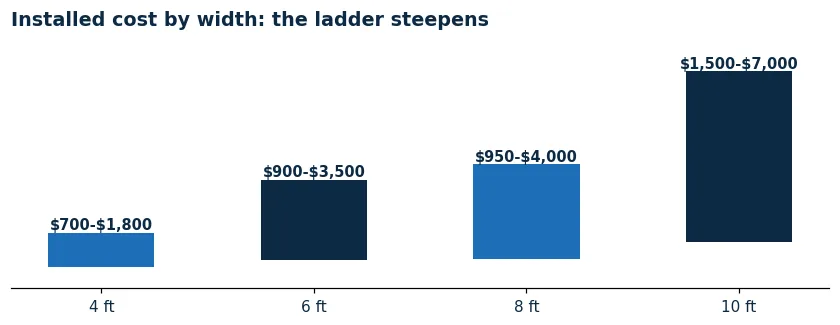
Width costs more than height because width multiplies both glass and structure. The published ladder: a 4-foot unit installed runs $700 to $1,800, a 6-foot $900 to $3,500, an 8-foot $950 to $4,000, and a 10-foot $1,500 to $7,000. Each step up is a bigger unit plus a bigger opening plus more support, which is why the ladder steepens instead of climbing linearly.
The average, used honestly
The cross-type national average is about $3,612 in the Fixr/Angi data. It describes a project mix, not your project: use it to sanity-check a quote's neighborhood, never as the budget.
One window, four prices: our measurement
The top of this search includes a homeowner asking whether an $8,121 quote for replacing a 30-degree bay unit is fair, which is the real question this page must answer. So we priced one window four ways, reading each source's scope lines, not just its totals.
What the cheap number excludes
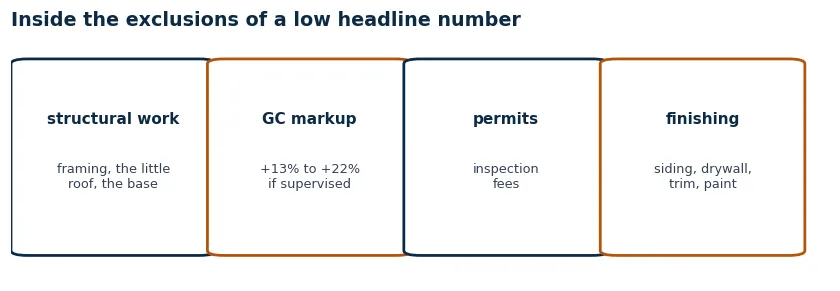
Homewyse's $1,215 to $1,851 is an honest number for a defined job: set the unit in the existing rough opening, shim, insulate, done. Its own notes exclude structural work, general contractor markup of 13 to 22%, permits, and hazardous-material handling. Nothing is hidden; but the headline travels further than the exclusions do, and the gap between $1,851 and $8,121 lives exactly in that excluded list.
Where the real quote lands
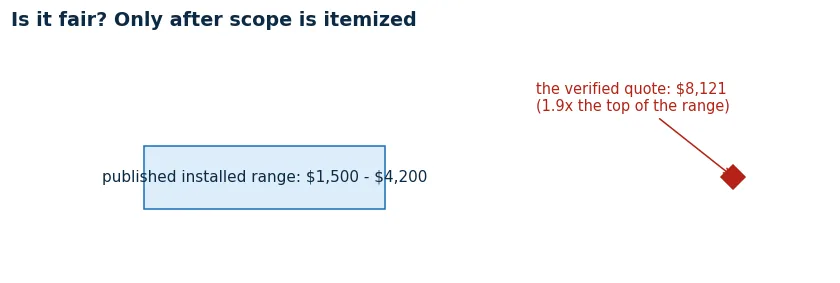
The verified quote, $8,121, sits at 1.9 times the top of the published canted-bay installed range. That does not make it a rip-off and it does not make it fair: it makes it a different scope until itemized. If it includes structural rebuild, a new roof over the projection, siding and interior finish, it may be honest. If it is a drop-in replacement at that number, it is not. The reading method is below.
Types: the shape is the price
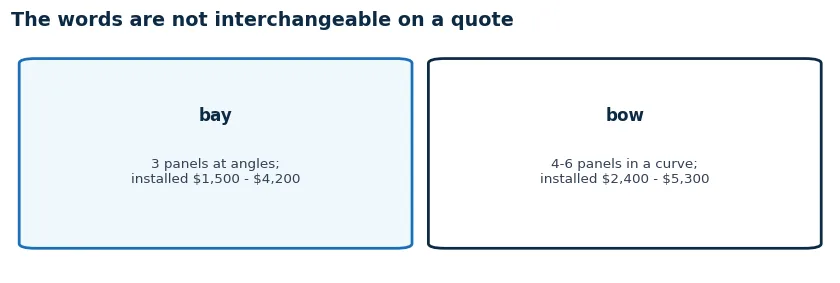
Bay and bow get confused constantly, including in quotes. A bay is usually three panels at angles; a bow is four to six in a curve. The bow multiplies panels and labor and sits at the top of the table. If your quote says bow, it should not be priced like a bay, and vice versa.
Box bay: the budget bay
The box bay, 90-degree sides forming a small greenhouse bump, is the cheapest entry at $750 to $1,200 for the unit. It delivers the shelf and the light without the seat. For kitchens and plant people it is most of the effect for the least money.
Oriel and circle: the specialists
An oriel is a bay that never touches the ground, carried on brackets, common on upper floors and older houses. A circle bay is the Victorian semicircle, usually custom. Both price above the canted standard because both complicate either the support or the manufacturing.
Size and material
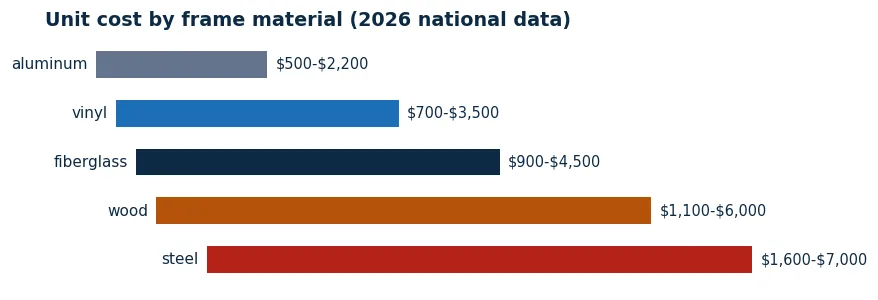
After type, the two dials are how big and what frame. The material table below is for the unit, and the frame choice matters more on a bay than on a flat window, because the projection exposes the frame to weather on three sides instead of one.
| Frame | Unit range | The trade-off |
|---|---|---|
| Aluminum | $500 to $2,200 | cheap and strong, but conducts cold; weak choice in cold climates |
| Vinyl | $700 to $3,500 | the value default; welded corners, no painting |
| Fiberglass | $900 to $4,500 | stable, efficient, mid-priced; the quiet upgrade |
| Wood | $1,100 to $6,000 | the look, with the maintenance bill attached |
| Steel | $1,600 to $7,000 | strong and thin-framed; overkill for most houses |
What brands like Andersen change
Brand premiums on bays follow the frame material more than the logo: a wood-clad brand unit prices like wood. What a big brand does change is the warranty structure and the dealer network doing the install; the frame material remains the honest first dial.
Glass is the quiet line
A bay gathers three directions of sun and weather, so the glass spec matters more than on a flat window: low-E argon double-pane is the sensible default, triple-pane where winters justify it. The efficiency case for the unit you choose is on the ENERGY STAR page linked below.
The structural half of the price
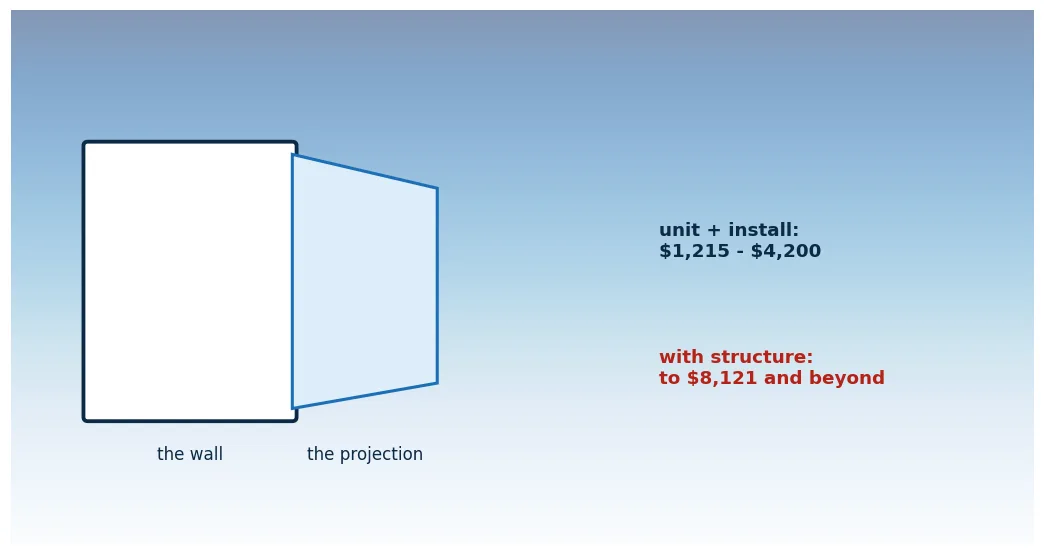
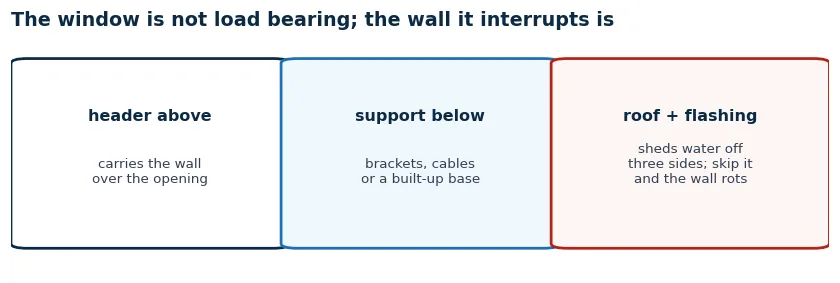
Are bay windows load bearing? The projection is not; it hangs off the house on brackets, cables or a built-up base, with a small roof or skirt above it. But the wall you cut to put it in is load bearing, and that is where a bay project turns into carpentry plus roofing plus siding plus paint. This is the half that the basic online estimate excludes.
What the exclusion list costs
Read the exclusions on any low headline number and price them mentally: structural framing, the little roof, siding repair, interior drywall and trim, permit, and a general contractor's 13 to 22% if one supervises. On a real project these lines can double a drop-in number, which is exactly what the four-price spread above shows.
The water question
A projecting window collects water from above and sheds it on three sides. The little roof and its flashing are not cosmetic: they are the difference between a bay that lasts and a wall that rots. Any quote without a roof-and-flashing line for a new projection is missing the weather.
Replacement versus new addition
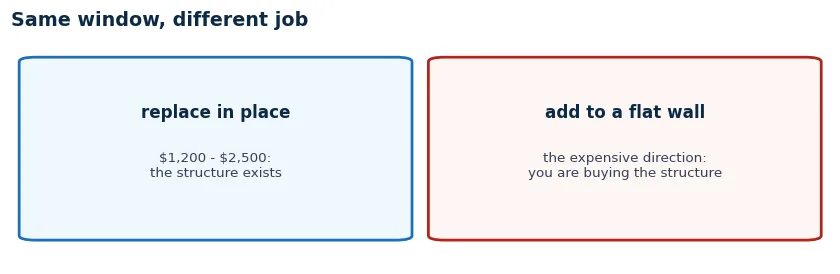
Replacing a bay in an existing opening is the cheap version of this job, because the structure already exists: figure the unit plus straightforward labor, roughly $1,200 to $2,500 at the honest end for standard sizes. Adding a bay where the wall was flat is the expensive version, because you are buying the structure: base, support, roof, opening, finish.
The reverse swap
Bay to flat is legal and occasionally smart: a flat unit in the same opening loses the seat and the projection but also the structure, the leaks and the price. If your bay is failing at the base or the roof, the honest comparison is a full structural rebuild against a simple, good flat window.
Are bay windows worth it?
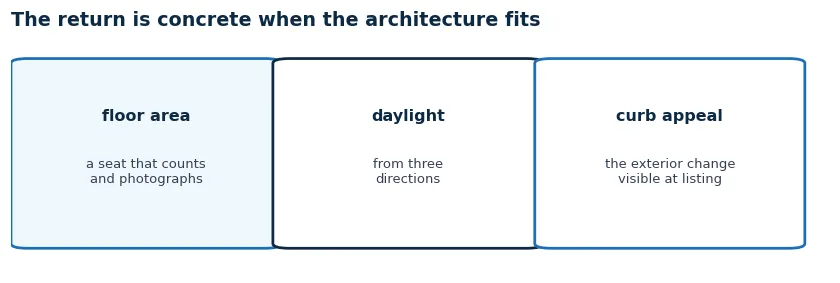
When the house suits one, yes, and the return is concrete rather than sentimental: counted floor area with a seat, daylight from three directions, and the one exterior change that photographs at listing time. Energy performance is a non-issue with a modern low-E argon unit; the drafty reputation belongs to thirty-year-old installs, not to the type.
When it is not worth it
On a facade where a bay looks bolted on, where the budget needs the structure money elsewhere, or where the honest goal is just more efficient glass, the same dollars work harder as good flat windows. The general cost picture for those is on the installation cost page.
How to read a bay window quote
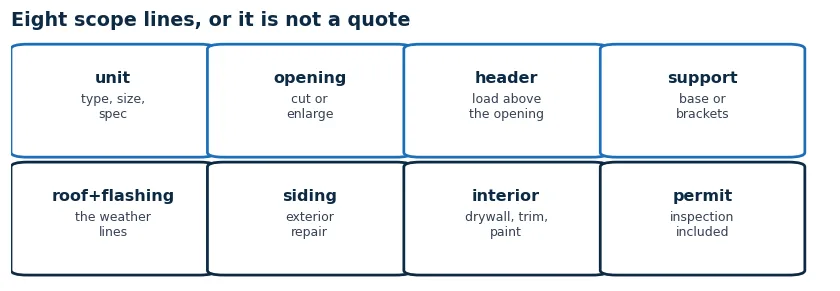
The homeowner in the ranking thread asked whether $8,121 was fair. The honest answer is a method: itemize the scope, then compare. A quote that lists the unit, the opening work, the support, the roof, the flashing, the siding, the interior finish and the permit is a quote you can judge. A number without those lines is not expensive or cheap; it is unknown.
Normalize before you compare
Two quotes are comparable only at the same scope: same unit spec, same structural work, same finish level. Ask each contractor to itemize identically, then the spread between them means something. This is the same discipline as reading any window quote, amplified by the structure a bay carries.
Basement and insurance edges
A basement bedroom version of this job is a different project with code minimums and a well; that is priced on the egress cost page. And if the replacement follows damage rather than a remodel, part of it may be a claim; the boundary is on the insurance page.
What we measured, and how
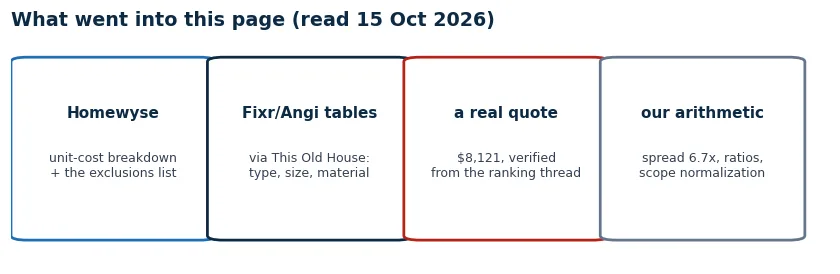
On 15 October 2026 we read the published estimates behind this search in full: Homewyse's unit-cost breakdown including its exclusions list, the Fixr/Angi type and size tables as carried by This Old House, and a current national guide's ranges. We then verified one real quote from the discussion that ranks at the top of this search, $8,121 for a 30-degree unit, and computed the spread and ratios ourselves.
The limits of this measurement
Published ranges are national and drift with labor markets; our read dates are printed. The real quote is one data point with unknown scope, used to show where quotes can land, not as a typical price. Your number comes from itemized quotes on your house, not from any table including ours.
The questions people actually ask
How much does a bay window cost installed?
The 2026 national figures land in a wide band: a basic swap of an existing bay opening starts around $1,215 to $1,851 (Homewyse, May 2026), a canted bay with full installation runs $1,500 to $4,200 in the Fixr/Angi data, and real quotes reach further when structure is involved. The honest average across types is about $3,600. Which number is yours depends on type, size, material and, above all, scope.
Why did I get a quote far above the published ranges?
Almost always scope. The published basic estimates exclude structural work, general contractor markup (13 to 22%), permits and interior finishing. A real quote we verified against the top search result ran $8,121 for a 30-degree unit, nearly twice the top of the published type range, because it priced a different, bigger job. Itemize the scope before judging the number.
What is the difference between a bay and a bow window?
A bay is typically three panels at angles, with a large center unit; a bow is four to six equal panels in a gentle curve. The bow is the more complex build and the pricier one: published installed ranges run $2,400 to $5,300 for a bow against $1,500 to $4,200 for a canted bay. If a quote says bow, it should not be priced like a bay.
Are bay windows load bearing?
The projection is not, but the wall you open is. A bay window hangs off the structure and carries itself with brackets, cables or a built-up base, and a roof or skirt above it. What is load bearing is the header over the opening you cut or enlarge, which is why the structural line items exist in a proper quote.
Are bay windows worth the money?
Where they fit the house, they return value three ways: floor area and a seat people can photograph at listing time, daylight from three directions, and curb appeal. Energy-wise, a modern unit with low-E argon glass performs like any good window; the old bay's reputation for drafts belongs to leaky installs, not the type. Worth it is mostly an architecture question with a correct installation attached.
How much does a bow window cost?
Bow windows run $1,600 to $4,800 for the unit and $2,400 to $5,300 installed in the current national data, the top of the type table, because the curve multiplies panels and labor. Five-panel bows are the common configuration; each added panel adds cost.
Can I replace a bay window with a flat window?
Yes, and it is a real cost decision: a flat window in the same opening removes the projection, the seat and some of the light, and costs considerably less because the structure comes off the job. Going the other direction, flat to bay, adds structure and is the expensive direction. Swapping bay for flat is the rare window job that gets cheaper than the opening it replaces.
How long does a bay window installation take?
A like-for-like replacement in an existing bay opening is typically a day. A new bay where none existed, with the base built up, support set and the roof or skirt framed and flashed, runs several days and multiple trades. If a quote promises a new projection in an afternoon, ask which steps are missing.
Sources
- Homewyse: cost to install a bay window (May 2026) · the unit-cost breakdown and the exclusions list this page builds on.
- This Old House: bay window cost (Fixr/Angi data) · the type, size and material tables.
- HomeBuild Windows: average cost of bay window and installation · the second national range set, for cross-checking the first.
- r/Home: "Is this quote to completely replace an existing bay window reasonable" · the $8,121 quote that anchors the reading method; the thread blocks bots, so only the titled figure is used.
- Pella: bay window replacement · the manufacturer view of what a replacement project involves.
- USA.gov: repairing your home · the federal doorway to doing work like this safely and financed sanely.
- HUD: home improvements · the federal frame for hiring and financing work like this.
- EPA: Lead Renovation, Repair and Painting program · cutting openings in a pre-1978 wall adds the lead-safe layer.
- ENERGY STAR: windows, doors and skylights · the efficiency case for the unit you choose.
Prices drift and scopes differ; every figure here carries its source and read date, and the itemized quote on your house is the number that governs. ClearView is an independent guide, not a seller or installer; see the disclaimer.
The rest of the house
If the bay is one line in a bigger window project, the whole-house pricing framework is on the installation cost page, and the longevity question for what you buy is on the lifespan page.