The window replacement process in 2026: the wait and the work
By the ClearView editorial team · Sources read on 2026-10-15
Read time about 9 minutes
The short answer
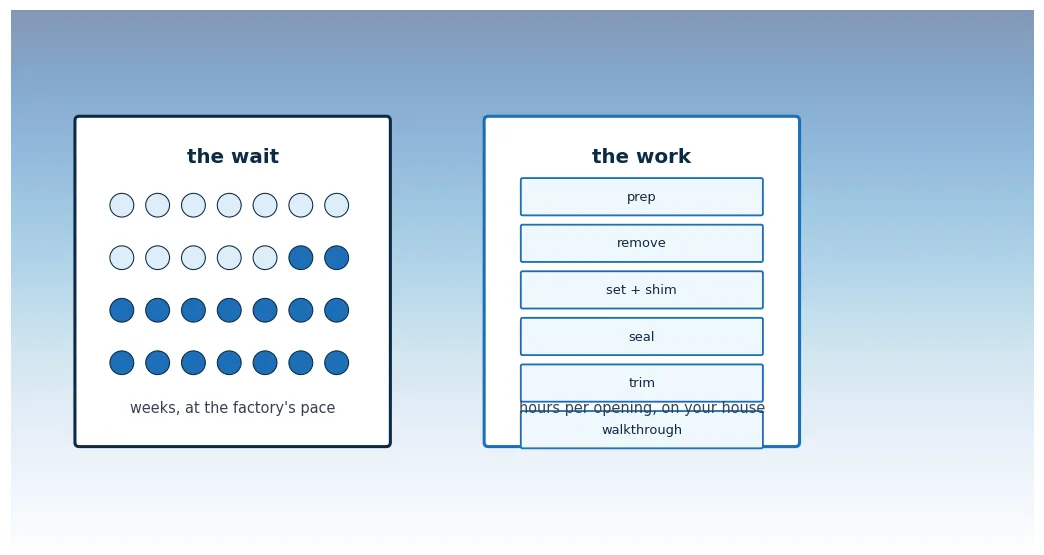
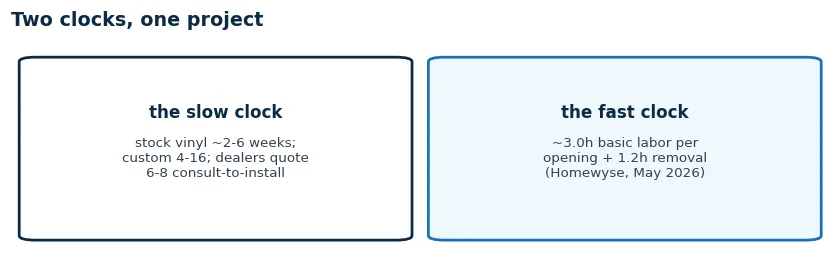
Every window project runs on two clocks, and most pages answer only one. The slow clock is the order: stated lead times run from about 2 weeks for stock vinyl units to 16 weeks for custom. The fast clock is the work: measured labor runs about 3 hours per opening for a basic insert replacement, so a whole house is days, not weeks. The process below is in the order it actually happens, with the hours and weeks printed where they belong.
On this page (11 sections)
The two clocks: the wait and the work
Ask how long window replacement takes and you get two kinds of answers that sound like one: weeks and hours. Both are right; they describe different clocks. The slow clock is the manufacturer's schedule. The fast clock is the crew on your house. A plan made from only one of them is how projects get scheduled before the windows exist.
The wait, in stated numbers
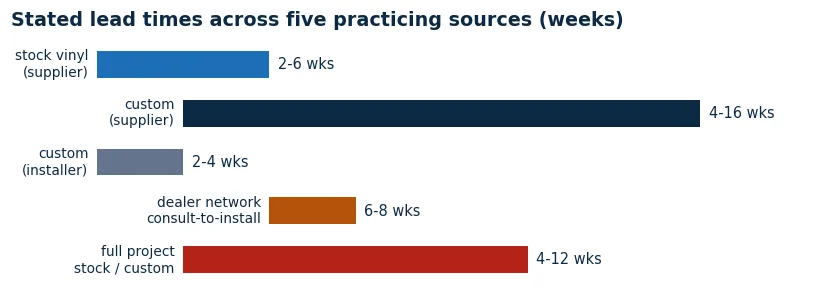
From the sources that state lead times: stock vinyl sizes ship in roughly 2 to 6 weeks, custom units run 4 to 16 weeks depending on material and glass, and big dealer networks quote 6 to 8 weeks from consultation to installation. Where your project lands depends on stock versus custom more than on brand.
The work, in measured hours
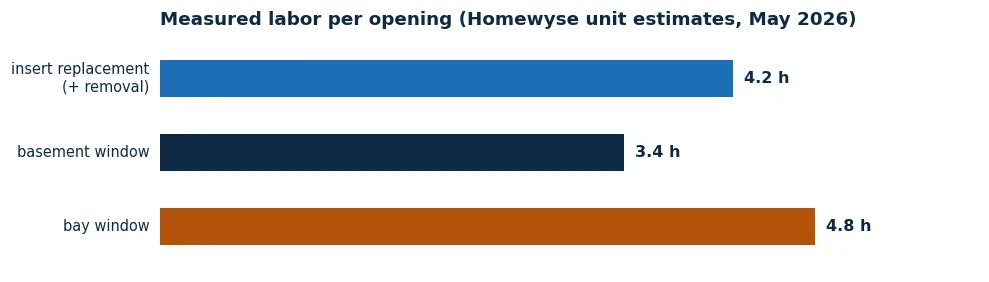
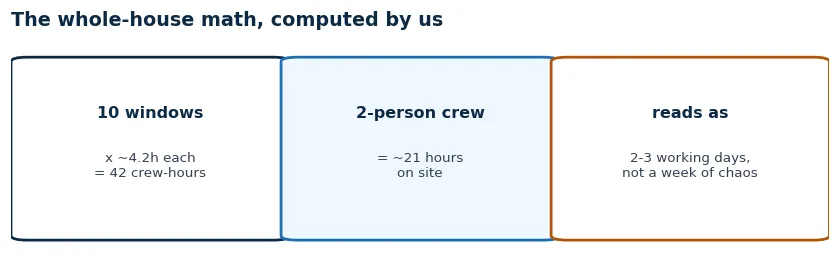
Homewyse's unit estimates publish the labor directly: 3.0 hours of basic installation labor per insert replacement, plus 1.2 hours to remove the old unit; 3.4 hours for a basement window; 4.8 for a bay. Our arithmetic on top of it: a ten-window house is about 42 crew-hours of installation, which a two-person crew covers in two to three working days. The day is short; the wait is the process.
The order of events
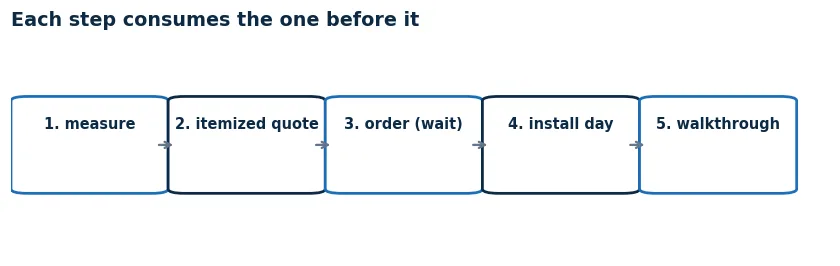
The sequence is stable across contractors because each step feeds the next: you cannot quote before measuring, cannot order before quoting, cannot install before the units arrive. Where projects go wrong is almost always a step pulled forward of its input.
Measure, then quote, then order
The measure visit is an hour or two and decides everything downstream. The quote should be itemized off those measurements, not off a phone description. The order goes in only when the quote is signed, and the clock that matters most, the factory one, starts there.
Install day, then the walkthrough
Installation is the short, loud part in the middle. The walkthrough at the end is the step homeowners skip and shouldn't: it is where operation, sealing and paperwork are verified while the crew is still on site. Both get their own sections below.
Measuring: where the project is decided
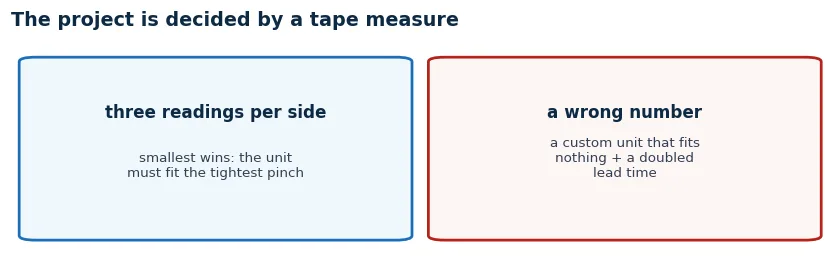
A replacement window is built to a measured opening, and a wrong measurement is not a small error: it is a custom unit that fits nothing, and a reorder that doubles the lead time. This is why the measure visit exists and why good installers measure twice with a second person reading back the numbers.
Why smallest-of-three
Openings in older houses are rarely square. Width and height are measured at three points each and the smallest value governs, because the new unit must fit the tightest pinch. A unit ordered to the largest reading binds; one ordered to the smallest shims true.
What else gets measured
Sill condition, squareness, depth of the jamb, and what the exterior trim will need. The measure visit is also when rot shows up: a soft sill discovered at measurement is a scope line, not a surprise on install day.
The day on site, hour by hour
With the units on site, the day follows a rhythm per opening. The measured labor below is Homewyse's published unit hours; the sequence is what those hours contain.
| Opening type | Basic labor | Removal of old unit | Reads as |
|---|---|---|---|
| Insert replacement | 3.0 h | +1.2 h | about 4 hours all-in per window |
| Basement window | 3.4 h | varies | tighter access, more setup |
| Bay window | 4.8 h | varies | the projection carries its own hours; priced separately |
Inside or outside?
Mostly inside. The old sashes come out inward, the new unit sets from the interior, and the exterior is worked for sealing and trim as needed. Upper floors happen off ladders or lifts. Your job on the day is the clear zone, covered in the FAQ below.
What the hours buy
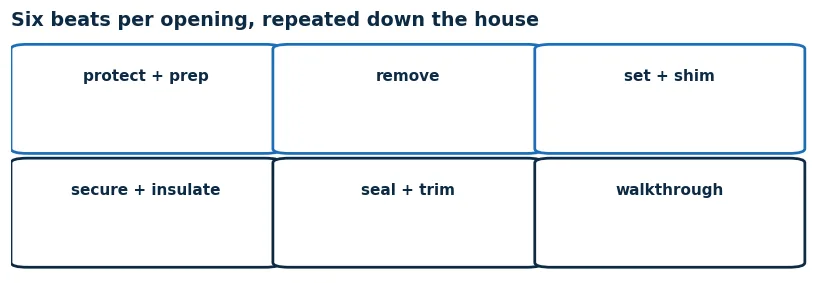
Most of the measured time is not the setting of the window; it is the shimming to level and plumb, the perimeter insulation, the sealing, and the protection of your floors. The unit going into the hole is the fast part. The hours are what keep it square and dry for the next two decades.
Insert versus full-frame: the fork
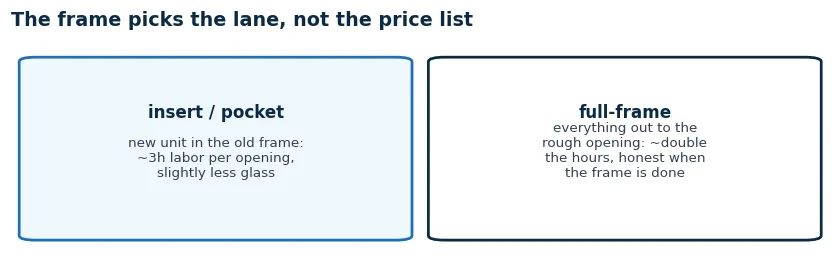
The biggest decision inside the quote is how much of the old window comes out. An insert, or pocket, replacement sets the new unit into the existing frame: the fast lane when the frame is sound. Full-frame goes to the rough opening, frame and all: the honest lane when the frame is rotten, out of square, or when you are changing the size.
What the fork costs in time
The insert carries the measured 3-hour figure. Full-frame adds the removal and rebuild of the frame itself, which is why contractor guides put full replacement at roughly double the per-window hours. The condition of your frames, read at the measure visit, is what decides which column your project is in.
The glass-area trade-off
An insert sits inside the old frame, so you lose a small band of glass around the edge. On small windows that band is noticeable; on large ones it is not. If daylight is the point of the project, the frame condition versus glass area trade is worth one question at the measure visit. The longevity side of the unit you pick is on the lifespan page.
What stretches the timeline
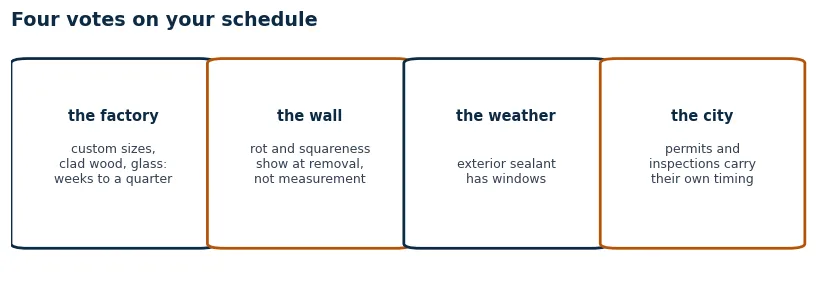
The plan above is the version where nothing surprises anyone. Four things reliably stretch it, and knowing them is how you read a promised date honestly.
The factory vote
Custom sizes, clad wood, specialty glass: the stated lead times stretch from weeks to a quarter of a year. Ordering late is the most common self-inflicted delay, and it is why the measure and quote steps belong early in your calendar, not at the end of it.
The wall's vote
Rot and out-of-square openings show themselves at removal, not at measurement. A sound project carries a contingency line for exactly this: the crew finds what the wall has been hiding, and the day stretches by the hours it takes to rebuild the opening before the unit goes in.
Weather and permits
Exterior sealant and roofing-adjacent work have weather windows, and structural openings carry permit and inspection timing. Neither is the crew's slowness; both are the calendar being honest. A schedule without either is a schedule written before anyone looked at the sky or the code.
What a good crew leaves behind
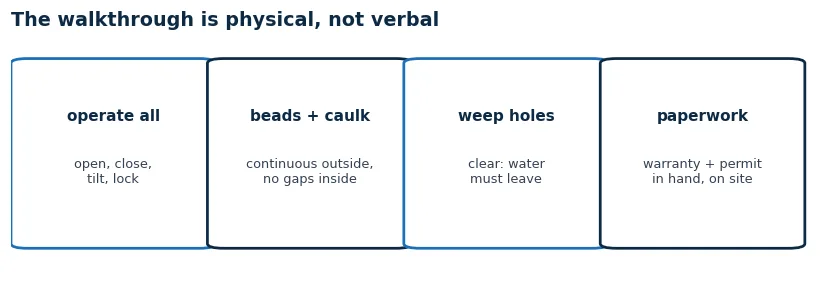
The walkthrough is the acceptance test, and it is physical, not verbal. Operate every window yourself: open, close, tilt, lock. Look at the exterior bead for continuity and the interior caulk for gaps. Confirm the weep holes are clear. Collect the warranty registration, the care instructions, and the permit sign-off while the crew is still in your driveway.
The paperwork is part of the job
Warranty registration windows close, and the NFRC label or its documentation is what your warranty and any future claim stands on. Photograph the labels before the trim covers them. The warranty side of what you just bought, including what the words actually promise, is on the lifespan page.
DIY or crew, honestly
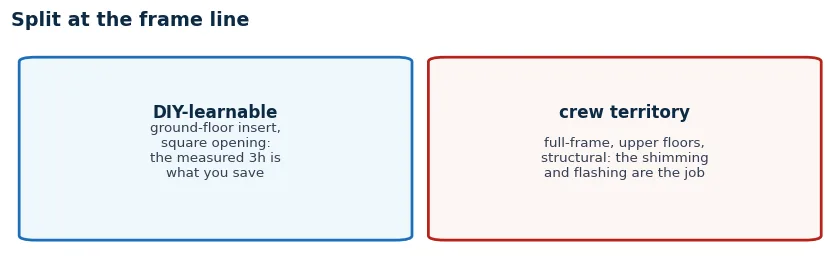
The forums ranking for this query are full of homeowners asking whether to do it themselves, and the honest answer is split at the same line the labor data draws. The measured 3 hours of basic labor per insert is what you save doing it yourself. What the crew carries that a first-timer does not: the shimming discipline that keeps the sash square, and the flashing detail that decides whether the wall stays dry.
The mistakes that cost more than the labor
A unit set out of square binds within a year. A perimeter sealed wrong leaks into the wall, invisibly, for seasons. Both are more expensive than the saved hours, and both are invisible on the day. If you DIY, the honest scope is a ground-floor insert with a square opening, and the discipline is measuring and shimming, not speed.
What we measured, and how
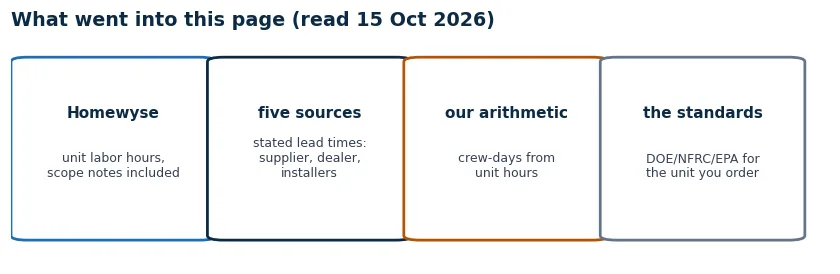
Two bodies of material, read on 15 October 2026. The labor hours come from Homewyse's published unit-cost estimates for three installation types, read in full including their scope notes. The lead times come from five practicing sources that state them, spanning a supplier, a big dealer network and independent installers, so the wait is shown as a stated range rather than a single promise. The whole-house day arithmetic on top of the unit hours is ours.
The limits of this measurement
Unit hours assume favorable site conditions; your house votes. Stated lead times are practice ranges, not guarantees, and they drift with manufacturer schedules. The written quote and its named dates, not any table here, govern your project.
The questions people actually ask
How long does window replacement take, start to finish?
Longer in waiting than in work. Stated lead times from manufacturers and suppliers run 2 to 16 weeks depending on stock versus custom units, and the measured on-site work is a few hours per opening: about 3 hours of basic labor for an insert replacement plus removal, per Homewyse's unit estimates. A full house of ten windows is typically two to three working days for a two-person crew, after weeks of waiting on the order.
What happens on installation day?
The crew protects floors and furniture, removes the old units, sets each new unit into its opening, shims it level and plumb, secures it to the framing, insulates the perimeter, seals the exterior, and trims out the interior. Then a walkthrough with you: every window opened, closed and locked, the work area cleared. Expect a day per handful of windows, not per window.
Do installers replace windows from inside or outside?
Mostly inside. Insert replacements are worked from the interior side: the old sashes come out inward, the new unit sets into the existing frame from inside, and the perimeter is sealed and insulated from both sides with the exterior trim worked from outside as needed. Upper floors are often done off ladders or lifts without ever entering the room much.
What is the difference between insert and full-frame replacement?
An insert, or pocket, replacement sets a new unit into the existing frame: faster, cheaper, and slightly smaller glass area. Full-frame removes everything to the rough opening, including the frame: slower and pricier, but the honest choice when the existing frame is rotten or out of square. The labor data puts an insert at about 3 hours of basic work per opening; full-frame runs longer because more of the wall is rebuilt.
How do I prepare my house for installation day?
Clear three feet inside each window, take down curtains, blinds and wall hangings near the openings, move furniture off the work path, and plan for dust. Alarm sensors on windows need the company notified. Pets need a closed room. The crew handles exterior access; your half is the interior clear zone.
Why do quotes give such different timelines?
Because part of the timeline is the factory, not the crew. Stock-size vinyl units ship in a couple of weeks; custom sizes, clad wood and specialty glass run four weeks and up, and suppliers state ranges as wide as 4 to 16 weeks. A quote promising a fast date on a custom unit is worth a direct question about what exactly is being delivered.
Can I replace windows myself?
An insert replacement in a ground-floor opening is the most DIY-feasible window job, and the labor math above is what you save. What professionals carry that a first-timer does not: the shimming discipline that keeps the sash square and operating, and the exterior sealing that decides whether the opening leaks. A window that is not level binds within a year; a wall that is not flashed rots quietly.
What should the final walkthrough cover?
Every window opened, closed, tilted and locked; screens fitted; weep holes clear; the exterior bead continuous; interior trim caulked; stickers and debris removed; and the warranty paperwork and permit sign-off in your hand, not promised by email. A crew that schedules the walkthrough is telling you the job is done; one that does not is telling you something else.
Sources
- Homewyse: cost to install replacement windows (May 2026) · the 3.0h basic labor plus 1.2h removal, read in full with the scope notes.
- Homewyse: basement window installation · the 3.4h figure for tighter-access openings.
- This Old House: how to install replacement windows · the on-site sequence as the trade teaches it.
- Lowe's: install a replacement window · the DIY-side version of the same sequence.
- US DOE FEMP: purchasing energy-efficient windows (October 2026) · the performance terms the ordered unit should carry.
- EPA: Lead Renovation, Repair and Painting program · pre-1978 houses add the lead-safe layer to any opening work.
- ENERGY STAR: windows, doors and skylights · the certification the ordered unit should meet.
- NFRC: the National Fenestration Rating Council · the label to photograph before the trim covers it.
- USA.gov: repairing your home · the federal doorway for doing work like this safely and financing it sanely.
Hours are published unit estimates under favorable conditions; weeks are stated practice ranges. Your written quote and its named dates govern. ClearView is an independent guide, not a seller or installer; see the disclaimer.
The price side of the same project
The process is half the picture; the other half is what the same hours and weeks cost. That is on the installation cost page, and if a draft is what started this project at all, the diagnosis sequence is on the drafty windows page.