Window replacement in Seattle in 2026: the one metro where the rebate is real
By the ClearView editorial team · Sources read on 2026-10-19
Read time about 11 minutes
The short answer
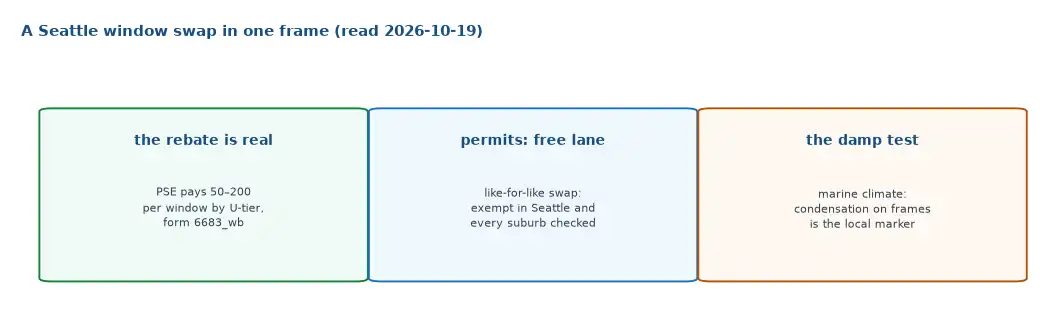
Seattle is the friendly end of our four-metro wave. It has the region's only live window rebate — Puget Sound Energy pays per window, in writing, with tiers we read off its own form on 19 October 2026 — and the metro's freest paperwork: a like-for-like swap in the same opening is permit-exempt in Seattle and every suburb we checked. The marine climate writes its own first test: condensation. What none of that changes is the arithmetic of the quote. Below: the cost bands, the PSE table with the catches that void it, the exempt-permit map, the glass for a damp heating climate, and the L&I check that filters companies in a state with no competency exam.
On this page (12 sections)
The utility map: who pays, who does not
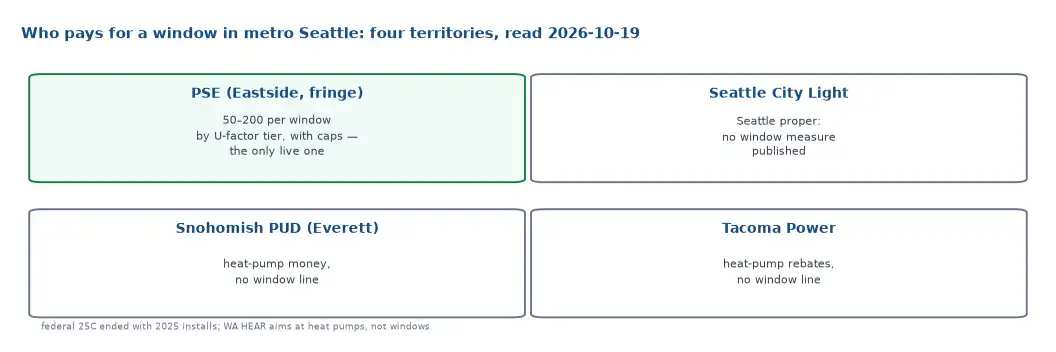
The metro splits across four electricity providers, and the answer flips at the meter, not the city line. On 19 October 2026 we read each one's residential catalog: PSE carries a per-window rebate with published tiers, and Seattle City Light, Snohomish PUD and Tacoma Power carry none. Above them, the federal 25C window credit ended with installations after 31 December 2025, and Washington's HEAR point-of-sale program is aimed at heat pumps, not windows.
| Utility territory | Window measure? | What the catalog pays for instead |
|---|---|---|
| PSE (Eastside, metro fringe) | Yes: $50 to $200 per window by U-factor tier | The live window rebate — tiers and catches in the next section |
| Seattle City Light (Seattle) | No window line | Heat-pump instant discounts, Clean Heat oil conversions, weatherization for income-qualified homes |
| Snohomish PUD (Everett) | No window line | Heat-pump conversions up to $2,500, water heaters to $1,000 |
| Tacoma Power (Tacoma) | No window line | Heat-pump rebates to $2,000, ductless to $1,000, EV charging credits to $600 |
| Federal 25C | Ended | Not available for installations after 12/31/2025 |
The PSE rebate, read off its form
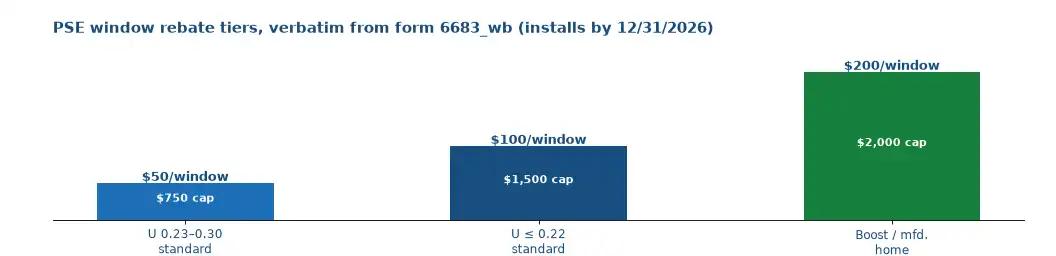
PSE's window rebate is written down in its own application form (6683_wb), and the numbers are per window: $50 at U-factor 0.23 to 0.30, capped at $750 per project; $100 at 0.22 or lower, capped at $1,500; and $200 per opening for Efficiency Boost income-qualified homes and manufactured homes, capped at $2,000 across 10 openings. Windows must be installed by 31 December 2026, the application goes in within 60 days of installation, and each home gets 15 rebated windows over its lifetime.
The catches printed on the same form
Four conditions decide whether the money is real. The job must be a full window replacement — glass-only does not qualify. Work required by the building code is excluded, so a remodel or addition cannot stack the rebate. The home's primary heat must be PSE electricity or PSE natural gas. And the invoice needs the NFRC stickers or a packing slip with each unit's U-factor, which is a good reason to have the values printed on the quote in the first place.
The arithmetic on a real job
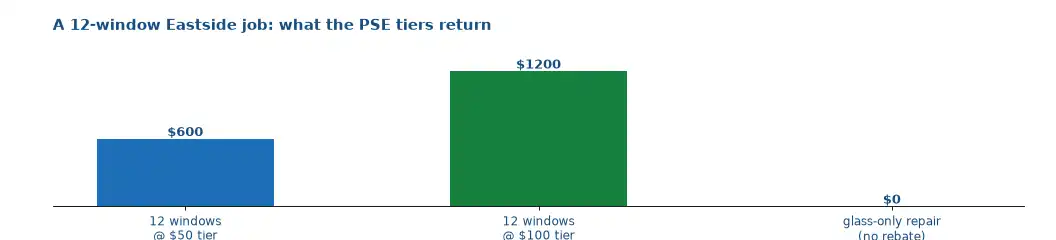
Run a 12-window Eastside job on the bands. At $50 a window the rebate is $600, capped toward $750; at the 0.22 tier it is $1,200 against the $1,500 cap. Stepping the glass from 0.25 to 0.22 typically costs $40 to $80 per window and returns double that in rebate, so on PSE territory the better glass is the cheaper net buy. That is the only sentence of its kind we can write in this wave's four metros.
What it costs in Seattle
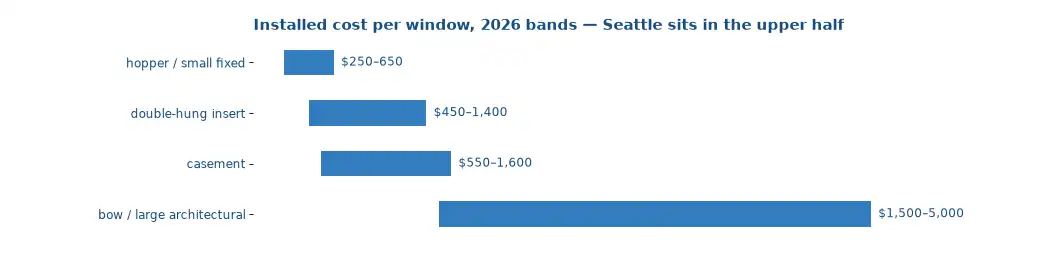
Begin with the honest bands: in the 2026 national data a standard double-hung insert lands near $450 to $1,400 installed, casements a step above it for the operator hardware, and bow or large architectural units well above the per-window range because they carry structure. Seattle bids cluster in the upper half of the band: metro labor is expensive, and the region's mid-century housing stock adds full-frame scope and lead-safe protocol on pre-1978 paint.
What moves the number here
Five drivers move any quote, here as anywhere: the opening count, insert against full-frame, the glass package, second-story access, and lead-safe protocol on pre-1978 paint. Seattle adds two local lines: the 0.22 glass tier pays for itself in PSE territory, and a landmark address adds the review layer before any installer sets a ladder. On type pricing: tilt-and-turn units, rarer here than in Europe, price above casements for the hardware. On the question behind most searches: the average cost of replacing a window is a band, not a number, and the bands are the chart above. Our installation cost guide carries the per-opening labor hours and the whole-house roll-up; the only binding number for your house is its written, itemized quote.
The exempt-permit map
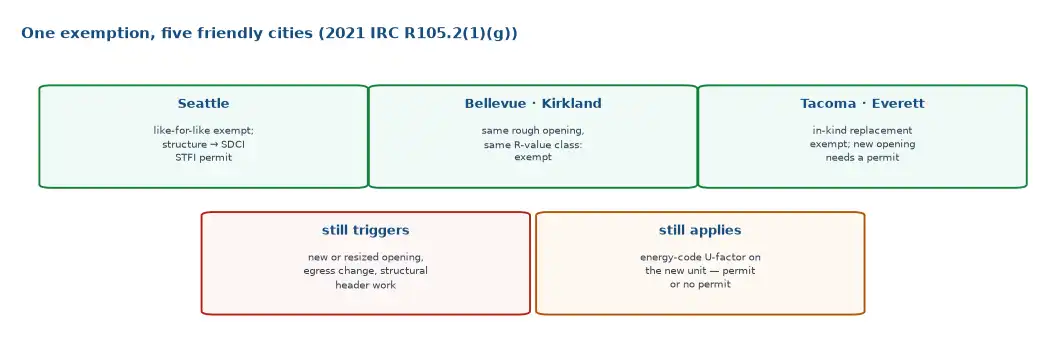
Washington adopted the 2021 residential code with its like-for-like exemption: replacing a window in the existing rough opening, with no structural member altered, needs no permit. The cities we checked read it the same way — Seattle, Bellevue, Kirkland, Tacoma and Everett all treat the plain swap as exempt, with the energy code's U-factor bar still applying to the new unit even when no permit is pulled. Enlarge an opening, resize an egress window or touch a header, and you are in permit territory; in Seattle that means SDCI's subject-to-field-inspection permit.
What "exempt" does not mean
No permit does not mean no rules. The replacement unit still owes the state energy code's U-factor, bedroom windows still owe egress sizing, and safety glazing rules still apply near doors and tubs. The exemption removes the counter visit, not the code — which is why the NFRC label on the quote matters even when nobody files paper.
Glass for a damp heating climate
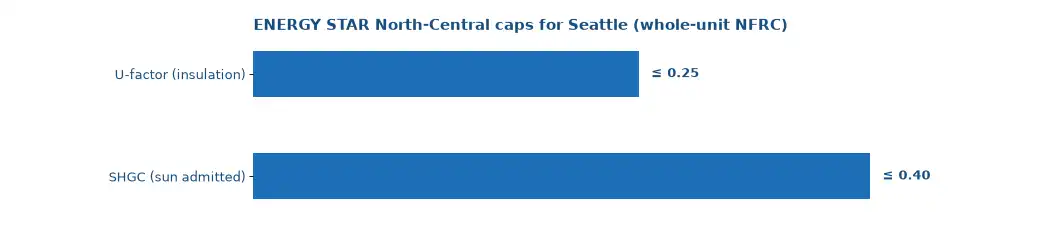
Seattle sits in ENERGY STAR's North-Central zone: certified windows cap whole-unit U-factor at 0.25 and SHGC at 0.40. In a heating climate the U-factor does the work, and the marine damp changes what fails first: condensation forms on the coldest interior surface, which on an old aluminum single-pane is the frame and sash. Warm-edge spacers and a thermally broken frame move that failure point; the gas fill alone does not.
Read the label, pick the tier
The NFRC whole-unit label is the only common tongue across brands. In PSE territory the label is also the rebate ticket: the quoted unit's U-factor decides whether the job earns $50 or $100 per window, so the number belongs on the quote before signing, not on a sticker scraped off at install. Our vinyl-versus-wood page measures the same habit from the other side: the glass package carries the energy number, the frame does not.
Landmarks and historic review
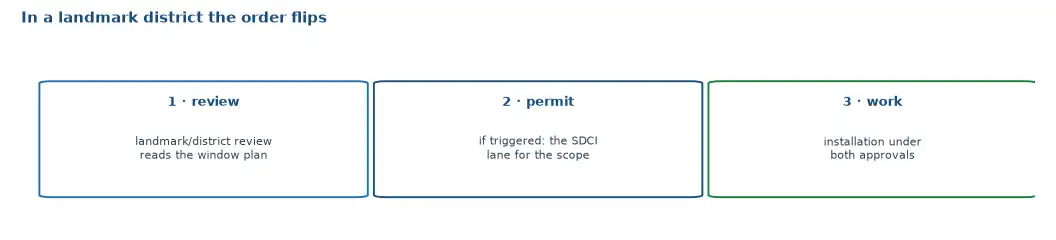
Seattle's landmarks and historic districts, Pioneer Square chief among them, review exterior changes visible from the street, and a street-facing window swap is one. The rule of thumb across districts: fix the original where possible; where it must go, match the original profiles and materials on anything the street can see; interior work and true like-for-like maintenance are generally outside review. Plan the review into the calendar before ordering units — it adds weeks, not days.
Repair or replace in the damp
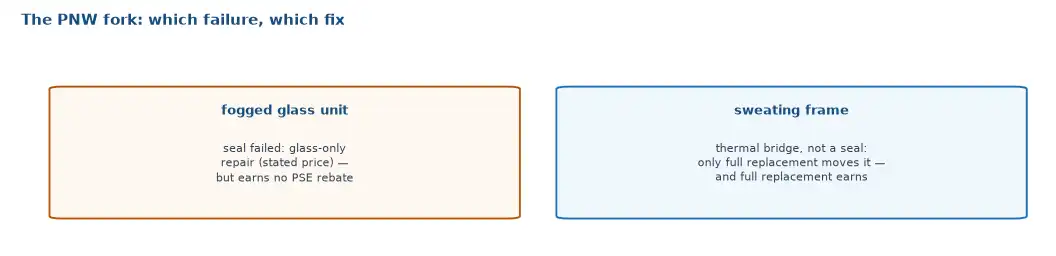
A fogged glass unit, worn weatherstripping or a failed crank is a stated-price repair, priced in tens where a new window prices in thousands; rotten frames, single-pane glass and crooked installs settle it toward replacement. The marine damp adds the local tell: a unit that fogs between panes has a failed seal, but a frame that sweats every November morning is a thermal-bridge problem that a glass-only fix will not solve. In PSE territory, run the rebate math before choosing the glass-only route — full replacement earns the rebate, glass-only does not.
Our when to replace windows page runs a five-minute test per signal, and the drafty windows page takes the leak half. Work through both pages before collecting quotes; a window salesman is not going to run them for you.
Choosing a company: the L&I check
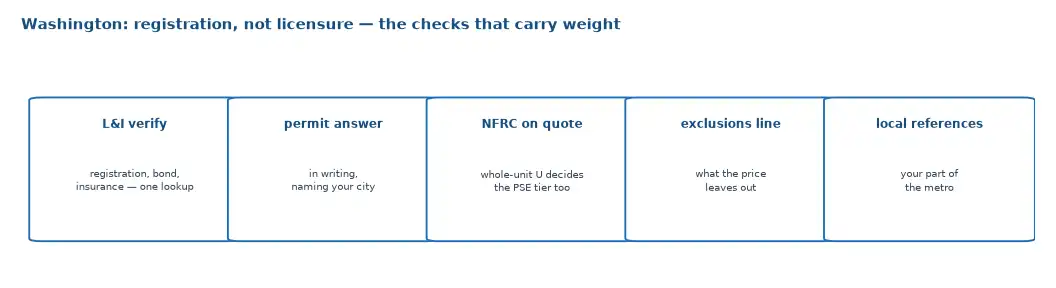
Washington runs registration, not licensure: no competency exam, but every contractor must be registered with the Department of Labor and Industries, bonded ($30,000 for general contractors since July 2024) and insured, and the registration number must appear on their ads and bids. That makes the first check fast and binary: no number on the quote, no registration — walk. The number verifies in a minute on the L&I lookup, with bond and insurance status in the same result.
The checks after the registration
A registration is the floor, not the answer. Registration checked, then the paper: a written permit answer that names your city; the bid printing the quoted unit's whole-unit NFRC figures; an exclusions line saying what the price omits; and references from your side of the metro — crew quality is local here, never brand-level. On the Eastside add the rebate line: who files the PSE form, within 60 days, and whose NFRC stickers it uses.
After wind weeks
The November-to-March wind season pulls out-of-area crews into the metro after every blowdown. The registration check matters twice as much then, and no storm deadline on a door hanger cancels your insurance claim.
The Seattle calendar
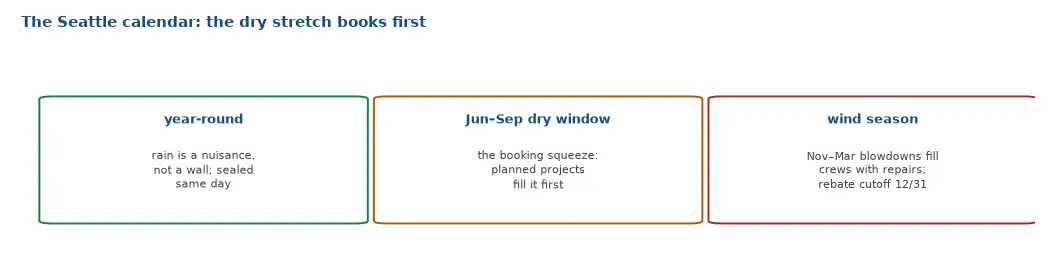
Installs run year-round here; rain is a scheduling nuisance, not a wall, and each opening stays sealed same-day regardless of month. What moves is the booking calendar: the dry June-to-September window books first with planned projects, and wind weeks fill crews with repairs. The honest seasonal discount is a faster, less rushed crew, not a lower number — and on PSE territory the real deadline is the rebate's 31 December install cutoff.
What we read, and how
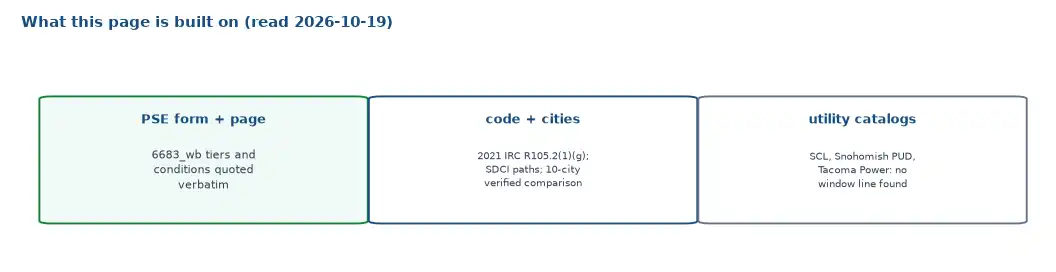
This page is built on primary reads, dated 19 October 2026: the PSE window rebate page and its application form (6683_wb), with the tiers and conditions quoted from the form itself; the residential catalogs of Seattle City Light, Snohomish PUD and Tacoma Power read for a window measure and found without one; the 2021 IRC R105.2(1)(g) like-for-like exemption as the cities apply it, cross-checked against a 10-city verified comparison; SDCI's permit paths; Washington's contractor registration law (RCW 18.27) with the July 2024 bond levels; and the repeal date of the federal 25C credit. A city or utility with no published window rule is reported that way, not guessed.
The limits of this read
Rebate programs turn with funding cycles, and PSE's form says so itself: amounts and eligibility can change, so confirm before ordering. The rebate arithmetic here uses the published tiers, not a model of your house. On lifespan: our window lifespan page answers how long the next units should last.
The rest of the wave: Denver against hail, Dallas against the Texas flip, Atlanta against an empty money map, Los Angeles against the code that writes the spec.
The questions Seattle actually asks
How much does window replacement cost in Seattle?
Per window installed, the 2026 national bands run about $450 to $1,400 for a standard double-hung insert, and Seattle bids land at the upper half of the band: metro labor is expensive, and the region's 1960s-80s housing stock adds full-frame scope and lead-safe handling on pre-1978 paint. The five drivers, unchanged by geography: how many openings, insert or full-frame, which glass package, second-story access, and lead protocol. The per-opening labor hours and the whole-house roll-up sit in our installation cost guide; no band binds your house — the written, itemized quote does.
Is there a window rebate in Seattle in 2026?
Yes, and it is the only live one in our four-metro wave — but not in Seattle proper. Puget Sound Energy pays $50 per window at U-factor 0.23 to 0.30 (up to $750) and $100 per window at 0.22 or lower (up to $1,500), with $200 tiers for income-qualified and manufactured homes, installed by December 31, 2026 and applied for within 60 days. PSE territory covers the Eastside and much of the metro fringe, not Seattle itself: Seattle City Light, Snohomish PUD and Tacoma Power carry no window measure. We read all four catalogs on 19 October 2026; the federal 25C window credit ended with 2025 installs.
Do I need a permit to replace windows in Seattle?
For a like-for-like swap, usually no, almost anywhere in the metro. Washington's adopted residential code (2021 IRC R105.2(1)(g)) exempts window replacement in the existing rough opening with no structural change, and Seattle, Bellevue, Kirkland, Tacoma and Everett all read that way; the energy code's U-factor still applies to the new unit even when no permit is pulled. Enlarge the opening, resize an egress window or touch a header, and you are in permit territory — in Seattle that means SDCI's subject-to-field-inspection permit.
What U-factor do I need in Seattle?
Seattle sits in ENERGY STAR's North-Central zone: certified windows cap whole-unit U-factor at 0.25 and SHGC at 0.40, read off the NFRC label. Two local notes: the state energy code (WSEC) applies its U-factor bar even when no permit is required, and PSE's rebate tiers start at 0.30, so a 0.25-or-better unit serves both the code and the rebate. In the marine climate, warm-edge spacers and frame material matter as much as the gas fill, because condensation on a cold frame is the mold starter, not the glass itself.
Who are the best window replacement companies in Seattle?
We are an independent guide and do not rank companies. Washington gives you a fast, real check: every contractor must be registered with the Department of Labor and Industries, bonded ($30,000 general since July 2024) and insured, and the registration number must appear on their ads and bids — verify it on the L&I lookup in a minute. Beyond the lookup: the city named in a written permit answer, the NFRC figures on paper in the bid, an exclusions line, and references from your side of the metro. Eastside jobs add one more: the PSE rebate math written into the quote.
Should I repair or replace foggy windows in Seattle?
Fog between the panes is a failed seal, and it does not heal; in this climate it also fogs every damp morning. If the frame is sound, replacing the insulated glass unit alone is the stated-price repair, far under a full window — with one local caveat: PSE's rebate is for full replacement only, so on the Eastside the glass-only fix and the rebate math should be compared on paper before choosing. Rotten frames, single-pane sashes and crooked installs settle it toward replacement either way. The when to replace windows page holds a five-minute test per signal.
Is window replacement worth it in Seattle?
As comfort, yes on the day the condensation stops; as money, honestly partial, with one Eastside exception. The gains stack is real in a heating climate — warmer interior glass, less mold pressure on frames and sills, quieter rooms, and a documented job that reads well at sale. Expect partial recoup at sale plus the daily gains while you live there; anyone quoting full recoup is selling, not appraising. The exception: in PSE territory the per-window rebate plus the heating savings move the payback math more than anywhere else in our wave.
Does home insurance cover window replacement in Washington?
Insurance pays for sudden, dated events: a windstorm break, a fallen fir limb. Tired or fogged windows count as maintenance; no policy pays for those. The Puget Sound wind season, November through March, is when the storm route is live: record the date, photograph every damaged sash and frame before any cleanup, and put the damage in writing with window locations. Our window-and-insurance page covers the claim end to end, down to what adjusters ask.
Do Home Depot, Lowe’s or Costco replace windows in Seattle?
Yes, all three sell and install across the metro, and each fulfills through subcontracted local crews, so the checks apply to the crew that shows up, not the logo on the receipt: L&I registration verified, the permit answer in writing, NFRC values printed on the quote, an exclusions line, and local references. In PSE territory add the rebate line: who files the form, and whose NFRC stickers it uses.
Can I replace windows in a Seattle historic district or landmark home?
Yes, with a review step first. Seattle's landmarks and historic districts, Pioneer Square chief among them, review exterior changes visible from the street, and a street-facing window swap is one. Districts share one instinct: keep the original where it can be kept, and where it cannot, match its profiles and materials on anything the street can see; interior work and true like-for-like maintenance are generally outside review. Plan the review into the calendar before ordering units.
Can I DIY a window replacement, and where do parts come from?
A like-for-like insert on the ground floor is the one DIY-feasible window job, and the permit exemption still applies to it — but two things stop most DIY plans: brand-specific hardware (a sash, a crank) goes through the manufacturer's channel, not the shelf, and in PSE territory a self-installed swap earns no rebate unless the program's documentation is met to the letter. Above the ground floor or on any structural opening, it is a pro job. The replacement process page maps what a crew day actually looks like.
What about Bellevue, Tacoma, Everett or Kirkland?
The damp is shared; the utility meter is not. Bellevue, Kirkland and most of the Eastside sit in PSE territory, where the per-window rebate is real money with a December 31, 2026 install deadline. Everett is Snohomish PUD, Tacoma is Tacoma Power, and Seattle proper is City Light, none of which carries a window measure. On permits all four suburbs read the same state exemption: like-for-like in the same opening is exempt, resizing or structure is not. West Seattle reads with the city; glass repair and window repair there are the same stated-price fixes as anywhere in the metro.
What do Seattle reddit threads say about window replacement?
The local threads repeat two findings that match our checks: quotes for identical openings vary by thousands (scope and glass package, not magic), and the PSE rebate gets missed by homeowners who never hear about it from a Seattle-side bidder who cannot offer it. Both are on this page, with the documents: the cost bands and the rebate tiers read from PSE's own form.
Other metro guides
Keep reading
Sources
- Puget Sound Energy: windows rebates · the live per-window rebate; tiers read against the program's own form.
- PSE: windows rebate application form (6683_wb) · the tiers, caps, 60-day window, 15-lifetime limit and the glass-only and code-required exclusions, verbatim.
- City of Seattle: SDCI · the permit paths, including the subject-to-field-inspection lane for structural window work.
- City of Bellevue: Development Services permits · the like-for-like exemption as the Eastside applies it.
- Washington State L&I: verify a contractor · the registration, bond and insurance lookup.
- Washington State L&I: contractor registration · registration, the July 2024 bond levels and the insurance floors.
- ENERGY STAR: windows, doors and skylights · the North-Central caps, U-factor 0.25 and SHGC 0.40, as whole-unit values.
- NFRC: the National Fenestration Rating Council · the label that carries the code bar and the rebate tier.
- US EPA: lead-safe work rules for pre-1978 homes · the lead layer on mid-century housing stock.