Egress window cost in 2026: the priced basket, not the guess
By the ClearView editorial team · Prices read from the retail listings on 2026-10-14
Read time about 9 minutes
The short answer
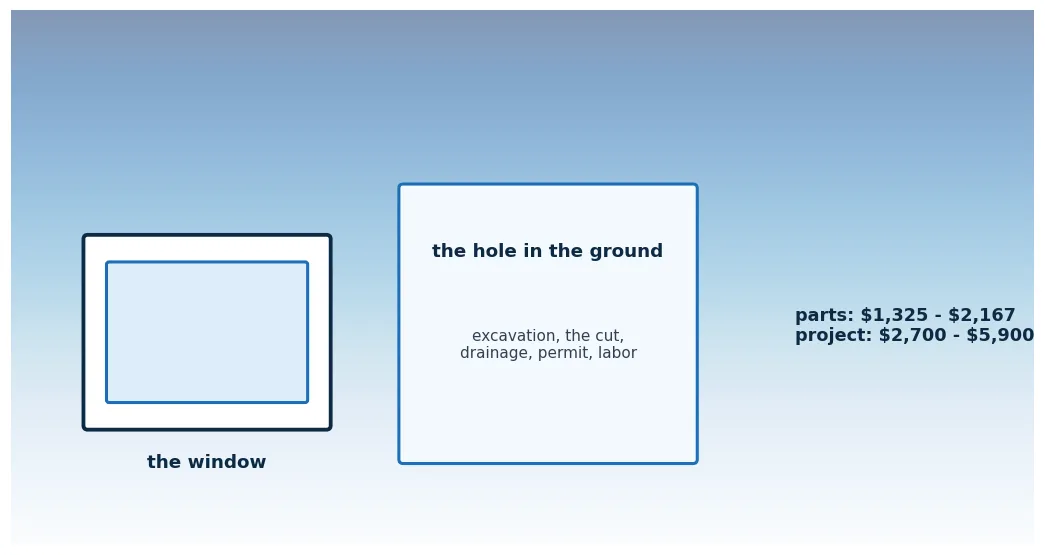
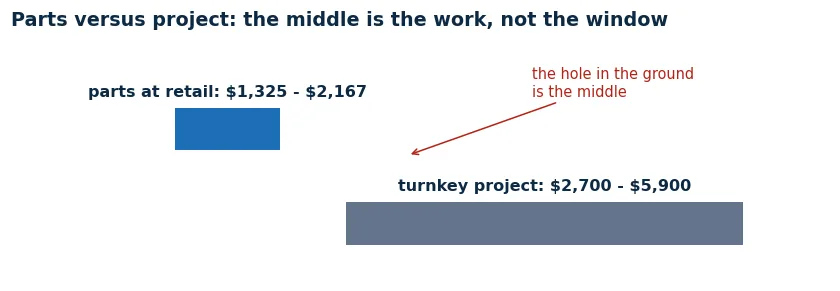
A new basement egress window, cut into the foundation with a well, drainage and a permit, runs $2,700 to $5,900 installed in the 2026 national guides, averaging around $4,000. But when we priced the actual parts at retail, the window, the well and the cover, the basket came to $1,325 to $2,167. The gap between those two numbers is the honest story of this project: you are mostly paying for the hole, not the window. Replacing a unit in an existing compliant opening is far cheaper, and enlarging one sits in between.
On this page (11 sections)
- The honest price ranges by project type
- The parts basket: what the pieces cost at retail
- The hole in the ground: where the rest goes
- The window itself: type decides price
- The well, the cover, and the 44-inch ladder rule
- DIY: where it works and where it does not
- Are egress windows worth it?
- Replacement versus new cut
- How to read an egress quote
- What we priced, and how
- Sources
The honest price ranges by project type
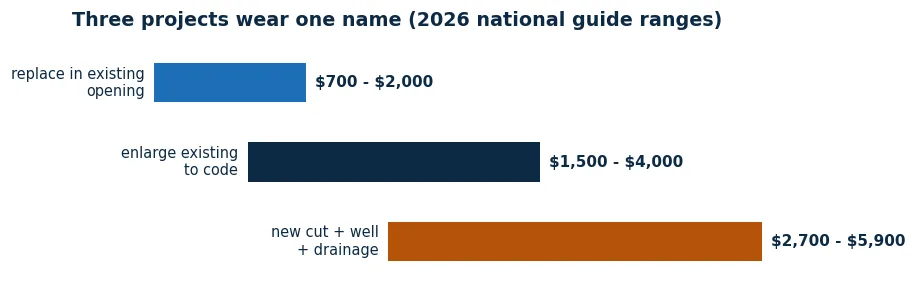
"Egress window cost" is three different projects wearing one name, and the price difference between them is not a detail. Which one yours is decides almost everything.
| Project | Typical range | Why it lands there |
|---|---|---|
| Replace in an existing compliant opening | $700 to $2,000 | no excavation, no structural work: a window job, not a project |
| Enlarge an existing opening to code | $1,500 to $4,000 | some cutting, less digging; the middle case most basements are |
| New cut with well and drainage | $2,700 to $5,900 | the full project: excavation, structural cut, drainage, permit |
The average, used honestly
The national average for a full new-cut installation sits around $3,850 to $4,200 in the current guides. Treat it as a bookmark, not a budget: foundation thickness, soil, access for the digger and local labor rates move real quotes by thousands in both directions. Your number comes from itemized quotes, not from the average.
What the Reddit thread is really asking
The top result for this query is a homeowner asking what a good price even looks like, which is the sensible question. A good price is one where the line items match the work: window, well, excavation, cutting, drainage, waterproofing, permit. A quote that cannot be itemized is not a good or bad price; it is an unknown one.
The parts basket: what the pieces cost at retail
Cost pages quote each other's ranges. We went to the retail listings instead and wrote down what the components actually sell for, on 14 October 2026, at the biggest home improvement retailer in the country. This is the basket a project is built from before any labor touches it.
| Component | Retail price | Notes |
|---|---|---|
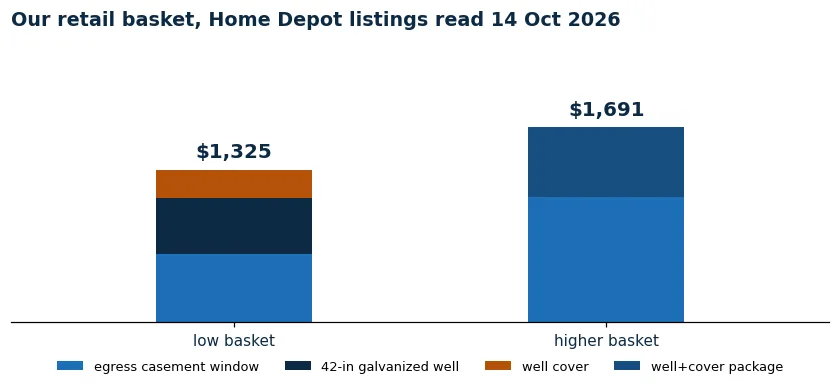
| Egress casement window | $594 to $1,083 | main egress category range; a second band runs $699 to $1,274 |
| Premium unit (Fakro) | $1,436 | the top of the retail shelf |
| 42" galvanized egress well | $488 | the standard below-grade shell |
| Well + cover package | $608 | 42x36x48 well with a 44x38 cover; cheaper than the pair separately |
| Well cover alone | $243 | keeps the pit clear of leaves, rain and pets |
The basket against the guides
Cross-checking ours against the published component tables: the current national guide puts DIY materials at $1,200 to $2,800 for this job. Our retail basket, $1,325 to $2,167, lands inside it. When two independent routes to the number agree, you can budget against it.
What the basket does not include
Gravel and drainage parts, fasteners and flashing, interior framing and trim, tool rental, disposal of the old concrete, and every hour of labor. The basket is the shelf price of the visible parts; the next section is the invisible majority.
The hole in the ground: where the rest goes
Subtract the basket from the turnkey price and you are looking at the actual project: between $1,300 and $2,200 of parts against $2,700 to $5,900 installed. The difference is not markup on a window; it is a different trade entirely.
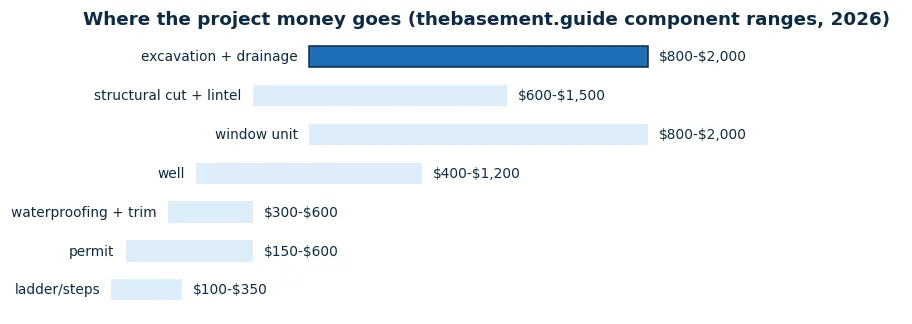
Excavation and drainage
The well needs a hole dug to below the footing line, a gravel bed and a drain so the pit does not become a pond against your foundation. The guides put excavation and drainage at $800 to $2,000 of the project, and it is the part with the most variance: soil, access for the machine, and how deep the footing sits all move it.
The structural cut
Enlarging or cutting a foundation opening is concrete or block cutting plus a lintel or header to carry the load above, priced around $600 to $1,500 in the current guides. This is the line that makes egress a structural job rather than a window job, and the reason the permit exists.
Waterproofing, trim, permit
Flashing and sealing the new opening runs a few hundred dollars, interior finishing a few hundred more, and the permit and inspection typically under $600. None of these is optional if the room is meant to count, and the inspection is the mechanism that makes the bedroom legal.
The window itself: type decides price
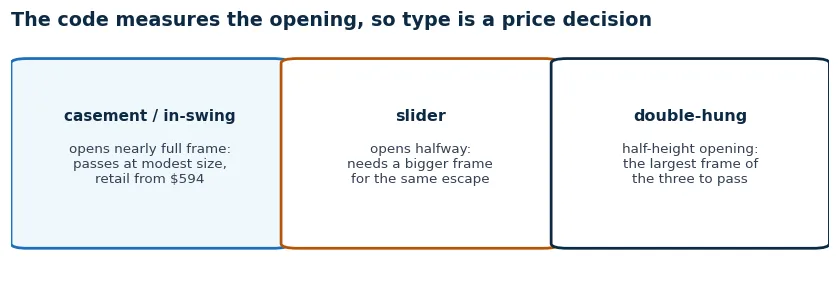
The code measures the open space, not the frame, which quietly makes the window type a price decision. A casement or in-swing unit opens nearly its whole frame and passes at a modest size. A sliding or double-hung window opens halfway, so it needs a much larger, more expensive frame to deliver the same clear escape opening.
Sizing to the code, not the catalogue
The four numbers that define a compliant opening, and the arithmetic showing which types clear them, are on our egress requirements page. The price-relevant version here: buying bigger than the minimum costs money twice, once on the window and once on the size of the hole you cut for it.
Where premium money actually goes
The premium units earn their price on glass specification, frame material and hardware, not on egress compliance, which the $594 unit meets if sized right. If the budget is tight, spend on the installation and drainage before the window; a premium window in a leaking well is the wrong order.
The well, the cover, and the 44-inch ladder rule
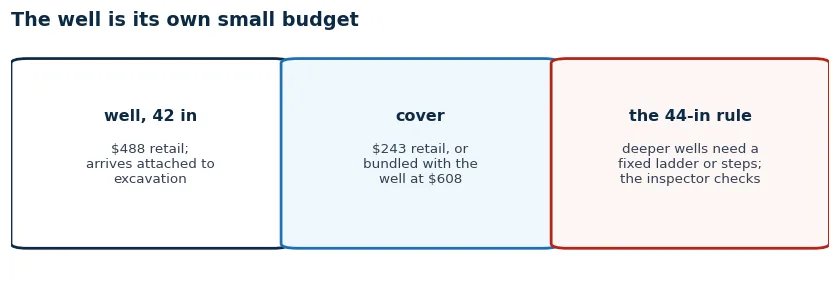
Below-grade openings need a window well with its own clearance rules, and the well is its own small budget. The retail reality: a 42-inch galvanized egress well at $488, a cover at $243, or the two bundled at $608. Installed, the well arrives attached to the excavation and drainage lines from the previous section.
The ladder rule
Under the residential code, a well deeper than 44 inches must have a permanently affixed ladder or steps. It costs little and it is checked. The full code picture, including the clearance the well itself must give the open window, is covered in the requirements guide; the cost angle here is simply that depth adds money on two lines, the well and the ladder.
Cover or no cover
A cover keeps the pit from filling with leaves, rain and the occasional pet, and it must lift off from inside without tools: it is an escape route, not a lid. At $243 retail it is the cheapest component in the basket and the one most often skipped to save money that then gets spent on cleaning the pit.
DIY: where it works and where it does not
The savings case is real and bounded. Our parts basket came to $1,325 to $2,167 against $2,700 to $5,900 turnkey, so the theoretical saving is the difference. The practical saving is smaller, because the parts of this job that fail are the parts amateurs should not do.
The DIY-friendly half
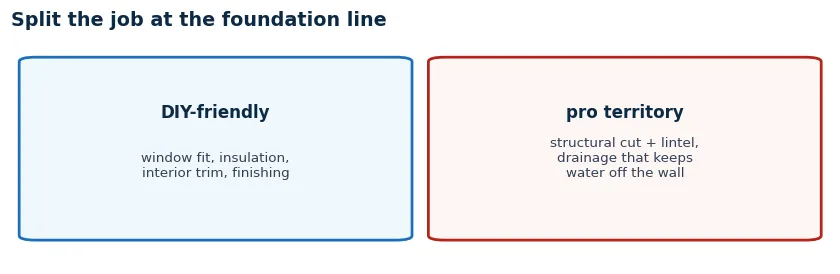
Fitting the window into a prepared opening, insulating, interior trim and finishing are learnable work with ordinary tools. Homeowners with masonry experience sometimes extend into the cut itself, but that is the exception, and the permit inspection applies regardless of who swings the saw.
The half that fails
Structural cutting without a lintel and drainage without a drain are the two classic DIY egress failures, and both are invisible until they are expensive: a crack above the opening or a well that ponds against the wall. If you split the job, split it there: pro for the hole, you for the finish.
Are egress windows worth it?
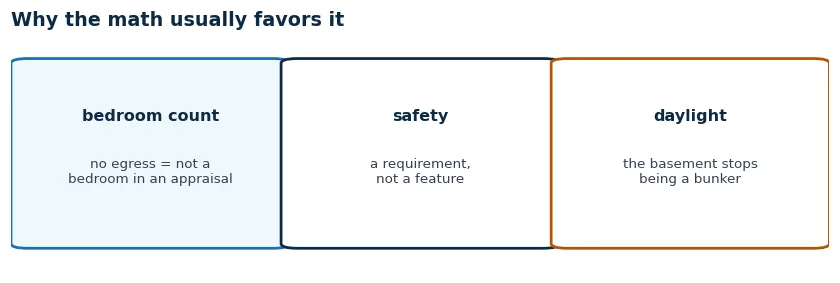
When the basement is becoming living space, usually yes, and the reason is arithmetic rather than sentiment. A basement room without a legal escape opening does not count as a bedroom in an appraisal; with one, it does. The project converts uncounted square footage into counted bedrooms, which is the strongest resale lever a basement has.
The inspection framing
An unpermitted egress window risks a failed inspection at resale, which converts your savings into a retroactive project at the worst possible time. The permit line in the budget is what makes the bedroom count stick.
When it is not worth it
For a utility basement that stays one, the project is optional, and the same money often works harder elsewhere in the house. The trigger is use: the moment someone sleeps down there, the calculation changes from optional to required.
Replacement versus new cut
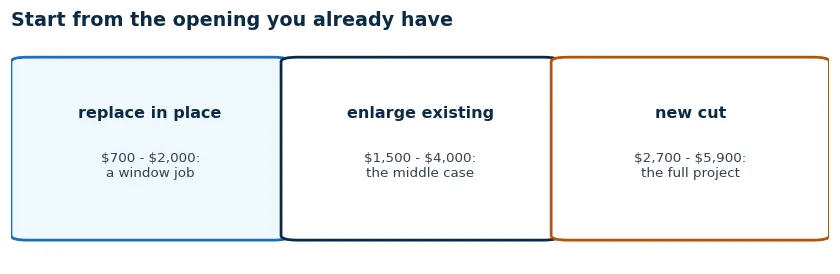
Replacing a window in an existing compliant opening is the cheap version of this job: $700 to $2,000, no excavation, no structural work. Enlarging an existing opening is the middle case at $1,500 to $4,000. The full new cut is the version with the well and the digging. If your basement has any existing opening near the right place, the middle path is usually the money answer.
Reading your own basement
Measure the existing openings before you collect quotes: width, height, sill height from the floor, and depth below grade outside. Those four numbers tell a contractor which project type you are, and they move the quote more honestly than any phone description.
How to read an egress quote
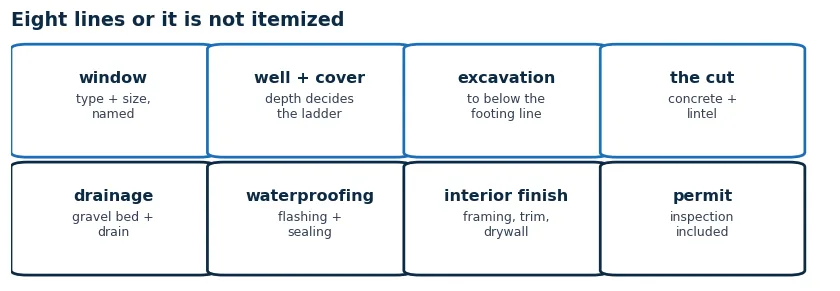
Egress quotes vary more than the windows do, and the variance lives in the line items. A clean quote lists the window, the well, excavation, cutting, drainage, waterproofing, interior finish and the permit separately. A single number with no breakdown is not a price; it is a guess with a signature line.
The spread between contractors
For general window work we audited what top pages claim and found them 2.4x apart on the same service; the details are on the installation cost page. Egress is worse, because the excavation half is quoted on visit, not from a table. Three itemized quotes on the same scope is the only reliable instrument here.
The insurance edge case
If the window project follows damage rather than a remodel, storm or vehicle impact for instance, part of it may be a claim rather than an expense. The boundary between the two is on the insurance page.
What we priced, and how
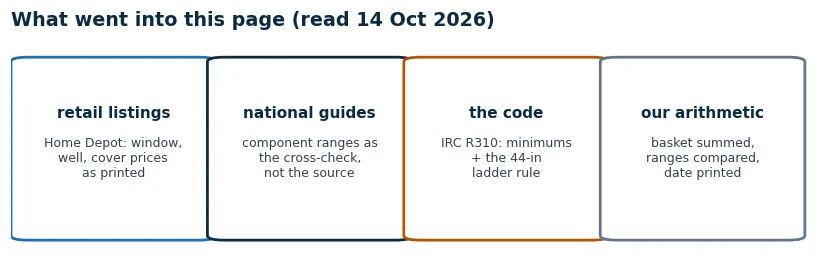
The basket on this page is our own measurement, not a quoted range. On 14 October 2026 we read the retail listings for egress-rated windows, wells and covers at the largest US home improvement retailer, transcribed the printed prices, and summed the basket ourselves. We then checked the basket against the published component tables in the current national guides, and it lands inside their DIY-materials range, which is the cross-check that makes both believable.
The limits of a retail basket
Retail prices are national shelf prices: your market's labor, soil and access move the project total far more than the basket. Two of the retail pages block automated reading, so those prices were transcribed from the listings as displayed; the date is printed above precisely because prices drift. The written quote, itemized, is the number that governs your project.
The questions people actually ask
How much does an egress window cost installed?
A new basement egress window, cut in with a well, drainage and a permit, runs $2,700 to $5,900 turnkey in the 2026 national guides, with the average around $3,850 to $4,200. Replacing a window in an existing compliant opening is far cheaper, and enlarging an existing opening sits in between. Our retail basket of the actual parts, window plus well plus cover, came to $1,325 to $2,167, which shows how much of the project price is not the window.
How much does the window unit itself cost?
At retail, egress-rated casement windows run $594 to $1,083 at Home Depot as of October 2026, with premium units like the Fakro at $1,436. Egress code rewards full-opening types: a casement or in-swing unit passes at a smaller, cheaper frame size than a sliding or double-hung window, which must be much larger to open the same clear area. The type choice is therefore a price choice.
How much does an egress window well cost?
A 42-inch galvanized steel egress well retails for $488 at Home Depot, a well-and-cover package for $608, and a cover alone for about $243, as of October 2026. Installed pricing is higher because the well arrives with excavation and drainage attached to it. Wells deeper than 44 inches need a permanently fixed ladder or steps under the residential code, a small line item that inspectors check.
Can I install an egress window myself?
Parts of it, yes: the window fit, interior trim and finishing are DIY-friendly. The parts that are not: cutting a structural opening in a foundation, setting drainage that keeps water out of the well, and the permit inspection the code expects. The DIY-materials basket we priced came to $1,325 to $2,167, against $2,700 to $5,900 turnkey, but the structural cut and the drainage are where DIY projects fail inspections and leak.
Are egress windows worth it?
The math usually favors it when the basement is becoming living space. A bedroom without an egress opening does not count as a bedroom in an appraisal, so the project converts square footage into counted bedrooms at resale. It is also the rare upgrade that is both a safety feature and a legal requirement, which makes the resale argument secondary to the inspection one.
Why is the excavation so expensive?
Because it is several trades in one: digging to below the footing line, cutting concrete or block, setting a lintel to carry the load above the new opening, building drainage so the well does not become a pond, and hauling away soil. The guides put that cluster at $1,700 to $3,500 of a typical project, which is why the window itself is the smaller half of the bill.
Does adding an egress window require a permit?
Yes, almost everywhere: cutting or enlarging a foundation opening is structural work, and the egress opening exists to be inspected. Permit fees typically run a few hundred dollars. The permit is not red tape here; it is the mechanism that verifies the escape actually works, and it is what protects the bedroom count at resale.
What is the cheapest way to add an egress window?
Enlarge an existing basement opening rather than cutting a new one: the excavation and structural work shrink, which is the expensive half. Choose a casement unit sized close to the code minimums rather than an oversized slider. Get the well and cover at retail prices like the ones we priced, and collect three quotes that itemize the same lines, because the spread between contractors on this job is wide.
Sources
- Home Depot: Egress windows category · the window prices in our basket, read 14 October 2026.
- Home Depot: SHAPE PRODUCTS 42-inch egress well and cover package · the $608 bundle and the well prices.
- Lowe's: window wells · the second retailer for the well category.
- The Basement Guide: egress window installation cost 2026 · the component table we cross-checked our basket against.
- Homewyse: basement window installation cost estimator · the independent labor-side reference.
- International Residential Code, Chapter 3 (ICC) · R310: the opening minimums and the 44-inch well ladder rule.
- Washington State Building Code Council · how a state adopts and amends the IRC, the layer under your permit fee.
- Oregon Building Codes Division · another state code administrator, for the same adoption layer.
- EPA: Lead Renovation, Repair and Painting program · cutting into a pre-1978 foundation wall adds the lead-safe layer to this job.
Prices move; every figure on this page carries its read date. The written, itemized quote is the number that governs your project. ClearView is an independent guide, not a seller or installer; see the disclaimer.
The window is the small half of this job
If the project grows past a single window, the pricing framework for the rest of the house is on the installation cost page, and the code numbers this project has to hit are on the egress requirements page.