Double-hung vs casement windows in 2026: the measured answer
By the ClearView editorial team · Sources read on 2026-10-15
Read time about 10 minutes
The short answer
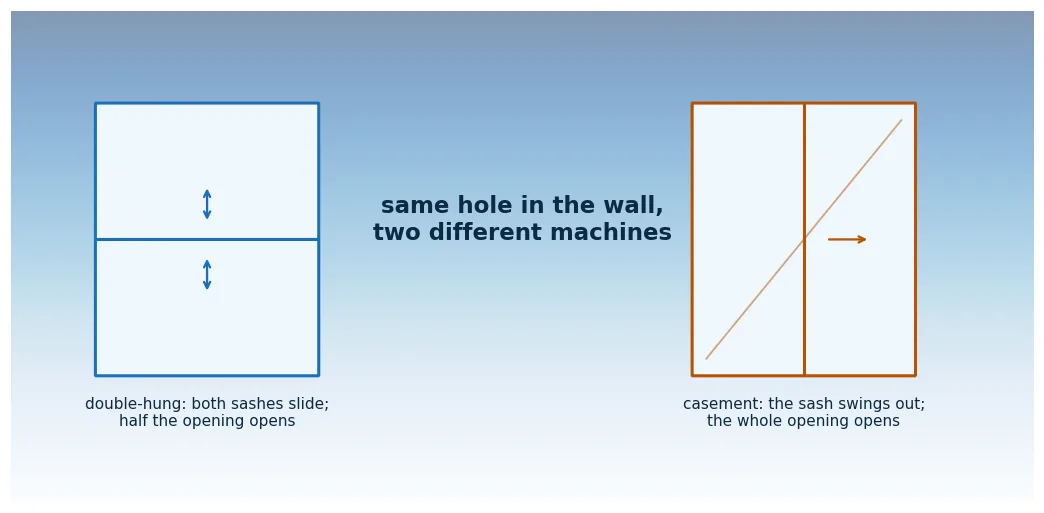
These are two different machines for the same hole in the wall, and the decision is mostly practical, not thermal. Measured at one manufacturer's own 250 Series documents: both types post the identical air-infiltration rating, so the famous casement airtightness advantage did not show up there. What did show up: the casement is rated tougher against wind and water and reads 4 STC points quieter, while the double-hung owns the practical floor: window AC units, exterior screens, tilt-in cleaning, simpler hardware. Pick by how the room will be used; the sections below give every deciding detail.
On this page (12 sections)
- The mechanics, measured
- How they open, and what it changes
- Ventilation: half an opening versus all of it
- Screens, air conditioners and the kitchen sink
- The crank question
- Cleaning: who reaches the outside glass
- Egress and the escape opening
- Cost: the modest, stable gap
- Which one where: room by room
- What we read, and how
- FAQ
- Sources
The mechanics, measured
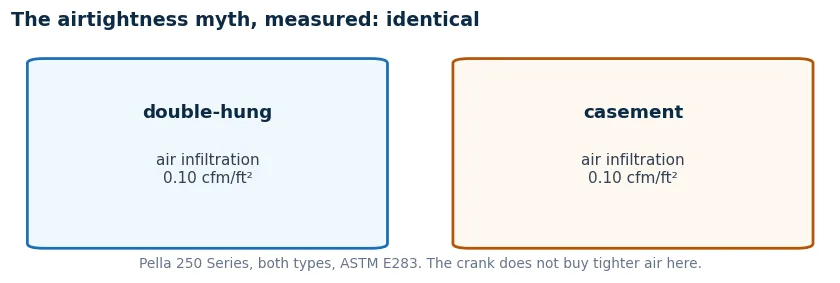
Comparison pages repeat that casements seal tighter because the crank pulls the sash against a compression gasket. The mechanism is real. The question is whether it shows up in the certified numbers, so we read one manufacturer's design manuals for both types of the same series, the Pella 250, where the glass, the vinyl and the test methods are held constant.
Where the casement is actually tougher
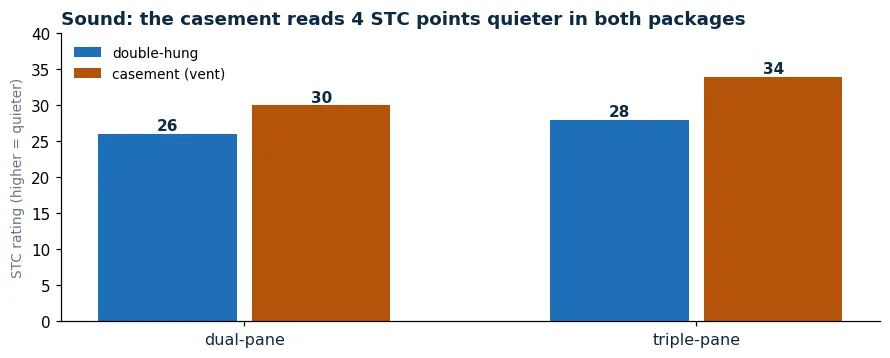
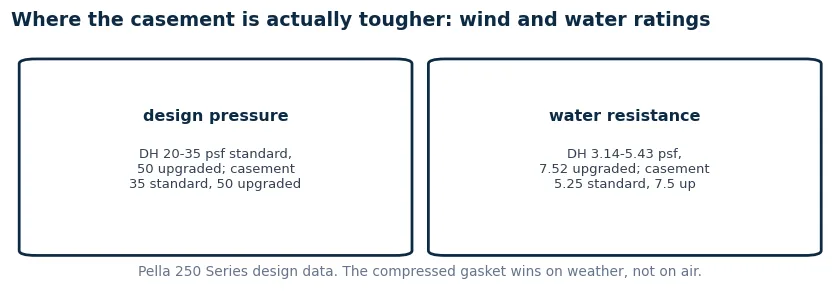
The casement's real wins are weather and sound. Design pressure: 35 psf standard against the double-hung's 20 to 35 band, both upgradable to 50. Water resistance: 5.25 psf standard against 3.14 to 5.43. And on sound the casement reads 30 STC to the double-hung's 26 with dual-pane glass, 34 to 28 with triple-pane: four points, which is an audible difference on a loud street.
The numbers, side by side
| Measure | Double-hung | Casement |
|---|---|---|
| Air infiltration (cfm/ft²) | 0.10 | 0.10 |
| Design pressure, standard | 20–35 psf | 35 psf |
| Design pressure, upgrade | 50 psf | 50 psf |
| Water resistance, standard | 3.14–5.43 psf | 5.25 psf |
| Water resistance, upgrade | 7.52 psf | 7.5 psf |
| STC / OITC, dual-pane | 26 / 22 | 30 / 25 |
| STC / OITC, triple-pane | 28 / 24 | 34 / 28 |
What this means for the choice
If your wall is windy, exposed or loud, the casement's ratings are a real argument. For an ordinary sheltered wall, the measured difference is smaller than the practical differences below, and those are what you will notice daily.
How they open, and what it changes
A double-hung stacks two sashes that slide past each other; each can move, and on modern units each tilts inward. A casement is a single sash hinged at the side, cranked outward like a door. Every practical difference on this page, from screens to cleaning to the AC question, falls out of those two motions.
What slides versus what swings
Sliding needs no clearance outside and never fights a shrub; swinging needs a clear arc outside and a crank's reach inside. Sliding sashes can both move for top-or-bottom airflow; a swinging sash is all-or-nothing but catches a passing breeze and turns it indoors.
Ventilation: half an opening versus all of it
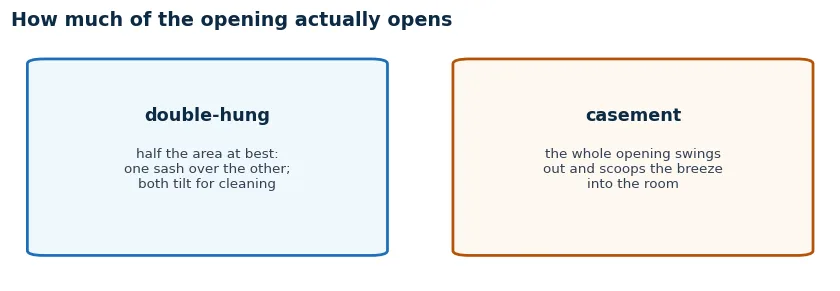
This is the casement's headline win. A double-hung opens at most half its frame area; the other half is always sash. A casement swings the whole glazed area out of the way and angles the sash like a scoop, pulling a sideways breeze into the room. For rooms that live on night air rather than AC, the difference is not subtle.
The double-hung's quieter trick
Open both sashes a few inches and a double-hung vents warm air at the top while pulling cooler air at the bottom: a gentle stack effect with no visible opening gap for rain. Different strength, different weather. Neither is a fan; both beat a fixed pane.
Screens follow the swing
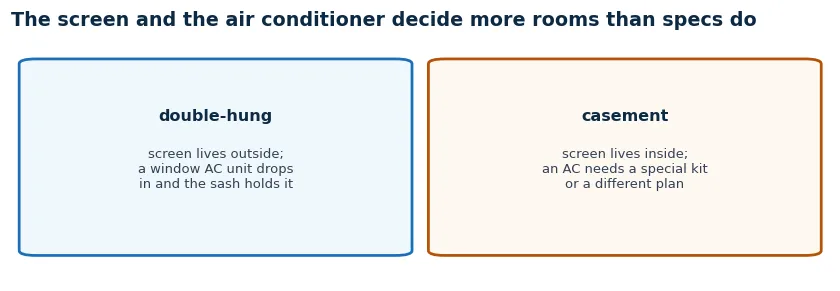
Because the casement swings out, its screen lives inside; because the double-hung slides, its screen lives outside. That one inversion decides who cleans what, and it gets its full treatment in the next section.
Screens, air conditioners and the kitchen sink
Three unglamorous facts decide more real rooms than any rating. They all come from the same source: which way the moving part moves.
Screens move to opposite sides
Double-hung screens live outside, exposed to weather. Casement screens live inside, stay cleaner, and come off without a ladder. Interior retractable screens are the common casement upgrade and one of its quiet quality-of-life wins.
The air conditioner only fits one of them
A window AC unit needs a sash to close onto it. The double-hung provides exactly that; the casement, swinging outward, provides nothing to rest a unit on. Casement AC exists as kits and workarounds, and all of them are compromises.
Over the kitchen sink, the crank wins
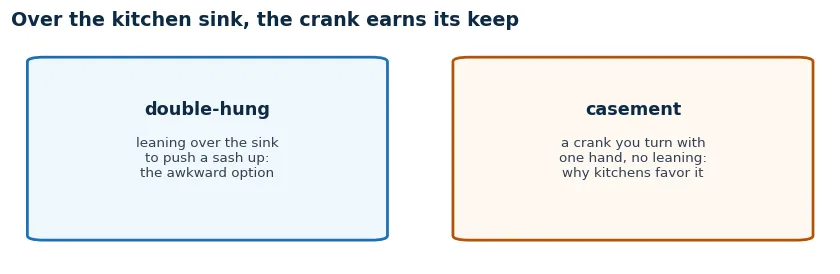
Reaching over a counter to shove a double-hung sash upward is the awkward version of the job. A casement's crank turns with one hand at counter height, which is why kitchen-sink windows are so often casements. One motion, no leaning.
The crank question
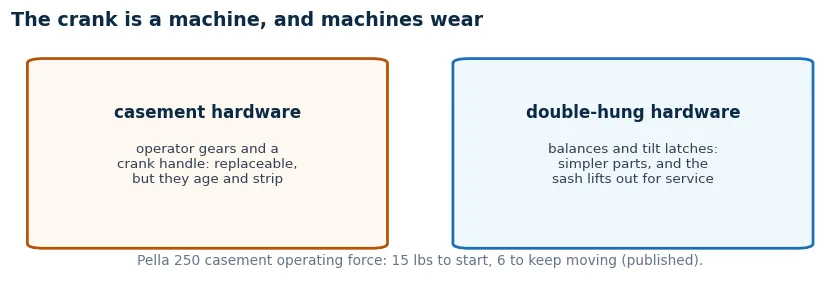
The casement's operator is a small machine: gears, an arm, a handle. It is the part people worry about and the part that does eventually wear. The measured operating force for the casement in our documents is 15 pounds to start the sash and 6 to keep it moving, so a crank that suddenly asks for much more is telling you the operator is tired. Replacement operators are standard parts, and the fix is a screwdriver job.
The double-hung's simpler hardware
Balances and tilt latches do the double-hung's work, and both are simpler and cheaper than an operator gearset. When a balance fails the sash drops or drifts; the sash tilts or lifts out, the part snaps in. Neither type is a maintenance burden; they just fail in different, equally fixable places. The signals worth acting on, for any window type, are mapped on the when to replace page.
Cleaning: who reaches the outside glass
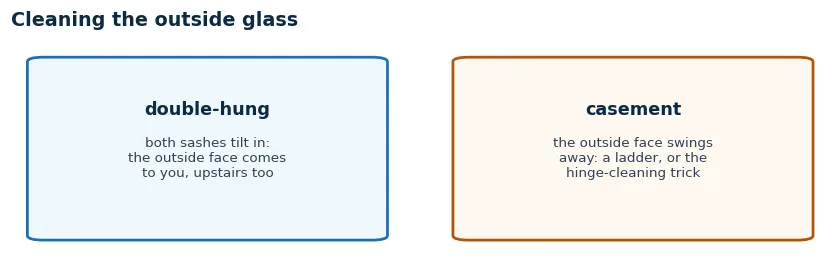
Modern double-hung sashes tilt inward, both of them, so the exterior face of the glass comes into the room. A casement's outer face swings away from you: ground floor means a hip-level reach around the open sash; upper floors mean a ladder or a hired squeegee. If washing your own upstairs windows is the plan, the double-hung is built for it.
Egress and the escape opening
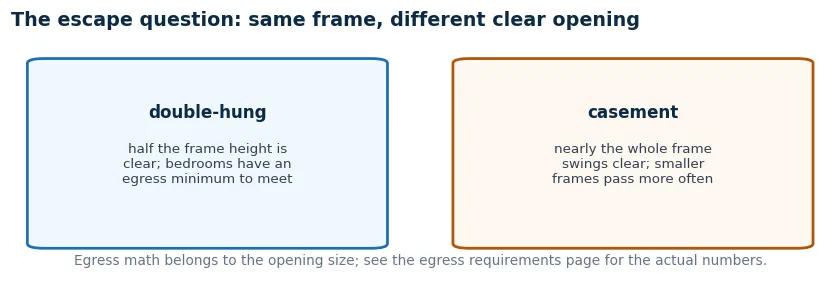
Bedrooms owe you an escape opening, and the code measures the clear openable area, not the frame. A double-hung gives up half its frame height to the stacked sashes; a casement swings nearly the whole frame clear. The result: at the same rough opening, the casement passes egress more often. The code numbers and the measuring method are on the egress requirements page.
Cost: the modest, stable gap
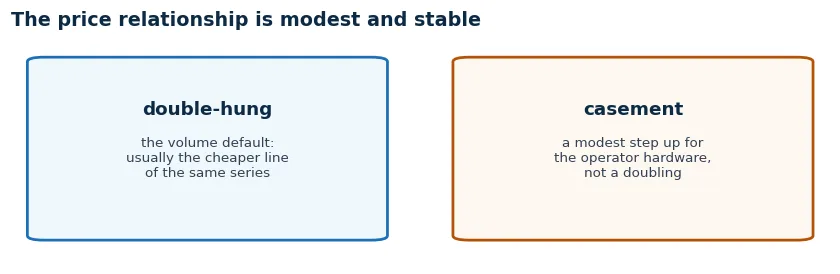
Within one series, the casement typically prices a modest step above the double-hung: you are buying the operator hardware. The gap between types is usually smaller than the gap between series or between glass packages, so the expensive decision is rarely the type. For the project-level arithmetic, measured hours and all, see the installation cost page; the frame-material side of the same question is on the vinyl vs wood page.
Which one where: room by room
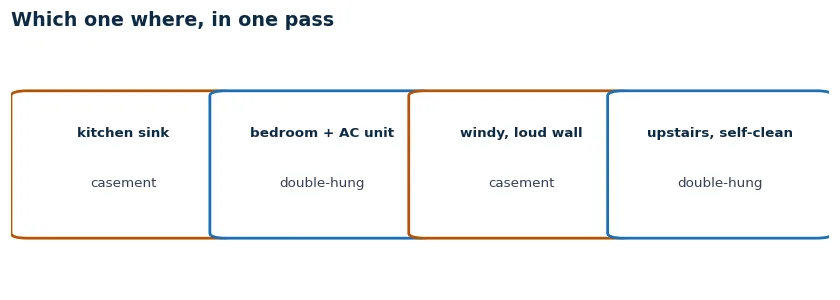
The honest answer to the Reddit question is per-room, not per-house. Kitchens over sinks: casement, for the crank. Bedrooms with a window AC: double-hung, for the sash. Loud or windy walls: casement, for the measured ratings. Upper floors you will clean yourself: double-hung, for the tilt. Breeze-cooled rooms: casement, for the full swing. Most houses end up mixed, and mixing is normal practice, not indecision.
If you are replacing only some
Types can be phased room by room without apology; what should stay consistent is the frame line and the glass package, so the house reads as one project. If a drafty room is what started this, diagnose it before choosing a type: the drafty windows page walks the sequence.
What we read, and how
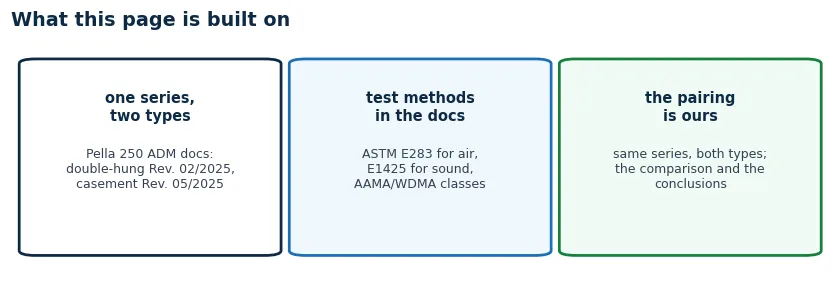
On 15 October 2026 we read the manufacturer's own architectural design manuals for the Pella 250 Series in both types: the double-hung document (Rev. 02/07/2025) and the casement document (Rev. 05/01/2025), extracting the published performance tables: air infiltration per ASTM E283, sound ratings per ASTM E1425, design pressure and water resistance per AAMA/WDMA classes. The same-series pairing, and the conclusions drawn from it, are ours.
The limits of this audit
One manufacturer and one series, on purpose: it is the only way to hold the glass and the frame constant. Other brands post different absolute numbers, and some do show tighter air for casements. Ratings are for tested standard sizes; your size shifts them. The label on your quoted unit is the version that governs.
The questions people actually ask
Which is better, double-hung or casement windows?
Better at different things, and the measured specs say less than you would expect: at one major manufacturer's same series, both types post the identical air-infiltration rating. Casement wins on ventilation (the whole opening opens), on sound (4 STC points quieter in both glass packages) and on weather ratings. Double-hung wins on window air conditioners, exterior screens, tilt-in cleaning and simpler hardware. The room usually picks the winner, not the spec sheet.
Are casement windows more energy efficient than double-hung?
The airtightness argument says casements seal tighter because the sash compresses a gasket, and in some brands that shows up in the numbers. In the manufacturer documents we read, both types posted the same 0.10 cfm per square foot air infiltration rating. Efficiency comes from the glass package, which both types share. Choose the type for how you live; choose the glass for the bills.
Are casement windows more expensive than double-hung?
Usually a modest step up, not a doubling: the casement carries the operator hardware (crank, gears, hinges) that a double-hung does not. Within one series the difference is typically smaller than the jump between series or glass packages. Your quote names the real gap; the type is rarely the expensive line item.
Can you put a window air conditioner in a casement window?
Not the standard box unit: a casement swings outward, leaving no shelf and no sash to hold one. There are special kits and through-wall plans, but if a window AC is part of your summers, that room wants a double-hung. This single practical fact settles more casement-versus-double-hung debates than any performance number.
Which is easier to clean, casement or double-hung?
Double-hung, and it is not close. Both sashes tilt inward, so the exterior glass comes to you, even upstairs. A casement's outer face swings away from the room: ground floors get a hip-level reach around the sash, upper floors get a ladder. If self-cleaning from inside matters, the double-hung is the machine for it.
Do casement windows have screens?
Yes, on the inside, because the sash swings outward. That inverts the usual routine: the screen comes off from inside, lives inside, and stays cleaner. Retractable interior screens are the common upgrade. Double-hung screens live outside, where weather reaches them.
Are casement windows good for egress bedrooms?
Often better than double-hung at the same frame size, because nearly the whole frame swings clear instead of half. Egress law measures the clear opening, not the frame, so a smaller casement can pass where a same-size double-hung cannot. The actual numbers and the code text are on our egress requirements page.
Do casement cranks break?
The operator is a small machine: gears, an arm, a handle. It wears and can strip, and replacements are standard parts. The published operating force for the casement we measured is 15 pounds to start and 6 to keep moving, so a crank that suddenly needs much more than that is telling you something. Double-hung hardware (balances, latches) is simpler and the sash lifts out for service.
Sources
- Pella 250 Series casement: Architectural Design Manual (Rev. 05/2025) · air infiltration, design pressure, water, STC/OITC, operating force.
- Pella 250 Series double-hung: Architectural Design Manual (Rev. 02/2025) · the same tables for the other type.
- ENERGY STAR: windows, doors and skylights · the certification both types share when the glass is right.
- NFRC: the National Fenestration Rating Council · the label behind every whole-unit number cited here.
- US DOE FEMP: purchasing energy-efficient residential windows · the federal purchasing view of the same numbers.
- Wikipedia: casement window · the mechanism and its history.
- EPA: Lead Renovation, Repair and Painting program · pre-1978 houses add the lead-safe layer to any window work.
- USA.gov: repairing your home · the federal doorway for doing this work safely.
Ratings are the manufacturer's published values for tested sizes; the label on your quoted unit governs. ClearView is an independent guide, not a seller or installer; see the disclaimer.
The frame material question, next door
Type settled, the next choice is what the frame is made of. That one we also settled with certified specs: vinyl vs wood windows, where the same reading method reaches a surprising tie.