Window replacement in Dallas in 2026: the local answer
By the ClearView editorial team · Sources read on 2026-10-15
Read time about 9 minutes
The short answer
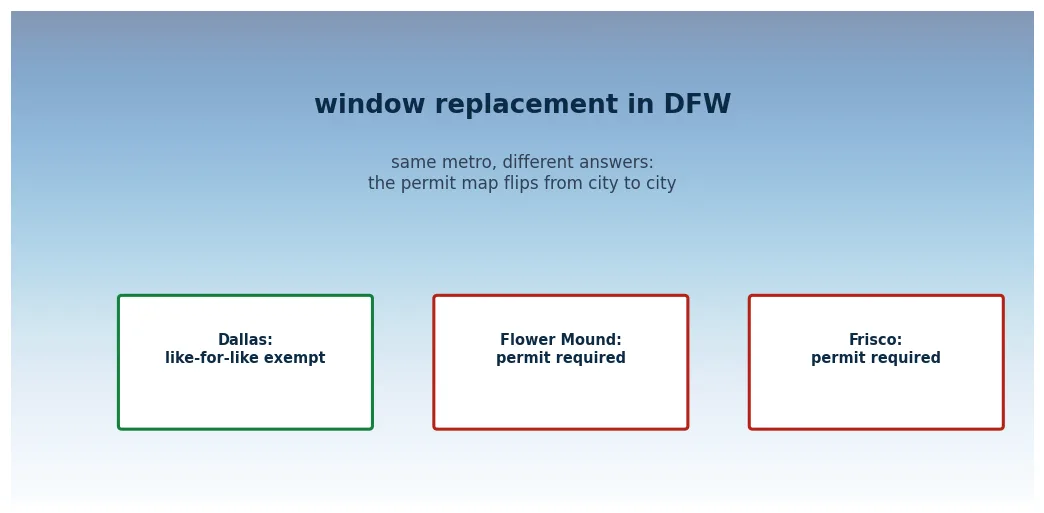
Replacing windows in Dallas-Fort Worth is mostly the national job plus two local layers: permits, which flip their answer from city to city inside the same metro, and glass, which carries a fixed federal bar for Texas heat. We read the cities' own pages: Dallas exempts a like-for-like swap, Flower Mound and Frisco require a permit for the same work. Below: the permit map, the glass that fits the climate, what shapes the quote, and the four checks that separate a solid DFW company from a brochure.
On this page (10 sections)
The permit map of DFW, read from the cities
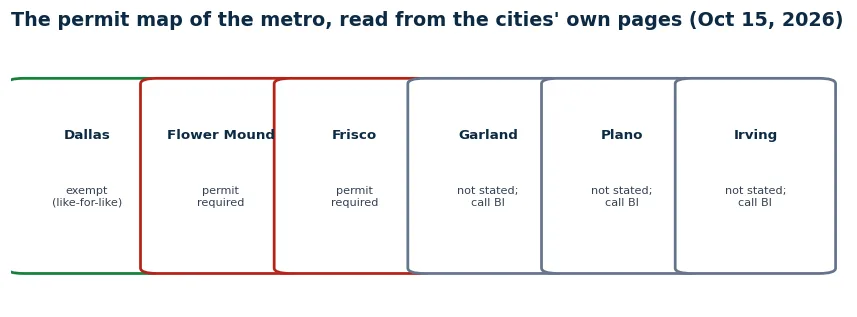
Texas has no statewide building code for this and no state general contractor license, so the permit question is answered city by city. We read the cities' own pages on 15 October 2026 and marked each by how solid the answer is. The pattern is the finding: identical work, opposite answers, one metro apart.
| City | Like-for-like window swap | Source level |
|---|---|---|
| Dallas | no permit (historic and conservation districts excepted) | city FAQ, quoted verbatim |
| Flower Mound | permit required; current energy code applies | town guidelines, quoted verbatim |
| Frisco | permit required | from the city's published permit lists, as cited |
| Garland | not stated publicly; call Building Inspection | city pages silent on the work |
| Plano | not stated publicly; call Building Inspection | city pages silent on the work |
| Irving | not stated publicly; call Building Inspection | city pages silent on the work |
Dallas: exempt, with a district exception
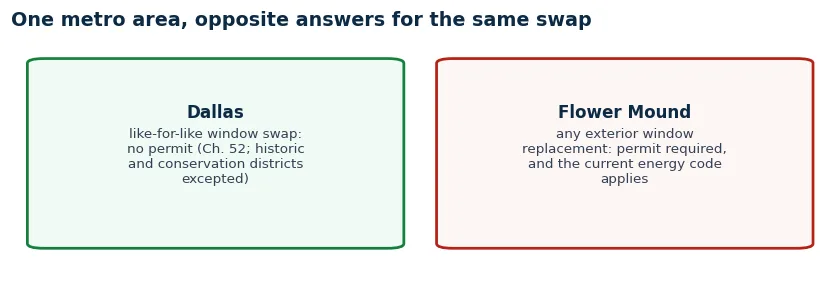
The city's own building inspection FAQ exempts nonstructural work that does not change the opening: a same-size, like-for-like swap needs no permit. Two exceptions flip it: changing the opening (a bigger window, a new one) and any address inside a historic, conservation or planned development district, where a design layer applies on top.
Flower Mound and Frisco: permit required
Flower Mound's residential permit guidelines say it in one sentence: the replacement of exterior doors and windows requires a permit, and the new units must meet the town's currently adopted energy code. Frisco's published permit lists include replacing windows and doors. Same swap, opposite paperwork. A permit pulls the energy code into your project, which connects straight to the glass section below.
Garland, Plano, Irving: not stated publicly
Three of the six cities we checked do not name window replacement on their public permit pages. That is not a yes and not a no; it is a phone call to the city's Building Inspection before you sign. We print this rather than guess, because the two cities that do answer disagree with each other.
Historic and conservation districts change the answer
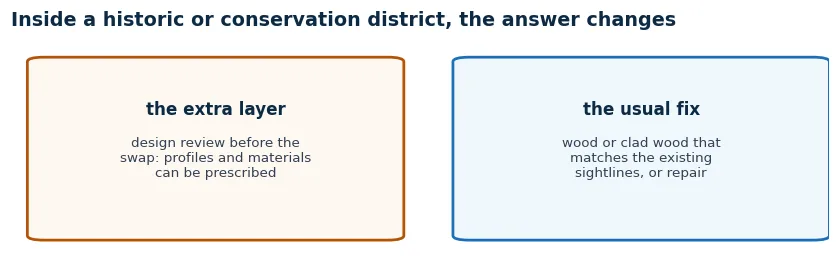
Dallas has them across the older grid, and inside one the free like-for-like answer picks up a design-review layer: profiles and materials can be prescribed to match the street. The usual compliant fix is wood or clad wood matching the existing sightlines, or honest repair of what is there. If your address is in one, that conversation comes before the quote, not after it.
The glass that fits Texas heat
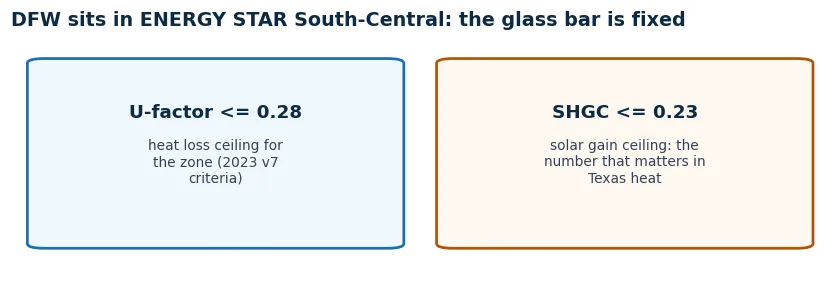
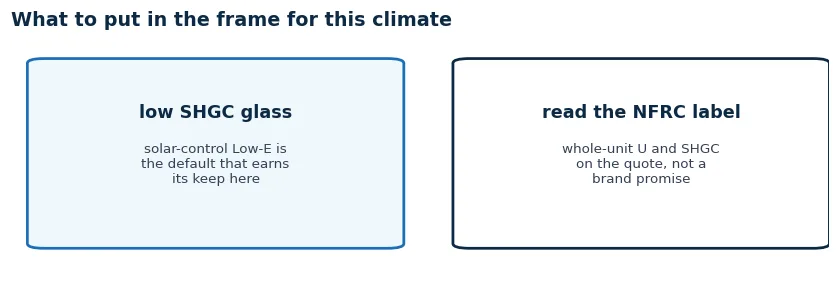
DFW sits in ENERGY STAR's South-Central zone, and the 2023 Version 7 criteria set two caps for windows there: U-factor at or under 0.28, and SHGC at or under 0.23. The first is the insulation number; the second is how much of the August sun gets through, and in this climate it is the one that pays. A solar-control Low-E package is the default that earns its keep here, not an upgrade.
Read the label, not the brochure
Every rated window carries an NFRC label with whole-unit U-factor and SHGC. Brand names for glass packages vary; the label does not. If the quote cannot name the two numbers, the glass is whatever is cheapest that week. We measured how little the frame material moves these numbers on the vinyl vs wood page; the glass package is where the energy money lives.
Hail: the quiet design input
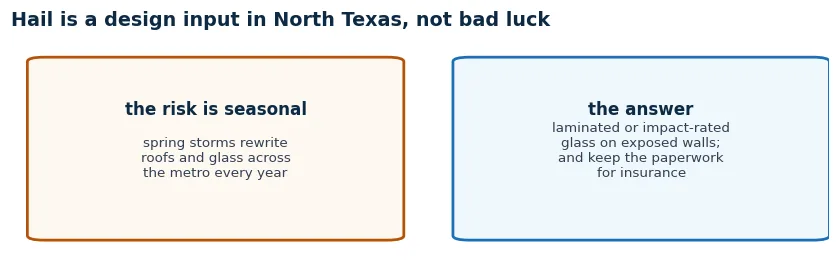
North Texas is hail country, and spring rewrites roofs and glass across the metro every year. Windows are not required to be impact-rated here the way coastal wind zones demand, so the choice is yours and it is worth making on purpose: laminated or impact-rated glass on the most exposed walls, priced as a visible line item, with the paperwork kept for insurance. If you are reading this after a storm, the claim side has its own page: the insurance guide.
Which walls earn the upgrade
The exposed ones: west and south walls without shade, upper-story glass facing open sky, and anything over a room where breakage would hurt. A whole-house impact package is rarely the honest buy; a per-wall decision is cheaper and does the same work where it counts.
What it costs in Dallas
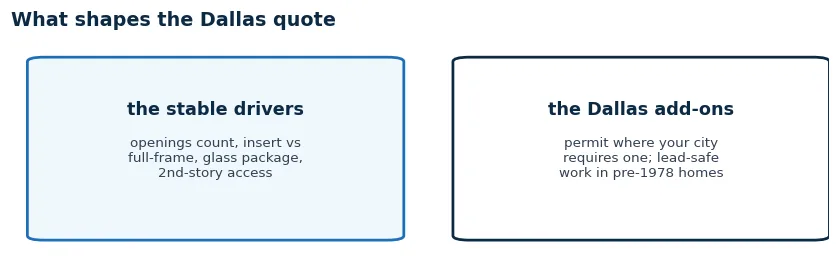
The price drivers are the same ones that drive every US window project: the number of openings, insert versus full-frame, the glass package, and access (a second story costs more than a first). Dallas adds two local lines: a permit where your city requires one, and lead-safe work practices in pre-1978 houses, which are common across the older grid. The measured per-window arithmetic is on the installation cost page; your written, itemized quote is the number that governs.
Why quotes in this metro disagree
Because they are often pricing different things: one includes the permit and the haul-away, another excludes both; one names the glass package, another says «energy efficient». Reading quotes line by line against each other is the only honest comparison, and it is free.
The lead-paint layer in older Dallas
Houses built before 1978 add a federal layer to any opening work: lead-safe practices under EPA's renovation rule, which certified crews build into the day rather than charge around. It shows up as containment and cleanup time, not as a mystery fee.
How to choose a company in DFW
We do not rank companies. What survives contact with reality in this metro is a four-check filter, and any company passing it is worth its bid.
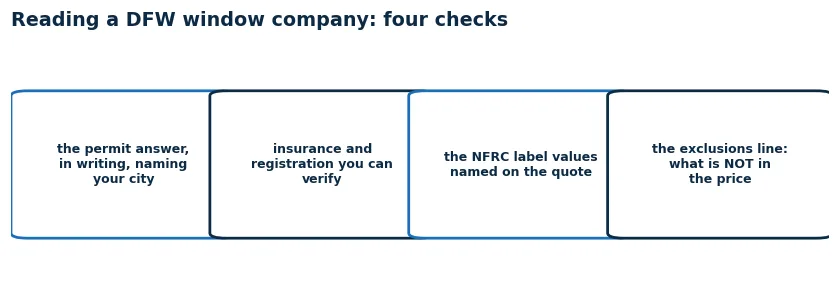
The permit answer, in writing
Ask each bidder: does this project need a permit in my city, and who pulls it? The map above is why the question works: a company that answers confidently without knowing your address is guessing, and a company that writes the answer into the quote owns it.
Insurance, registration, and the label
Texas does not license general contractors at the state level, so the burden shifts: liability insurance you can verify, any city registration your jurisdiction runs, and the NFRC values of the quoted unit printed on paper. None of these is exotic; all four together filter hard.
Across the metro: the northern suburbs
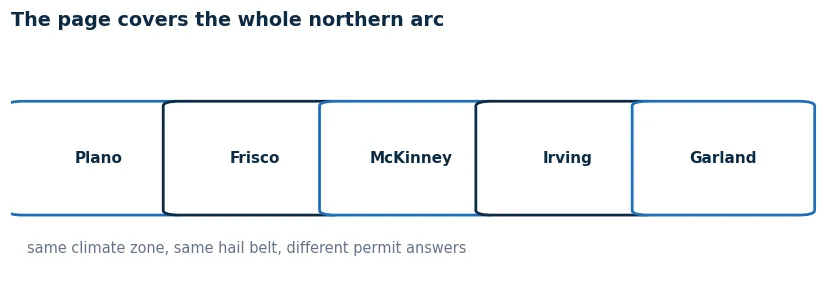
This page covers the whole northern arc of the metroplex: Plano, Frisco, McKinney, Irving, Garland. The climate guidance is identical across them; the permit answers are not, which is the whole reason the map exists. If your address is inside one of these cities, the permit row for your city is the one that applies to you, not Dallas's.
The HOA layer
Newer suburbs add a second approval layer: many homeowners associations review exterior changes, windows included, before the city sees anything. Read your deed restrictions before ordering; the HOA answer and the permit answer are independent of each other.
Repair or replace first
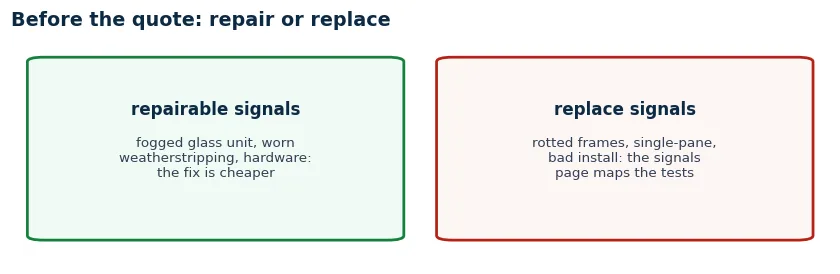
Before any quote: some of what sends people shopping is repairable. A fogged glass unit swaps out for a fraction of a window; worn weatherstripping is an afternoon; a dead balance is a part, not a project. Rotten frames, single-pane glass and crooked installations are the real replacement signals. The full map, with a five-minute test for each signal, is on the when to replace windows page. If a draft is what started this, the diagnosis sequence is on the drafty windows page.
When to schedule
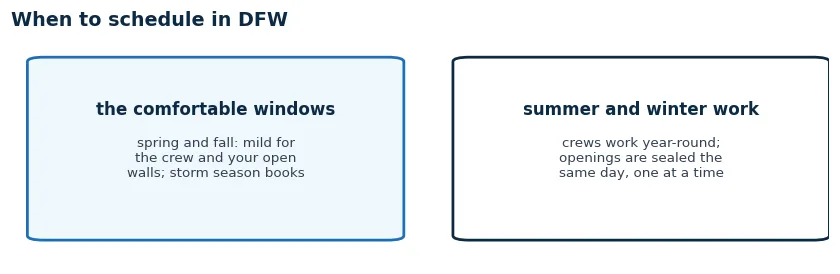
Spring and fall are the mild windows: comfortable for the crew and for your temporarily open walls, and the first to book out after hail season. Summer and winter projects are normal practice, not a risk: crews open one hole at a time and seal it the same day. What the install day actually contains, hour by hour, is on the replacement process page.
Storm-season booking
After a big hail event, every good crew in the metro is suddenly busy and lead times stretch. If your project is elective, booking before storm season is the calm version of the calendar; if the storm found you first, insurance timelines have their own logic and your policy sets the tempo.
What we read, and how
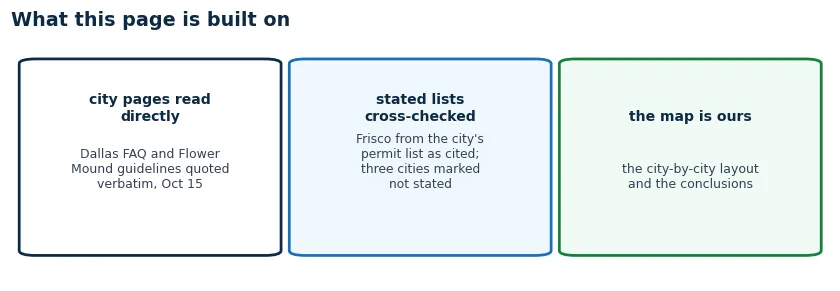
On 15 October 2026 we read the cities' own pages: Dallas's building inspection FAQ (the like-for-like exemption, with the district exceptions) and Flower Mound's residential permit guidelines (the permit requirement and the energy-code sentence) are quoted verbatim; Frisco is stated from its published permit lists as cited; Garland, Plano and Irving are marked «not stated publicly» because their pages do not name the work, and we print that rather than guess. The climate caps come from ENERGY STAR's 2023 Version 7 criteria for the South-Central zone. The metro layout and the conclusions are ours.
The limits of this map
City rules change, and this is a snapshot of one day in October 2026. Every address deserves one phone call to its own Building Inspection department, and every address inside a historic, conservation or planned district deserves two. We are an independent guide, not a contractor, and we do not sell leads.
The questions people actually ask
Do you need a permit to replace windows in Dallas?
Inside Dallas, a like-for-like swap that does not change the opening is exempt under the city's own building inspection FAQ (Chapter 52 logic), except in historic, conservation and planned development districts, where the answer changes. Change the opening size, and you need a permit anywhere. And the metro flips by city: Flower Mound and Frisco require a permit for the same swap, with the current energy code applying. Ask your city in writing, or make the contractor's written permit answer part of the quote.
How much does window replacement cost in Dallas?
The drivers are stable: how many openings, insert versus full-frame, the glass package, and second-story access. Dallas adds two local lines: a permit where your city requires one, and lead-safe work in pre-1978 houses. For the measured arithmetic (per-window labor hours, lead times, whole-house math), see our installation cost page; your written, itemized quote is the only number that governs your house.
What windows are best for Texas heat?
Dallas sits in ENERGY STAR's South-Central zone, where the 2023 criteria cap windows at U-factor 0.28 and SHGC 0.23. The second number is the Texas one: a low solar heat gain coefficient is what keeps a west-facing room livable in August. Ask for the NFRC whole-unit values of the exact quoted unit, on paper, and check both numbers against those caps.
Who are the best window replacement companies in Dallas?
We do not rank companies; we are an independent guide, not a marketplace. What we can give you is the filter that separates them in this metro: a written permit answer that names your city, verifiable insurance and registration, NFRC label values printed on the quote, and an exclusions line that says what the price does not cover. Any company that survives those four checks is worth its bid; the rest are marketing.
Should I repair or replace my windows?
Run the tests before the quotes. Fogged glass, tired weatherstripping and tired hardware are repairable at stated prices well under replacement; rotted frames, single-pane glass and crooked installations are not. The full signal-by-signal map, with five-minute tests for each, is on our when to replace windows page.
When is the best time to replace windows in Texas?
Spring and fall are the comfortable windows for you and the crew, and they book out first in storm season. Work runs year-round: each opening is open for a short planned interval and sealed the same day, so a January project is normal practice, not a risk.
Do I need impact-resistant windows in Dallas?
Not by code for most of DFW, but hail is a design input in North Texas, not bad luck. Laminated or impact-rated glass on the most exposed walls is the practical answer many owners choose, and the paperwork from a rated install is useful at insurance time. Ask for it as a line item so you can see what it costs.
What about homes in Plano, Frisco, Irving or Garland?
Same climate zone, same hail belt, different permit answers: the map on this page is the point. Dallas exempts a like-for-like swap; Flower Mound and Frisco require a permit; Garland, Plano and Irving do not state it on their public pages, which means one phone call to the city's Building Inspection before you sign anything. The glass guidance is identical across the metro.
Other metro guides
Sources
- City of Dallas: Building Inspection FAQ · the like-for-like exemption and the district exceptions, quoted verbatim.
- Town of Flower Mound: Residential Permit Guidelines · the window replacement permit requirement, quoted verbatim.
- ENERGY STAR: windows, doors and skylights · the 2023 v7 South-Central zone criteria.
- NFRC: the National Fenestration Rating Council · the label behind the whole-unit numbers to demand on a quote.
- US DOE FEMP: purchasing energy-efficient residential windows · the federal purchasing view of the same numbers.
- EPA: Lead Renovation, Repair and Painting program · the lead-safe layer for Dallas houses built before 1978.
- USA.gov: repairing your home · the federal doorway for doing this work safely.
City rules change; your city's Building Inspection answer governs your address. ClearView is an independent guide, not a contractor or marketplace; we do not sell leads. See the disclaimer.
The project behind the paperwork
Once the permit answer is settled, the project itself has a shape: measured hours per opening and weeks of lead time. Both are on the replacement process page, with the numbers printed.