Drafty windows: find the hole before you buy a window
By the ClearView editorial team · Sources read on 2026-10-15
Read time about 9 minutes
The short answer
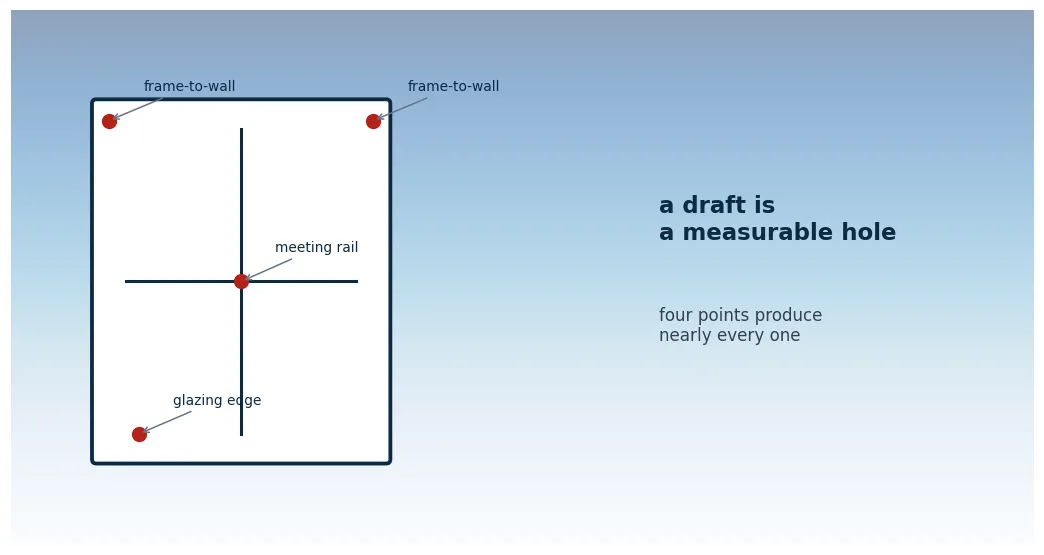
A draft is a hole of measurable size, not a worn-out window. Almost every draft comes from a handful of findable points: the weatherstripping at the sash, the caulk where the frame meets the wall, the lock that no longer pulls tight, the glazing around the glass. Sealing those is the Department of Energy's cheapest energy win, worth 10 to 20% of heating and cooling across a home. Replace the window only when the frame is done. The math and the diagnosis sequence below, with the numbers computed rather than quoted.
On this page (10 sections)
A draft is a measurable hole
The window industry measures airtightness as air leakage, AL, in cubic feet per minute per square foot of window, tested at a fixed pressure difference. New windows must come in at or under 0.3 cfm per square foot to meet code and ENERGY STAR; tight casements run under 0.10 because their sash compresses a seal on all four sides. Your house is not a lab, but the unit is the point: a drafty window is leaking a measurable amount of air through specific points, and each point has a specific fix.
The four points that leak
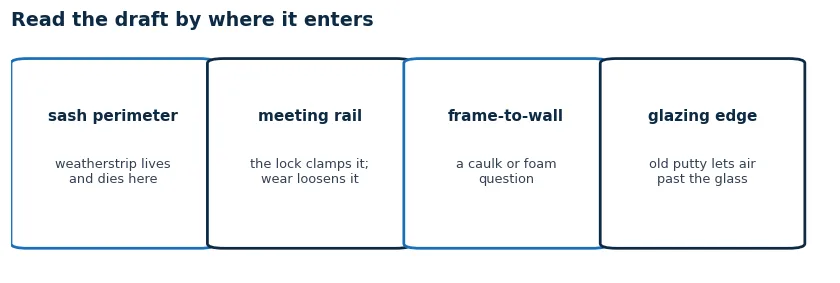
The sash perimeter, where weatherstripping lives and dies. The meeting rail on a double-hung, where the lock is supposed to pull the two sashes together and wear stops it. The frame-to-wall line, a caulk or foam question. And the glazing edge, where old putty lets air past the glass itself. Everything else people blame, the wall, the insulation, the house settling, is rarer than these four.
Why it feels worse than it is
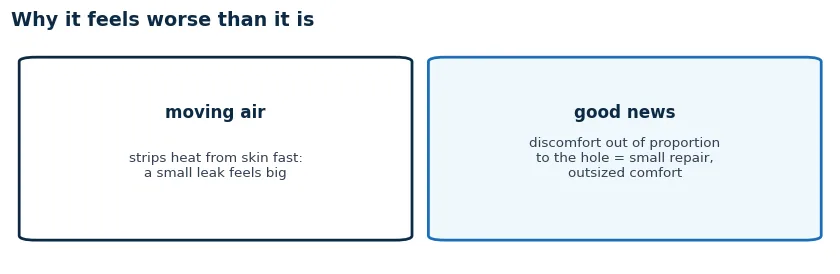
Moving air strips heat from skin fast, so a small leak feels like a big one. That is good news in disguise: the discomfort is out of proportion to the hole, which means a small repair has an outsized effect on comfort. The draft you feel at the couch is usually a gap measured in millimeters.
Find where it actually leaks
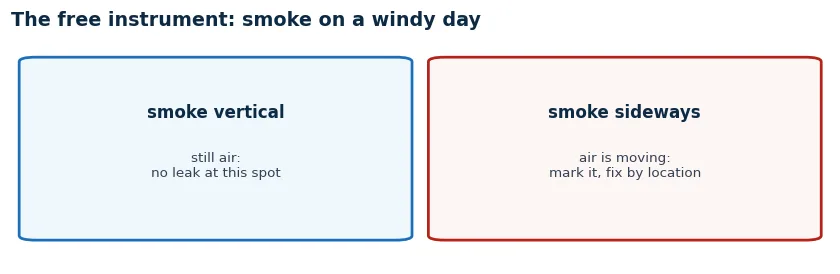
Diagnose before buying. The Department of Energy's method is free: on a windy day, move a lit incense stick or smoke pen slowly along the sash lines, the meeting rail, the frame perimeter and the glazing edge. Where the smoke stream lies sideways, cold air is coming through the window at that exact spot. Write down each point; drafty window solutions are chosen from that map, not from a product shelf.
The dollar-bill check
Close the window on a bill and pull. If it slides free, the weatherstrip seal is gone at that spot; if it grips, the seal still works there. Run it around the sash: the result is a map of exactly which stretch of weatherstripping is dead.
What is not a leak
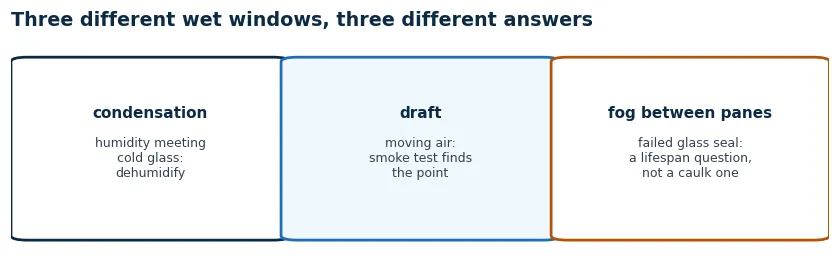
Interior condensation is humidity meeting cold glass, a different problem with a different fix (dehumidify, or warm the glass with better shades). Fog between the panes is a failed seal on the glass unit, which no caulk touches; that one is a lifespan question, answered on the window lifespan page. The smoke test separates all three in one windy afternoon.
The draft math, worked honestly
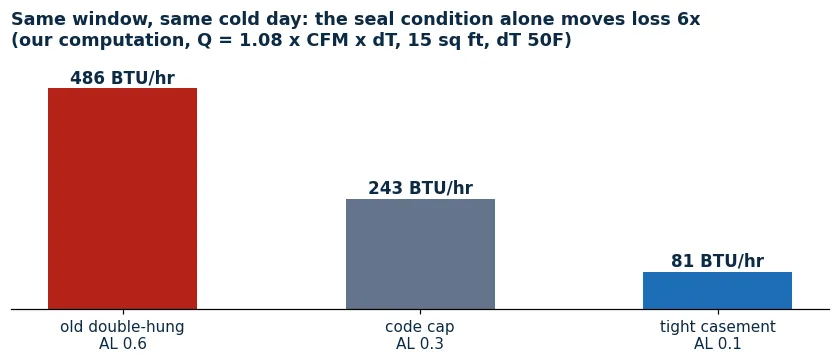
Infiltration heat loss follows a standard formula: Q equals 1.08 times the airflow in cubic feet per minute times the temperature difference in degrees Fahrenheit, in BTU per hour. We applied it to the rating anchors: an old double-hung leaking at 0.6 cfm per square foot, the code maximum of 0.3, and a tight casement at 0.1, on a 15-square-foot window at a 50-degree difference. The spread is the whole argument for fixing the leak instead of the window.
| Window state | AL (cfm/sq ft) | Airflow | Heat loss |
|---|---|---|---|
| Old double-hung, worn seals | 0.6 | 9.0 cfm | 486 BTU/hr |
| New window at the code cap | 0.3 | 4.5 cfm | 243 BTU/hr |
| Tight casement | 0.1 | 1.5 cfm | 81 BTU/hr |
The honest caveat
The ratings are measured at a pressure difference matching a serious wind, so a calm Tuesday leaks less than the table. We print the rated-condition numbers because they are the ones that compare windows fairly, and the formula scales linearly if your day is milder. The dollar frame below translates the physics into a bill without pretending your weather is a wind tunnel.
Why the repair answer is usually right
Read the table as a repair case: weatherstripping and a working lock take a worn double-hung most of the way from 0.6 toward the code line, at materials cost measured in tens of dollars. Replacement buys the last stretch, from the code line to 0.1, at thousands. Both directions are legitimate; they are just priced very differently per unit of draft.
Fix the cheap leaks first
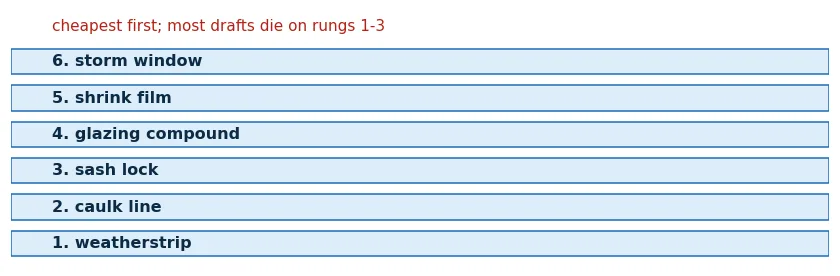
The DOE guide is blunt about the order: caulking and weatherstripping are the air-sealing measures that often pay back within a year, and all of it is DIY-friendly work. Work the map from the smoke test, inside out: moving joints get weatherstrip, stationary gaps get caulk, the sash lock gets tightened or replaced, and failed glazing putty gets redone where the smoke showed movement at the glass. A draft coming through a window you have already mapped is a Saturday job, not a contractor.
Weatherstrip the moving parts
V-strip, foam tape and bulb seals each fit different joints; the window type picks which. Double-hungs take V-strip in the channels and a bulb at the rail; casements take a perimeter bulb. The DOE's air-sealing guide lists which material suits which joint, and the packing shelf at any hardware store follows the same logic.
Caulk the stationary ones
The frame-to-wall line and the trim joints are stationary: caulk is the answer there, and low-expansion foam behind the trim where a bigger gap hides. Do not caulk anything that moves or drains: weep holes at the sill exist to let water out, and sealing them converts a draft into a leak of the worse kind.
The lock is a seal part
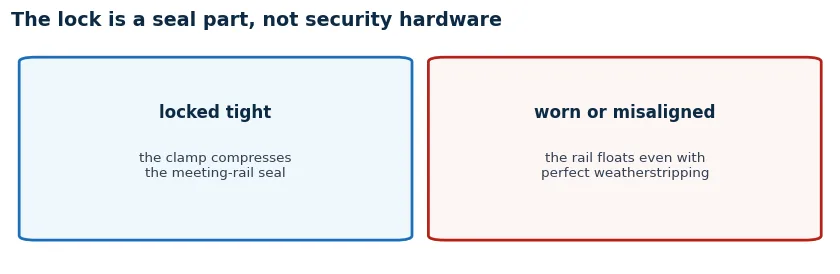
A double-hung lock is not security hardware; it is the clamp that compresses the meeting-rail seal. A worn or misaligned lock leaves the rail loose even with perfect weatherstripping. Replacing or resetting it costs almost nothing and is the most skipped line on the list.
Storm windows and films
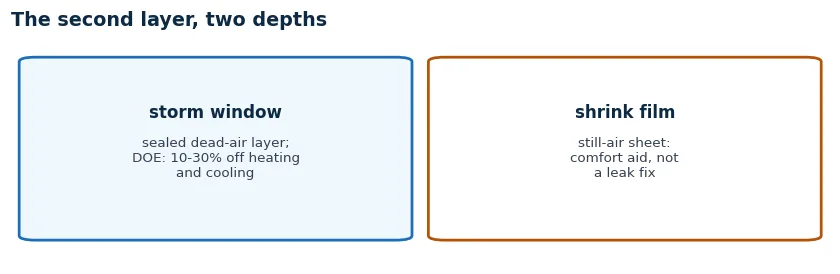
Between sealing and replacing sits the second layer. The DOE guide puts low-emissivity storm windows at 10 to 30% savings on heating and cooling depending on the window they cover, because a storm adds a sealed dead-air layer over the leaky original. Interior shrink film is the cheap version of the same idea: a still-air sheet over the glass that calms radiant chill and minor seepage, useless against a real sash leak.
When the storm wins
On a sound old single-pane window, a quality low-E storm approaches the thermal performance of a replacement at a fraction of the price and none of the landfill. It is the answer landlords and old-house owners keep rediscovering, and the DOE savings figure is the reason it keeps being right.
When it is the window, not the leak
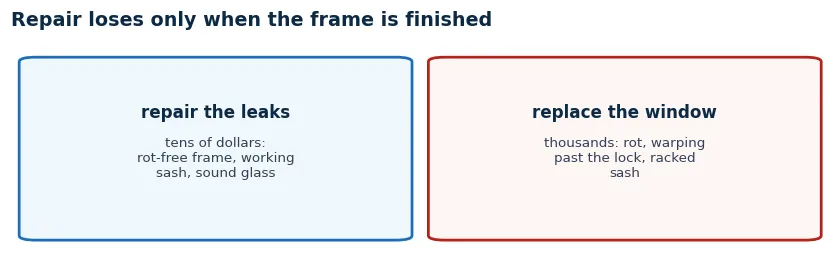
Repair loses when the frame is finished: rot in wood, vinyl warped past what any lock can pull square, or a sash so racked the seal cannot meet. The measured lifespans by material, and the field data on what fails first, are on the window lifespan page. If replacement is the verdict, the cost framework is the installation cost page, and the first thing to read on a quote is the air-leakage line.
The AL line on the label
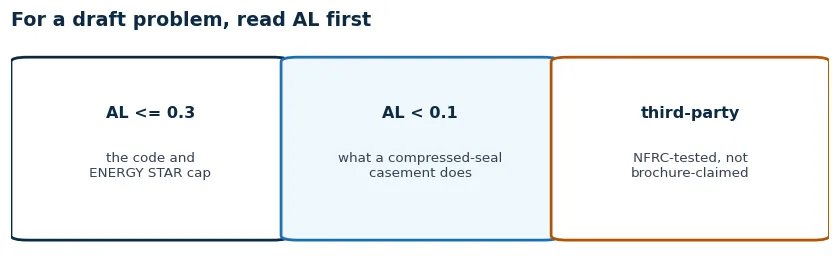
The NFRC label carries five ratings, and the one that answers a draft is air leakage. At or under 0.3 is the legal and ENERGY STAR ceiling; under 0.1 is what a compressed-seal casement does. If your house leaks, the AL number is the difference you are buying, and it is third-party tested rather than brochure-claimed, which is what makes it worth reading.
What it is worth in dollars
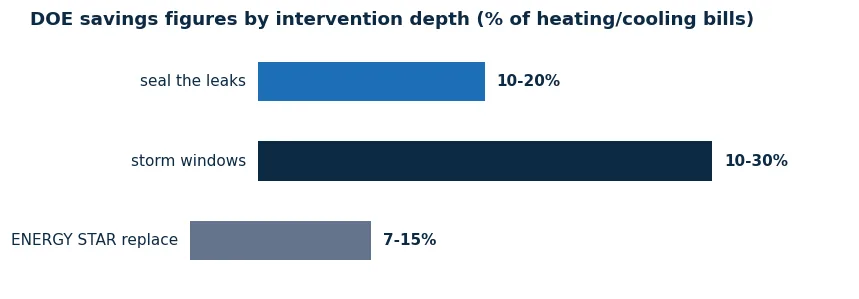
The Department of Energy's honest bounds: sealing uncontrolled leaks saves 10 to 20% on heating and cooling across a home; storms add 10 to 30% on the windows they cover; full replacement with ENERGY STAR units saves 7 to 15% on the household energy bill, quoted as $71 to $501 a year depending on climate and what is being replaced. Note the shape of those figures: the cheapest intervention and the dearest one overlap at the edges, which is why the diagnosis comes before the wallet.
Reading the overlap honestly
These percentages describe different baselines, so they do not add. What they say together: a house with real drafts gets a large share of the benefit from the cheapest work. Spend the tens before the thousands, measure comfort after, and let what remains justify what comes next.
What we computed, and how
The physics table on this page is our computation, run 15 October 2026: the standard infiltration formula applied to published rating anchors, with the window size and temperature difference printed next to it so you can rerun it for your own room. The rating anchors come from the code and certification documents; the savings percentages come from the Department of Energy's own guides, linked below, each with its scope intact.

The limits of this computation
Rated-condition airflow overstates a calm day, and real houses leak at the wall and the attic as much as at windows. The table compares windows honestly under one test condition; the DOE percentages carry your actual bill. Neither tells you where your house leaks, which is why the smoke test is section two and not a footnote.
The questions people actually ask
Why are my windows drafty?
Almost never because the window is worn out as a whole. Drafts come from specific points: compressed or cracked weatherstripping at the sash, gaps in the caulk line where the frame meets the wall, a lock that no longer pulls the sash tight, or glazing compound that has failed around the glass. Each is a small, findable, fixable opening. The window as a unit is usually fine.
How do I find where the draft comes in?
On a windy day, hold a lit incense stick or a smoke pen along the sash lines, the frame perimeter and the meeting rail: smoke that lies sideways marks the leak. The Department of Energy's Energy Saver Guide describes exactly this method. A damp hand works too, slower. Note each spot before buying anything, because the fix is chosen by location, not by product.
What is the cheapest fix that actually works?
Weatherstripping the moving joints and caulk on the stationary ones. The Department of Energy's guide calls caulking and weatherstripping the air-sealing measures that often pay for themselves in under a year, and sealing uncontrolled leaks saves 10 to 20% on heating and cooling bills across a home. Start there before any film, shade or replacement conversation.
Do window films and draft stoppers work?
They help at the margin, in the right place. Shrink film adds a still-air layer over the glass, which helps with radiant cold and a little with leaks. A draft stopper blocks one sill line. Neither seals a failed sash joint. Treat them as comfort aids after the leaks are sealed, not as the fix.
Do storm windows help with drafts?
Yes, measurably: the Department of Energy puts low-emissivity storm windows at 10 to 30% savings on heating and cooling, depending on the window already in place, precisely because they add a sealed second layer over the leaky one. On an old single-pane opening, a good storm is often the value answer short of replacement.
When should I replace instead of repair?
When the frame itself is done: rot, warping that no lock can pull tight, or a sash so racked it cannot seal. The measured lifespans by material are on our window lifespan page. If the window is structurally sound, the leak points are almost always cheaper to fix than the window is to replace; if the frame is at the end, sealing it is money into a sinking hull.
What should I look for if I do buy new windows?
The NFRC label, and on it the air leakage number. Code and ENERGY STAR require 0.3 cfm per square foot or less, tested at a set pressure; tight casements run under 0.10 because they compress a seal all around, while double-hungs leak along the meeting rail by design. For a drafty-house problem, the AL line on the label is the one to read first.
Can condensation mean my windows leak?
Interior condensation is usually about humidity and glass temperature, not leaks: moist indoor air condensing on the coldest surface in the room. A draft is moving air you can feel or measure with smoke. They overlap only where a leak chills the frame. Fog between the panes is a third thing entirely: a failed seal, covered on the lifespan page.
Sources
- US DOE: Energy Saver Guide (2022) · the smoke-test method, the 10-20% sealing figure, the storm-window and cold-weather window guidance.
- US DOE: Consumer Guide to Air Sealing the Home · why sealing beats insulating for moving air, and where leaks live.
- US DOE FEMP: purchasing energy-efficient windows (October 2026) · U-factor and the low air-leakage buying rule.
- US DOE: Consumer Guide to Energy-Efficient Windows · the 7-15% replacement savings and the install-quality warning.
- NFRC: the National Fenestration Rating Council · the label, and the Certified Products Directory for checking a unit's AL.
- Energy Code Ace: fenestration air-leakage requirements · the 0.3 cfm/sq ft cap, tested per NFRC 400 or ASTM E283 at 75 Pa.
- Minnesota Center for Energy and Environment: fixing drafty windows · a nonprofit energy center's practical take, from a cold state.
- ENERGY STAR: windows, doors and skylights · the certification the AL cap belongs to.
The physics compares windows at one test condition; the DOE percentages carry real bills. Your leak map comes from the smoke test, not from any table here. ClearView is an independent guide, not a seller or installer; see the disclaimer.
If the map says the frame is done
Then the question changes from sealing to buying: what a fair project price looks like is on the installation cost page, and how long the next window should last is on the lifespan page.