How long do windows last? The measured answer, not the rule of thumb
By the ClearView editorial team · Fact-checked against the primary documents on 2026-10-14
Read time about 10 minutes
The short answer
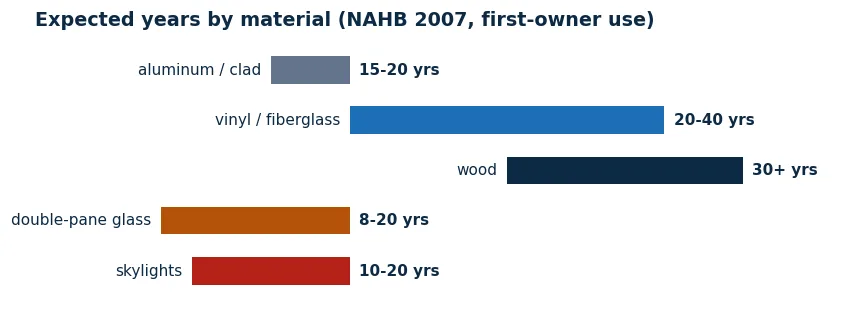
The honest range, from the NAHB life-expectancy study: aluminum windows 15 to 20 years, vinyl and fiberglass 20 to 40, wood 30 and up with maintenance. But a window is not one thing, and its parts age at different speeds. The sealed glass unit is the weak link, rated 8 to 20 years on its own; in the only long field measurement we have, 9.2% of sealed units had failed by year 25. And the warranty you were promised is shorter and narrower than the word lifetime suggests. The details, with the documents, below.
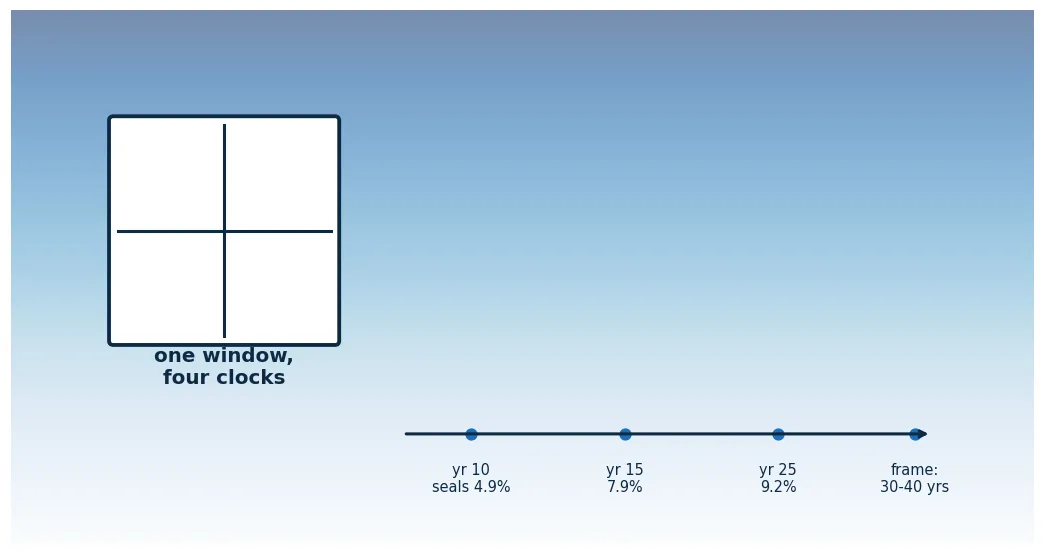
On this page (10 sections)
- Lifespan by material: the honest ranges
- A window is four parts with four clocks
- The one long measurement: 25 years, 2,400 windows
- What the four big warranties actually promise
- The lifetime warranty, translated
- What shortens the life you get
- Brand by brand: the questions people type
- Repair or replace, by the years
- What we audited, and how
- Sources
Lifespan by material: the honest ranges
The most-cited numbers in this niche come from the National Association of Home Builders' Study of Life Expectancy of Home Components, carried today in InterNACHI's public chart. They are ranges rather than promises, because they compress quality tiers, climates and maintenance into single lines. Read them as the outer fence posts, not as your window's destiny.
| Window part or type | Expected years | What the range hides |
|---|---|---|
| Aluminum / aluminum-clad | 15 to 20 | frame survives; the finish and the seals do the aging |
| Vinyl / fiberglass | 20 to 40 | the widest spread: builder grade to premium welded lines |
| Wood | 30+ | the maintenance tax is priced in; skip it and the range collapses |
| Double-pane sealed glass | 8 to 20 | the shortest clock in the window; the seal, not the glass |
| Skylights | 10 to 20 | roof exposure is harder than any wall |
Why ranges, not numbers
A page that tells you windows last 20 years is averaging across things that do not average: a vinyl window in Arizona sun and one in coastal Maine, a premium welded frame and a builder-grade one, a careful install and a rushed one. The range is the honest answer; the sections below are about which end of it you land on.
The builder-grade question
Builder-grade windows, the ones a subdivision gets by default, cluster at the bottom of every range: thinner vinyl, simpler balances, basic seals. They are also the windows most often asked about at the 15-year mark, which is not a coincidence. If your 2000s subdivision house has its original windows, the range to plan around is the low one.
A window is four parts with four clocks
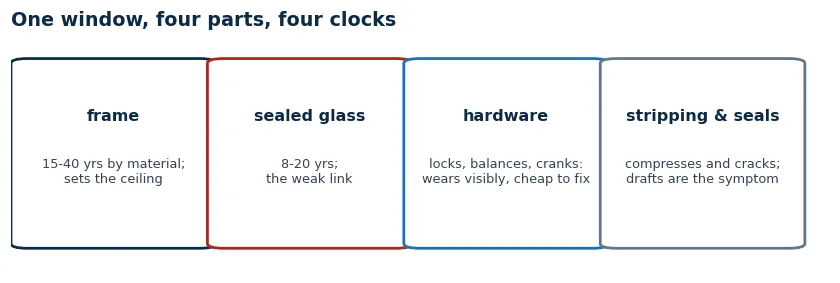
People ask whether windows wear out as if a window were one object. It is four: the frame, the sealed glass unit, the hardware, and the weatherstripping and seals between them. They fail in different ways on different schedules, and knowing which clock is ringing changes whether the answer is a tube of caulk, a new glass unit, or a new window.
Do double pane windows wear out?
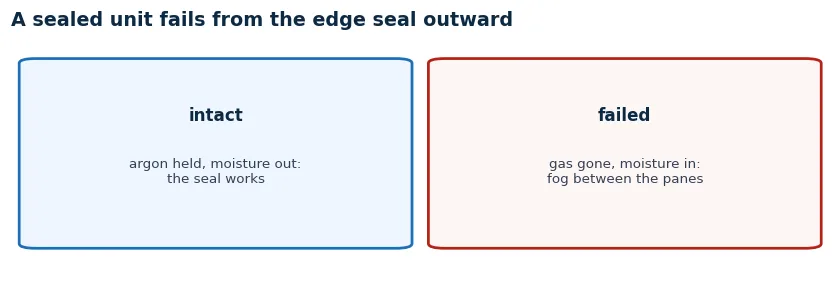
Yes, and from the inside out. The two panes are held apart by a spacer and sealed around the edge; that seal keeps the insulating gas in and moisture out. Every heating and cooling cycle pumps a little against it. When the seal goes, the gas is gone and moisture follows: fogging between the panes you cannot wipe off is the signature. The glass looks dead because it is.
The parts that give warning
Hardware wears visibly: locks that stop pulling the sash tight, balances that let a double-hung drift, crank gears on casements that skip. Weatherstripping compresses and cracks. These are cheap failures with loud symptoms, drafts and sticking, and they are the repairs worth doing on a frame that still has years in it.
The frame decides the ceiling
Glass and hardware can be swapped; the frame cannot. Rot in wood, UV-chalked and warped vinyl, corroded aluminum: when the frame goes, the window is done regardless of the glass. That is why the material ranges above matter less as averages than as ceilings on every repair decision.
The one long measurement: 25 years, 2,400 windows
Almost every lifespan number online is a survey of guesses. There is exactly one long field measurement of the part that fails first, and we went to the paper itself. Starting in 1980, the insulating glass industry's association tracked more than 2,400 sealed glass units across 140 buildings in 14 US cities, inspecting for fogging and seal failure at the 10, 15 and 25-year marks. Nearly all of them faced south or southwest: the harshest exposure a window gets.
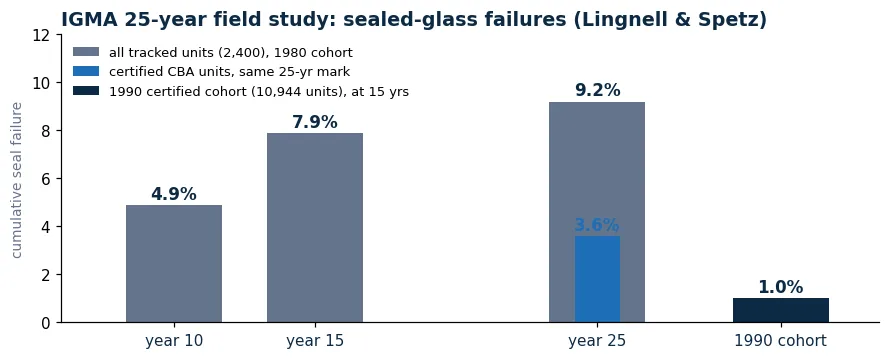
What 9.2% at 25 years actually means
Two things at once. The reassuring half: about 91% of sealed units were still intact after a quarter century in the sun, so the catastrophic early failure people fear is rare. The sobering half: failures were already visible at 10 years, 4.9%, and the curve does not flatten. Windows do not die at a birthday; they accumulate failures, and the odds of one in your house failing grow every year past the tenth.
The detail that changed the industry
Units certified to the tougher testing class failed at 3.6% over 25 years, against 14% for the rest, roughly a four-to-one gap, and a second cohort of nearly 11,000 certified units made by newer processes failed at just 1% at 15 years. The study's other finding is the one homeowners can act on: glazing systems that let water sit against the edge seal failed several times more often. Water management at the sill is a lifespan feature, not a detail.
Why you have never seen this study quoted
It is old, it is hosted as a conference PDF, and it says something inconvenient for anyone selling urgency: most windows outlast the panic. We cite it because it is measured, and because the measured answer is more useful to you than a rule of thumb someone else invented.
What the four big warranties actually promise
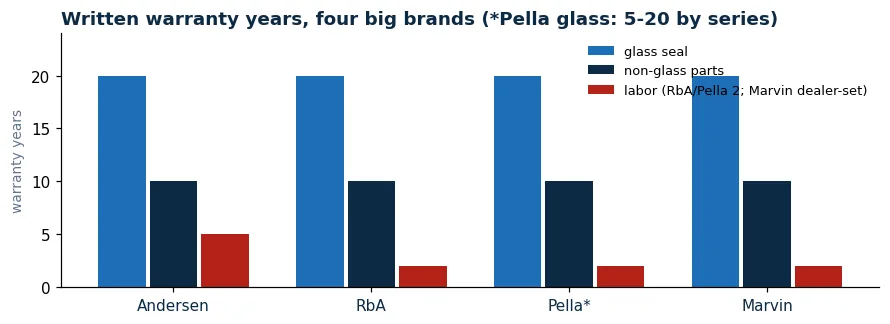
Manufacturers know their own failure curves better than anyone, and their warranties are those curves translated into legal language: warranty length is the maker's own estimate of trouble-free life. So we read the written warranties of the four biggest names and laid them next to the field data. The table is the audit; the finding is below it.
| Brand | Glass seal | Non-glass parts | Labor | Transfers? |
|---|---|---|---|---|
| Andersen (400, E, A-series) | 20 yrs | 10 yrs | 5 yrs, certified installer | yes, Owner2Owner |
| Renewal by Andersen | 20 yrs | 20 yrs Fibrex, 10 rest | 2 yrs | yes |
| Pella | 5 to 20 by series | limited lifetime* | 2 yrs | becomes 10 yrs flat |
| Marvin | 20 yrs (to 60 sq ft) | 10 yrs | dealer-dependent | yes |
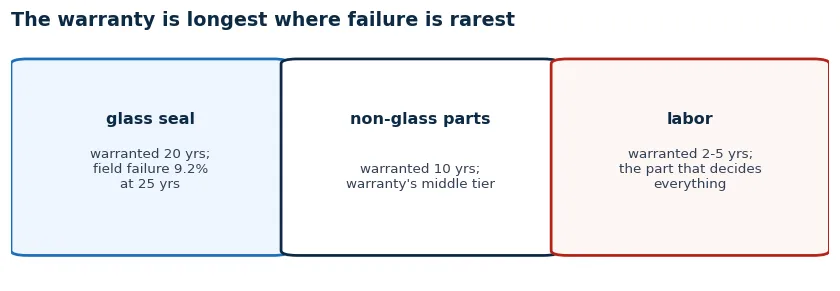
The gap the table exposes
The glass seal, warranted for two decades, is the component least likely to fail: 9.2% over 25 years in the field, 3.6% for certified units. The labor, warranted for 2 to 5 years, is the part that decides whether the whole window performs, because installation and water management are the failure multipliers the field study found. The warranty is longest exactly where you are least likely to need it. That is not a scandal; it is how risk pricing works. But it tells you what to pay attention to: the installer, not the brochure.
The clock starts at purchase, not at failure
Every warranty in the table runs from the original purchase or installation date. A seal that fogs in year 19 of a 20-year warranty is covered; the same fog in year 21 is yours. Keep the receipt and the serial numbers, register the product if the maker offers it, and photograph the labels before the trim goes on. Warranty claims die on paperwork more often than on merit.
The lifetime warranty, translated
Lifetime is the most misunderstood word in window marketing, and the fine print deserves a plain reading. In the documents, it does not mean the life of the window or the life of the house.
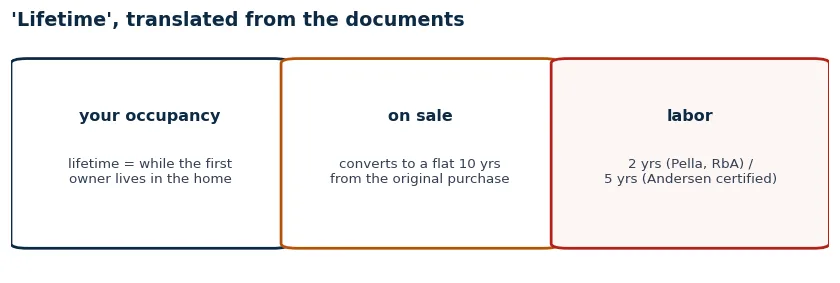
Whose life it means
Pella's limited lifetime, the flagship use of the word, applies to the original purchaser in an owner-occupied single-family home. Sell the house and it converts to a flat 10 years counted from the original purchase date, so a sale in year 8 leaves the buyer two years. Other brands with lifetime language work the same way: the life being measured is your tenancy, not the product's durability.
What this means when you are buying
If you expect to sell within a decade, a transferable warranty with a fixed term, Andersen's Owner2Owner being the clean example, can be worth more to the next owner than a lifetime that dies at the closing. If you are the buyer of a house with recent windows, the first question is not how old they are but which warranty, if any, survived the sale.
What shortens the life you get
The material ranges assume average conditions. Four things reliably push a window toward the bottom of its range, and three of them are set on the day it goes in.
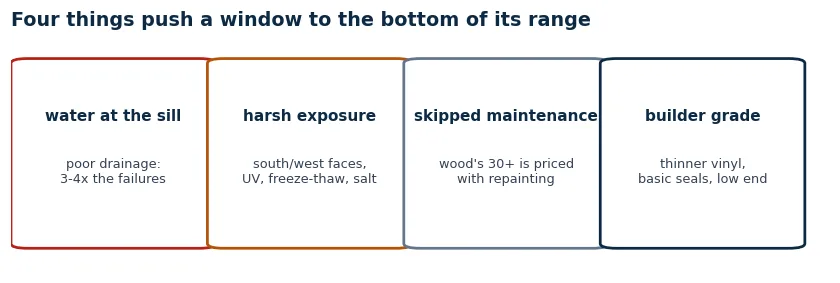
Installation and water
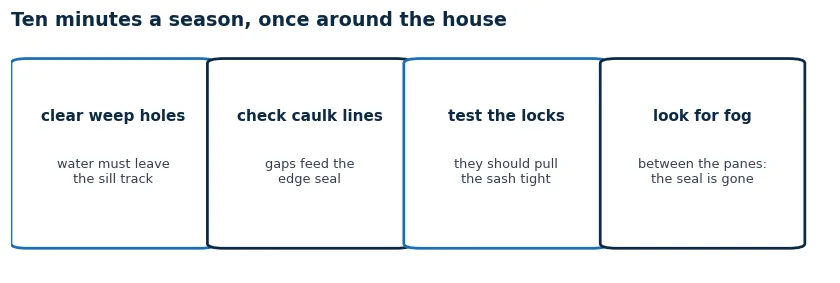
The 25-year study's standout finding was that glazing systems trapping water at the sill failed at three to four times the rate of properly weeped ones. In a house, the equivalent is a window set without flashing and drainage. You cannot see it after the trim is on, which is why the install day matters more than the brand day.
Exposure and climate
The study deliberately tracked south and southwest faces, the harshest orientation, and even its good numbers come from that exposure. Add the regional multipliers: desert UV and heat cycles, freeze-thaw on frames and seals, coastal salt on hardware and cladding. The same window ages at different speeds in different ZIP codes.
Maintenance, and its absence
Wood's 30-plus years are priced with repainting and caulking included; skip a decade of it and the range collapses toward rot. Vinyl and fiberglass ask for little but still want weep holes clear and tracks cleaned. The cheapest life extension in windows is a seasonal walk-around with a keen eye, and it is also the most skipped.
Brand by brand: the questions people type
The autocomplete record shows people asking about specific brands by name. The honest answer is the same shape for all of them, because the warranty tables above are the manufacturers' own statements of expected life.
How long do Andersen windows last?
Andersen warrants glass for 20 years and parts for 10, transfers it cleanly to the next owner, and its Fibrex composite carries 20 years at Renewal by Andersen. Read the warranty as the floor: a product the maker will stand behind for two decades, in a field where 91% of sealed units reach 25 years intact.
How long do Pella and Marvin windows last?
Marvin's written terms mirror the industry: 20 years on insulating glass up to 60 square feet, 10 on non-glass parts, 10 to 20 on cladding finishes. Pella's glass term varies 5 to 20 by series, so the series name on the quote decides the answer; its lifetime language is the occupancy-limited kind described above. Both outlast their paperwork when installed well.
What about Milgard, Jeld-Wen and the rest?
The pattern repeats down the market: 20 years on glass seals has become the industry's standard promise, with the differences hiding in labor terms, transfer rules and finish coverage. When a brand departs from the pattern, that departure, not the headline number, is the thing to read.
Repair or replace, by the years
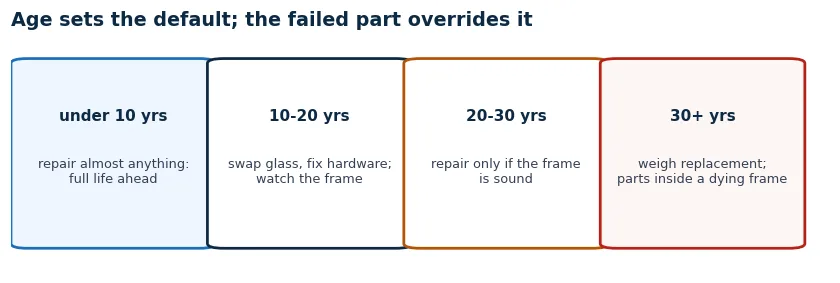
Since the parts age separately, the repair-versus-replace answer changes with the window's age and the part that failed. The useful frame is not "how old is too old" but "which clock rang, and how much life is left on the others."
The glass-only fix
A fogged sealed unit on a sound frame is the classic repair: the glass unit is swapped, the window stays. It makes sense when the frame has years left, and it stops making sense when the frame is at the end of its material range, because then you are buying a new part for a dying whole. Beware defogging services that drill and vent the unit: they clear the view but cannot restore the gas fill or the seal.
When replacement is the honest answer
Frame rot or warping, multiple failed seals across the house, or a window at the bottom of its material range with compounding symptoms: that is replacement territory, and it is a project priced like one. The cost side, including what a clean quote should itemize, is on the installation cost page. If part of the house has you weighing a claim instead, storm damage and the like, the coverage question is answered on the insurance page.
What we audited, and how
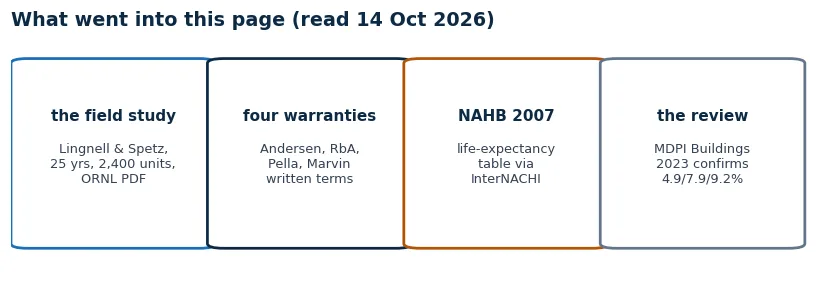
Two bodies of primary material went into this page, read on 14 October 2026. The first is the only long field measurement of window failure we could find: Lingnell and Spetz's 25-year IGMA study of more than 2,400 sealed glass units, read from the conference paper itself rather than from summaries. The second is the written warranty text of Andersen, Renewal by Andersen, Pella and Marvin, compared line by line against the field numbers.
What we did not use
The lifespan lists on publisher sites, which mostly restate the NAHB table without saying so, and manufacturer marketing pages, which restate warranties without their conditions. Where the industry consensus number comes from a survey of estimates, we say that. Where it comes from a measurement, we say that too.
The limits of this audit
The field study ended in 2006 and tracked commercial-grade units on harsh exposures; modern certified residential units should do better, and the 1990 cohort in the same paper, 1% failure at 15 years, suggests they do. Warranty terms change; the written warranty for the specific series you buy, on the maker's site, governs. Our table is a dated reading, not a permanent one.
The questions people actually ask
How long do windows last on average?
By material, from the NAHB life-expectancy study: aluminum 15 to 20 years, vinyl and fiberglass 20 to 40, wood 30 or more with maintenance. The part with the shortest real life is the sealed glass unit: double-pane glazing is rated 8 to 20 years, and the one long field measurement found 9.2% of units fogged or failed by year 25. Whole-window life is usually decided by the glass seal and the installation, not the frame.
Do double pane windows wear out?
Yes, and they are usually the first part to go. The seal around the two panes slowly loses its hold on the insulating gas and its dryness. In the 25-year IGMA field study, failures reached 4.9% at 10 years and 9.2% at 25 years among the tracked units. Fogging between the panes is the visible sign; the insulating value has been leaking away well before the fog shows.
How long do vinyl windows last?
The NAHB figures put vinyl at 20 to 40 years, the widest range of any material because quality spread is wide. Builder-grade vinyl sits at the bottom of that range; premium lines with welded frames and better seals sit at the top. The frame usually outlives the glass seal, so the practical answer is that the glazing gives out first.
How long do Andersen, Pella or Marvin windows last?
All three warrant glass against seal failure for 20 years (Pella varies 5 to 20 by series) and non-glass parts for 10, which is the manufacturers' own statement of expected trouble-free life. Field data suggests most units outlive those warranties: only about one in eleven sealed units failed by year 25 in the long study. Pella's limited lifetime warranty, despite the name, covers only the original owner living in the home.
Is a lifetime window warranty actually for life?
Not in the way the word suggests. In the documents we read, lifetime meant the original purchaser's time living in that house. Pella's limited lifetime converts to a flat 10 years from the original purchase date when the home is sold. Labor is covered for just the first 2 years at Pella and Renewal by Andersen, and 5 years through an Andersen-certified installer. The product outlives the labor coverage by decades.
How often should windows be replaced?
There is no schedule, only condition. The numbers say sealed glass reaches a 9.2% cumulative failure rate at 25 years, frames run 15 to 40 years by material, and installation quality moves both. Replace on evidence: failed seals, rotten or warped frames, hardware that no longer closes the unit tight. Age alone is a weak reason; age plus symptoms is the real one.
Can I repair a foggy window instead of replacing it?
The glass unit can be replaced without replacing the whole window, and it is the standard fix for a failed seal on a frame that is still sound. Defogging services that drill and vent the unit exist, but they do not restore the insulating gas or the original seal. If the frame itself is at the end of its material life, a new sealed unit is money spent inside a dying window.
What shortens a window's life the most?
In the field study, the strongest failure multiplier was glazing that let water sit against the edge seal: poor drainage and wet glazing systems failed three to four times more often than certified, properly weeped ones. South and southwest exposure, temperature swings, deferred maintenance on wood, and coastal salt all shorten life. Installation quality is the variable you control once, at the start.
Sources
- Lingnell & Spetz: Field Correlation of the Performance of Insulating Glass Units, a 25-year study (IGMA, via Oak Ridge National Laboratory) · the failure curve this page is built on; read 14 October 2026.
- MDPI Buildings 2023, 13(2):551, Degradation of Insulating Glass Units · the independent review confirming the 4.9 / 7.9 / 9.2% figures.
- Andersen E-Series written limited warranty (PDF) · 20 years glass, 10 years non-glass, from the document itself.
- Pella: window and door warranties · lifetime defined as the original owner-occupant; labor covered the first two years.
- Marvin: limited warranty hub · glass 20 years to 60 sq ft, non-glass 10, cladding 10 to 20.
- InterNACHI life-expectancy chart (NAHB 2007 figures) · the material ranges: aluminum 15-20, vinyl and fiberglass 20-40, wood 30+, double-pane 8-20.
- Lawrence Berkeley National Laboratory: Windows and Daylighting · the national lab research program behind window energy performance ratings.
- EPA: Lead Renovation, Repair and Painting program · replacing windows in a pre-1978 home disturbs lead paint; certified crews are the rule, not the upgrade.
- ENERGY STAR: windows, doors and skylights · the efficiency case when replacement is the answer.
Warranty terms change by series and over time; the written warranty for your product governs. ClearView is an independent guide, not a seller or installer; see thedisclaimer.
If the verdict is replacement
A houseful of windows at the end of their clocks is a real budget item, and the quotes will vary more than the windows do. What the work should cost, line by line, is on the installation cost page; if a bedroom or basement project is involved, the egress requirements apply before the first quote is written.