Window replacement in Atlanta in 2026: read the money map before the quote
By the ClearView editorial team · Sources read on 2026-10-19
Read time about 11 minutes
The short answer
An Atlanta window job is the national job with two local signatures: paperwork and the missing rebate. On paperwork, the metro is not one answer. Georgia's mandatory state code never exempts a window swap, each city runs its own permit desk, and 22 historic districts add a design review before the permit. On money, we read the five programs that could pay for windows here, line by line, on 19 October 2026: none of the four utilities carries a window measure, and the state's Home Efficiency Rebates pay for windows only inside a whole-home project that models a 20 percent energy cut. Below: the price bands, the program-by-program map with our arithmetic, the permit table, the historic step, the glass for zone 3A, and the checks that filter companies in a state where no license gates this trade.
On this page (12 sections)
What it costs in Atlanta
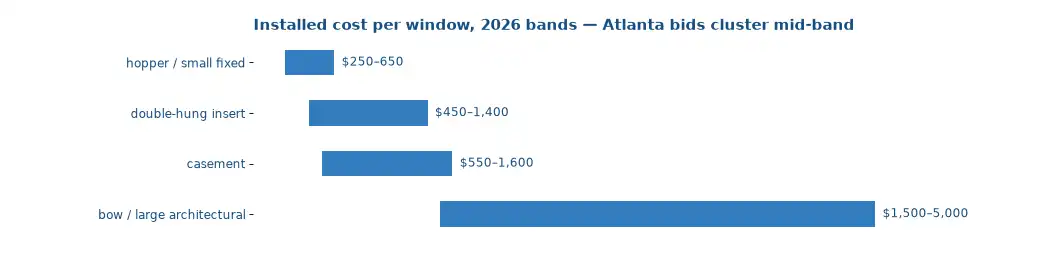
Start with the honest bands, because every quote you collect will land somewhere on this map. A standard double-hung insert installed runs about $450 to $1,400 per window in the 2026 national data; casements track a step up for the operator hardware, and bow or large architectural units sit well above the per-window range because they carry structure (the four-price anatomy of one is on our bay window cost page). Atlanta prices near the national middle: the metro has a deep installer pool, no hurricane-rated glass mandate of the coastal kind, and no hail-belt premium baked into every bid.
What moves the number
Five drivers, same as anywhere: how many openings, insert versus full-frame, the glass package, second-story access, and lead-safe handling in the metro's many pre-1978 houses. Atlanta adds two local lines. Inside the perimeter, older housing stock means more full-frame work and more lead protocol. And a historic-district address can add the review layer and its material expectations before any installer sets a ladder. The basic window replacement cost question (one standard opening, an insert swap) anchors the bottom of the band; small side jobs like a garage window or a basement hopper sit there too.
For the detailed math, labor hours per opening and the whole-house roll-up, see our installation cost guide. Until a written, itemized quote exists, every number is a band.
The money map: five programs, read
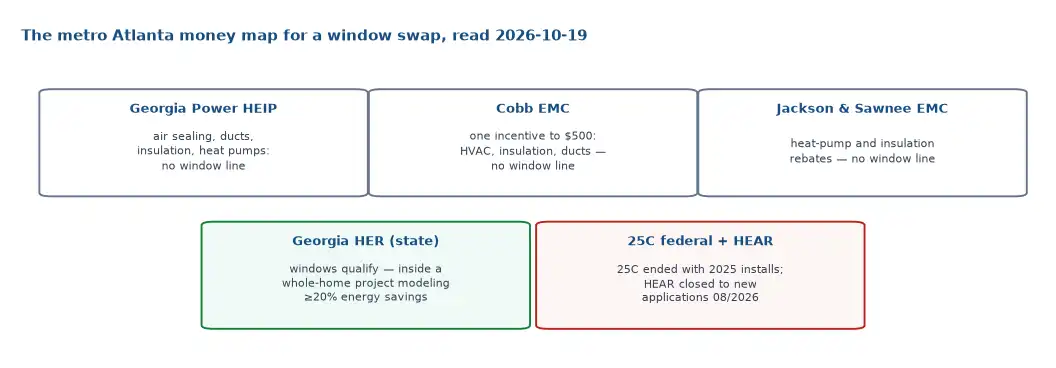
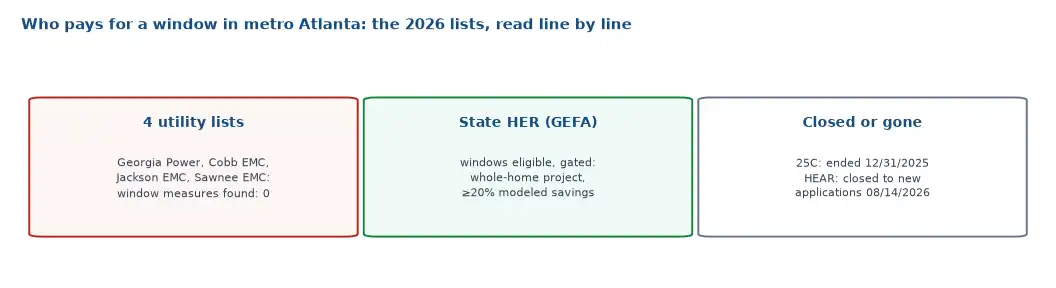
Every Atlanta cost page says "check rebates." We did, and we read the programs themselves rather than blogs about them. Five programs can theoretically touch a window project in the metro. Four are utilities, and their current lists are below; the fifth is the state's. The finding in one sentence: in 2026, no metro Atlanta utility rebates a window, and the one program that does pay for windows pays only inside a bigger project.
| Program | Window measure? | What the list actually pays for |
|---|---|---|
| Georgia Power HEIP | No window line | Air sealing to $400, duct sealing to $600, heat pumps to $1,500, attic insulation to $300, assessment to $150 (cycle Jan 2026 to Dec 2028) |
| Cobb EMC Energy Network | No window line | One incentive up to $500 across HVAC, water heater, attic insulation, duct sealing, weatherstripping |
| Jackson EMC | No window line | Heat pump replacement to $400, level-2 charger $250 |
| Sawnee EMC | No window line | Insulation-class rebates; 2026 list read on its rebates page |
| Georgia HER (state, GEFA) | Yes, with a gate | Windows qualify only inside a whole-home project modeling 20 percent energy savings; percent-of-cost rebates with income-tiered caps up to $16,000 |
Two more lines that quotes keep forgetting. The federal 25C energy credit ended with installations after 31 December 2025, so no 2026 window install carries it. And HEAR, the state appliance rebate, closed to new applications on 14 August 2026, and never covered windows to begin with. If a 2026 quote subtracts a rebate for window units, it owes you a program name.
The 20 percent rule, with arithmetic
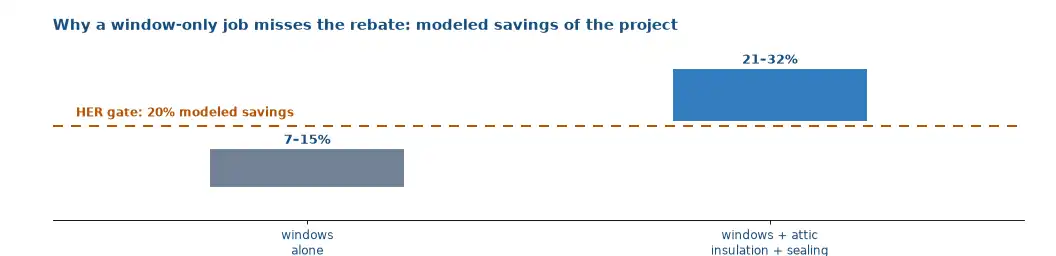
The state's Home Efficiency Rebates program is real money (up to $16,000 for lower-income households), but it does not pay for measures, it pays for modeled savings. An approved contractor runs a SnuggPro model of your home, and the rebate tier keys to the modeled reduction: 20 percent opens the door, 35 percent opens the bigger tiers. That single rule decides whether windows are rebated at all.
Why a window-only project misses the gate
The Department of Energy's own bands put efficient replacement windows at roughly 7 to 15 percent of energy bills, and the window share of envelope loss is smaller still once attic and infiltration take their parts. A window-only swap models in the low teens at best, below the 20 percent gate. Add attic insulation and air sealing, the two measures every utility on the map does pay for, and the modeled project crosses the threshold, with the windows then eligible inside it. The program is telling you something useful: in this climate the envelope order is seal and insulate first, glass second.
What to ask before counting it
Three written answers before you let a rebate line into a quote: which program, by name; what the model says your project saves; and who applies, with approval before work. HER requires an approved contractor and the model up front, so a rebate cannot be a retroactive surprise either way. If the quote just says "federal green rebate", that program does not exist for 2026 windows.
The metro permit table
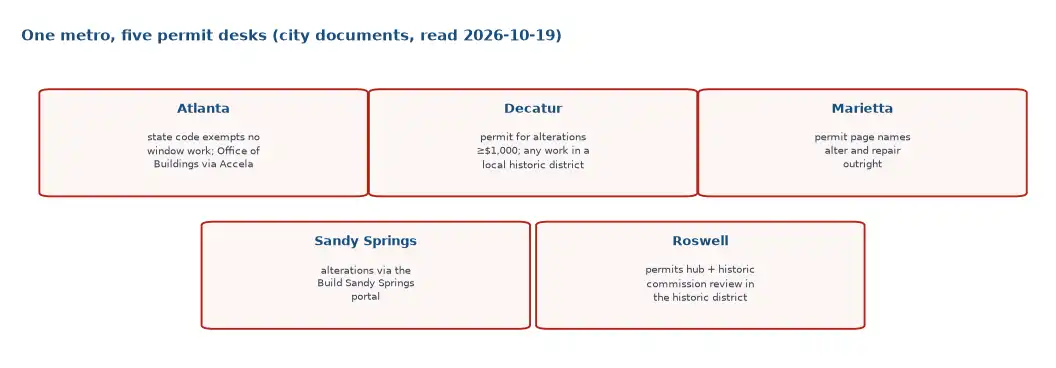
Georgia runs construction on the State Minimum Standard Codes, which are mandatory in every city whether or not the city enforces them locally. The residential code's exemption list frees awnings, painting and finish work, not window replacement. So the metro's default is "expect a permit for an alteration," and the cities write their own versions of that default.
| City | Answer | Source |
|---|---|---|
| Atlanta | Permit expected: state code exempts no window work; Office of Buildings takes alterations on the Accela portal; contractors file elevations and a site plan | atlantaga.gov Office of Buildings; Georgia State Minimum Standard Codes |
| Decatur | Permit required for alterations valued $1,000 or more (a window job is one) and for any work in a local historic district | decaturga.com permit page, Unified Development Ordinance §10.1.1 |
| Marietta | Permit required: the city's permit page covers anyone who intends to "construct, enlarge, alter, repair" a structure | mariettaga.gov, Building Permits page |
| Sandy Springs | Permit required: alterations go through the city's Build Sandy Springs portal (secondary aggregator; the city portal does not publish a window-specific page) | sandyspringsga.gov Build portal; doineedapermit.org listing |
| Roswell | Permits for alterations via the city's permits hub; the Roswell historic district adds its preservation commission review | roswellgov.com building FAQs and permits hub |
What the permit actually buys you
The fee is not the point; the record is. A permitted window job leaves an inspection trail that buyers and insurers read later, and it forces the egress question onto paper: replacing or resizing a bedroom window touches the emergency-escape rules (our egress requirements page has the four IRC numbers), and a permit review is where that gets caught instead of after closing. Whoever pulls the permit owns the answer, so ask on the quote whose name goes on it.
Historic Atlanta: the COA step
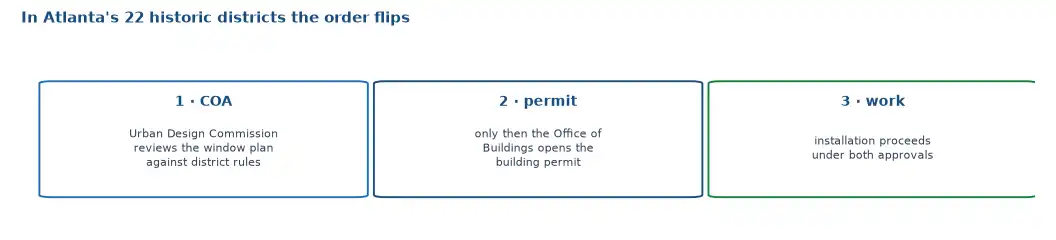
Atlanta keeps 22 local historic and landmark districts (Inman Park, Grant Park, West End, Cabbagetown, Ansley Park and the rest), and in them the first approval is not the building permit. The Urban Design Commission issues a Certificate of Appropriateness first; only then does the permit desk open. The district regulations cover exterior alterations visible from the street, which is exactly what a street-facing window swap is. The Bonaventure-Somerset district code puts it in plain terms: a Type II certificate is required for all exterior alterations to existing structures visible from a district right-of-way.
What review usually asks of a window
The pattern across districts is repair-first, then replacement that matches the original profiles and materials on visible elevations: wood or a convincing clad profile, true proportions, no stock vinyl grids on a 1915 facade. Rear and non-visible faces get more latitude, and interior work stays outside review. Plan the COA into the calendar: it adds weeks, not days, and starting work without one can be undone at your expense.
Glass for a mixed-humid zone
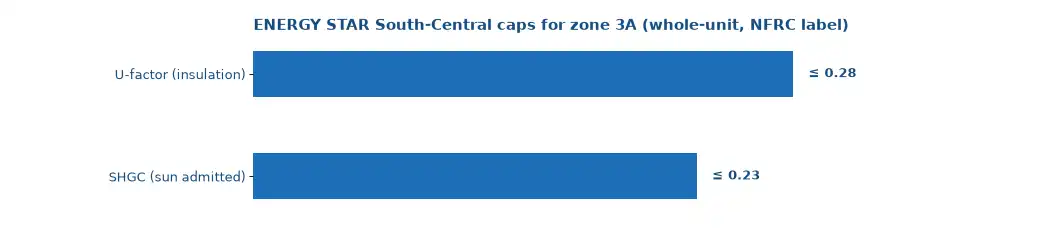
Atlanta sits in climate zone 3A, mixed-humid: real cooling seasons, meaningful winter nights, and humidity for most of the year. ENERGY STAR's South-Central window criteria cap whole-unit U-factor at 0.28 and SHGC at 0.23 for certified units. Read those numbers off the NFRC label as whole-unit values; center-of-glass numbers always read better and are not the certified figure.
The canopy caveat
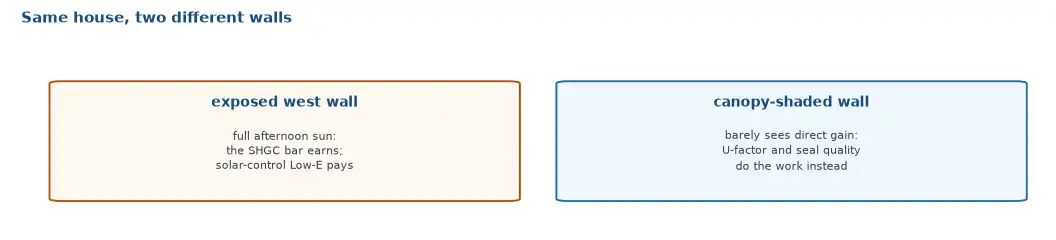
The metro's tree cover changes the SHGC arithmetic house by house. A west wall that sees full afternoon sun earns every bit of the 0.23 solar-heat bar; the same wall under mature canopy barely sees direct gain, and there the U-factor and seal quality do more work than solar coating. In a humid summer, a failed insulated-glass seal fogs between the panes fast, so spacer and seal warranty are not decoration on the quote. Match the package to the wall, not to the brochure.
Read the label, not the brand line
Brand names for glass packages vary by manufacturer; the NFRC label does not. If the quote cannot name the quoted unit's whole-unit U and SHGC on paper, the glass is whatever was cheapest that week. The same pairing habit is measured on our vinyl versus wood page, where the glass package, not the frame, carries the energy number.
Repair or replace, tested first
A clouded insulated unit, flattened weatherstripping or a crank that will not turn each has a stated repair price far below a new window, and much of the metro's comfort grumbling ends at one of those three. A rotten frame, single-pane glass or a crooked installation closes the repair file for good. The local tell: a unit that fogs between the panes on humid mornings has a failed seal, and the seal, not the frame, is what failed.
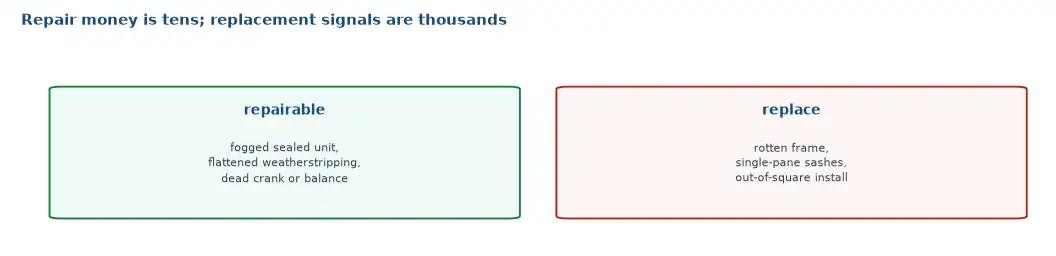
Each signal carries a five-minute test on our when to replace windows page; chasing the leak half of the problem belongs to the drafty windows page. Run both before collecting quotes, because a crew paid to sell windows will not run them for you.
Choosing a company in Georgia
The usual first check, "is the contractor licensed", works differently here. Georgia licenses residential and general contractors above $2,500 of contract value, but window and door installation sits on the state's traditional specialty list, exempt from that license. A window crew may therefore be fully legitimate with no license to look up. The filter has to be documentary in other ways.
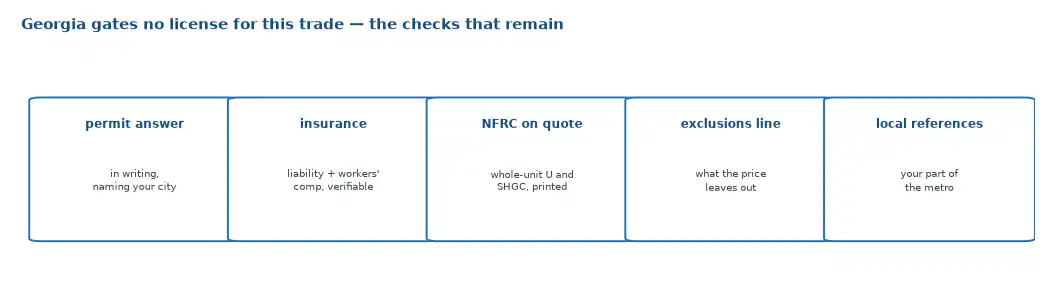
The five checks that remain
One: the permit answer in writing, naming your city. A company working the metro daily knows which desk it uses. Two: general liability and workers' compensation certificates you can call back and verify. Three: the quoted unit's NFRC whole-unit values printed on the quote. Four: an exclusions line naming what the price leaves out. Five: references in your part of the metro, because crew quality in this trade is local, not brand-level. A bidder that clears all five has earned its price, whatever the logo.
Storm-week addendum
After a thunder outbreak the metro fills with out-of-state crews. The same five checks apply twice as hard, plus two local ones: a signature deadline tied to the storm is sales pressure, not a discount, and a "mobile" outfit that exists only as a truck and a phone number fails the insurance-verification check on contact. Your insurance claim does not expire in 48 hours, whatever the door hanger says. The deal worth having is the service near you that still exists next spring.
The Atlanta calendar
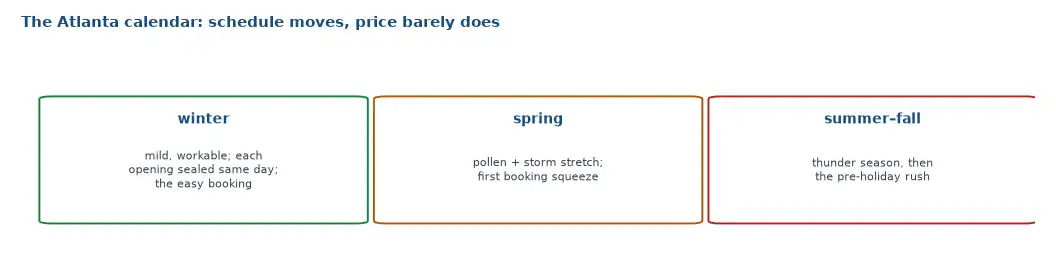
Season to season the price holds steady; what actually moves is the booking calendar, and that calendar is the real currency. Winter is mild and workable, with each opening sealed the same day. Spring brings the pollen-and-storm stretch and the first booking squeeze. Late summer runs thunder season, and fall fills with people catching weather before the holidays. The easy slot is the one nobody is thinking about.
What we read, and how
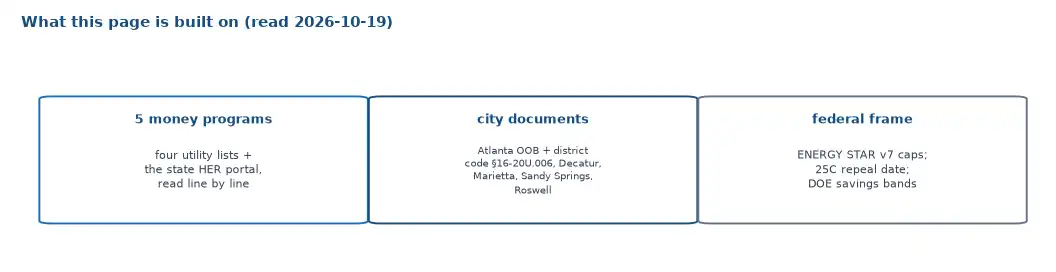
This page is built on primary reads, dated 19 October 2026: the rebate lists of Georgia Power (Home Energy Improvement Program), Cobb EMC, Jackson EMC and Sawnee EMC read line by line for a window measure; the state Home Efficiency Rebates rules on the official Georgia energy rebates portal, including the 20 percent modeled-savings gate and the income-tiered caps; the HEAR program's August 2026 closure update; the repeal date of the federal 25C credit. For permits: Georgia's mandatory State Minimum Standard Codes and the residential exemption list, Atlanta's Office of Buildings process, Decatur's ordinance, Marietta's permit page, Sandy Springs' Build portal and Roswell's permits hub, plus the Urban Design Commission certificate process and a district code chapter quoted directly. Sandy Springs' window-specific answer is marked as read from a secondary aggregator because the city does not publish one; we say so rather than smooth it over.
The limits of this measurement
Program lists change without notice, and a rebate read today can close tomorrow; the date on every row is the answer to that. The 20 percent arithmetic uses the Department of Energy's published savings bands, not a measurement of your house. Your SnuggPro model is the version that counts for a rebate decision. Cities whose documents do not name windows are reported as written, not guessed. And on longevity: what the next unit should last is on our window lifespan page.
Sibling pages in this wave: the Denver page maps permits against hail, Dallas against the Texas permit flip, and Austin against its solar-screen rebate quirk.
The questions Atlanta actually asks
How much does window replacement cost in Atlanta?
Per window installed, the 2026 national bands run about $450 to $1,400 for a standard double-hung, with bow and large architectural units above that and small hoppers below. Atlanta pricing sits close to the national middle: the metro has a deep labor pool and no energy-code premium of the kind hail or hurricane zones carry. Five things decide the quote: the count of openings, insert against full-frame, which glass package, second-story access, and whether the house predates 1978 for lead-safe handling. Our installation cost guide carries the per-opening labor hours and the whole-house roll-up; until a written, itemized quote exists, every number is a band.
Do I need a permit to replace windows in Atlanta?
Plan on yes. Georgia's State Minimum Standard Codes are mandatory statewide, and the residential code's exemption list does not cover window replacement, so the default across the metro is a permit for an alteration. Atlanta takes them through the Office of Buildings on the Accela portal; Decatur's ordinance requires one for alterations of $1,000 or more; Marietta's permit page names altering and repairing outright. Inside one of Atlanta's 22 local historic districts there is an earlier step: a Certificate of Appropriateness from the Urban Design Commission before the building permit. The city-by-city table on this page shows who says what, with the documents.
Are there rebates for window replacement in Georgia in 2026?
Not for a plain window swap, and that is the page's own measurement, not a guess. We read the five programs that could touch a metro Atlanta home on 19 October 2026: Georgia Power's Home Energy Improvement Program, Cobb EMC's Energy Network, Jackson EMC's residential rebates and Sawnee EMC's rebates carry no window measure at all. Windows are an eligible measure only inside the state's Home Efficiency Rebates program, and only when the whole project models a 20 percent energy reduction, which a window-only job almost never reaches. The federal 25C credit ended with 2025 installs, and the HEAR appliance rebate closed to new applications in August 2026.
What windows work best for Atlanta heat and humidity?
Atlanta sits in the mixed-humid climate zone 3A, which puts it in ENERGY STAR's South-Central window zone: certified units cap whole-unit U-factor at 0.28 and SHGC at 0.23. Read the NFRC label as whole-unit values, not center-of-glass. One local nuance the national guides miss: the metro's heavy tree canopy shades many walls, and a shaded west wall and an exposed one are different problems — the SHGC bar earns most on glass that actually sees afternoon sun. Humidity makes the spacer and seal quality matter as much as the gas fill, because a failed seal in a humid summer fogs fast.
Who are the best window replacement companies in Atlanta?
We are an independent guide and do not rank companies. Georgia adds a wrinkle to the usual license check: window installation sits on the state's traditional specialty list, so the $2,500 general-contractor license threshold does not gate a window job, and a license lookup alone cannot filter your bidder. What filters instead: a written permit answer naming your city, verifiable general liability and workers' compensation, the NFRC values of the quoted unit printed on the quote, an exclusions line, and references in your part of the metro. A bidder that clears all five earns its price, large company or small.
Can I replace windows in an Atlanta historic district?
Yes, but the order of steps changes. In one of the city's 22 local historic districts, the Urban Design Commission issues a Certificate of Appropriateness before the building permit, and district regulations cover exterior alterations visible from the street — which is what a street-facing window swap is. Many districts ask for repair first, or replacement that matches the original profiles and materials on visible elevations. Interior-only work and true in-kind maintenance are usually outside review. Check the district map before you assume the plain-swap path is yours.
Should I repair or replace my windows?
Test before you quote. A fogged sealed unit, flattened weatherstripping or a dead crank each has a stated repair price far below a new window; a rotten frame, single-pane glass or a crooked install ends the repair conversation. In this climate add one local test: a unit that fogs between the panes every humid morning has a failed seal, and the seal, not the frame, decides. The when to replace windows page holds a five-minute test per signal; leak-chasing belongs to the drafty windows page.
Is it cheaper to replace windows in winter in Atlanta?
The number holds steady across seasons; what moves is the booking calendar. Atlanta's mild winters make January a normal work slot, and each opening is sealed the same day, so cold is not the obstacle it is up north. What fills crews here is the spring storm and pollen stretch and the late-summer thunder season, plus the fall rush of people catching weather before the holidays. The easier booking is usually the one nobody is thinking about — and the honest discount is a faster, less rushed crew, not a lower number.
Does home insurance cover window replacement in Georgia?
Insurance pays for sudden, dated events (a storm break, a fallen limb), not for worn-out windows, which are maintenance. Georgia's thunder season makes the storm claim the live route: date the event, photograph every damaged sash and frame before cleanup, and describe the damage in writing with window locations. Our insurance and window replacement page walks the whole claims route, down to what adjusters ask for.
Do Home Depot, Lowe’s or Costco replace windows in Atlanta?
Yes, all three sell and install replacement windows in the metro, but each fulfills through subcontracted local crews, so the five checks apply to the crew that shows up, not the logo on the receipt: the written permit answer naming your city, verifiable insurance, NFRC values printed on the quote, an exclusions line, and local references. Store financing can be real money, but it does not change who holds the nail gun.
What do Andersen or Pella windows cost, and what about a picture window?
Brand lines price by series more than by brand name: an Andersen or Pella double-hung lands in the same installed bands as any quality unit, with the premium lines above them. A picture window has no operator hardware, so per square foot of glass it is the cheap shape — the cost question for a picture unit is size, not mechanism. Manufacturer parts are a different matter: brand-specific hardware (a Pella crank, an Andersen sash) goes through the brand's channel, which is why repair quotes on name-brand units run higher.
Is window replacement worth it in Atlanta?
As comfort, yes on the day the drafts stop; as money, honestly partial. The benefits stack is real: lower bills in a cooling-heavy climate, quieter rooms, easier cleaning with tilt-in sashes, and a documented, permitted job that reads well at sale — but buyers and appraisers pay full attention only to documented work, so expect partial recoup at sale plus the daily gains while you live there. Anyone quoting full recoup is selling, not appraising.
Do windows with broken seals need to be replaced?
A broken seal is the fog between the panes, and it does not heal: the insulating gas is gone and humidity keeps fogging the unit. But the seal, not the window, failed. If the frame is sound, replacing the insulated glass unit alone is the stated-price repair, well under a full window. Replacement of the whole unit is the answer when the frame is also tired or the window is single-pane.
What do Atlanta reddit threads say about window replacement?
The local threads repeat two warnings that match our five checks: quotes for identical openings varying by thousands (scope, not magic), and storm-week crews vanishing before warranty season. The threads are right about both. What they rarely add is the paperwork layer — the permit answer by city and the review step in the historic districts — which is what the tables on this page are for.
What about Marietta, Decatur, Sandy Springs or Roswell?
The climate is shared; the paperwork and the power company are not. Marietta's permit page names altering and repairing as permitted work, Decatur's ordinance requires a permit for alterations at or above $1,000 and for anything in its local historic districts, Sandy Springs permits through its Build Sandy Springs portal, and Roswell runs its own permits hub with a historic district commission on top. On the money side, your rebate territory follows your electric meter: Georgia Power, Cobb EMC, Jackson EMC and Sawnee EMC each publish their own list, and we read all four on this page.
Other metro guides
Keep reading
Sources
- Georgia Home Energy Rebates (GEFA): the state portal · the 20 percent modeled-savings gate, the income-tiered caps to $16,000, and windows as an eligible measure inside a whole-home project.
- DSIRE: Georgia Power Home Energy Improvement Program · the single-family rebate list for the 2026-2028 cycle — no window measure.
- Cobb EMC: Energy Efficiency Incentive · one incentive up to $500 across HVAC, insulation, duct sealing and weatherstripping — no window measure.
- Jackson EMC · residential rebate list read for a window line; none published.
- Sawnee EMC · residential rebates read for a window line; none published.
- City of Atlanta: Office of Buildings · the permit desk and the Accela portal for alterations.
- City of Atlanta code, Bonaventure-Somerset historic district §16-20U.006 · Type II certificates for exterior alterations visible from a district right-of-way.
- Historic West End: historic regulations · the COA-before-permit order from the Urban Design Commission, in a district's own words.
- City of Decatur: how to obtain a permit · alterations at or above $1,000 and any work in a local historic district.
- City of Marietta: Building Permits · construct, enlarge, alter, repair — the trigger window work falls under.
- City of Roswell: building FAQs and permits hub · alteration permits and the historic-district layer.
- ENERGY STAR: windows, doors and skylights · the South-Central caps, U-factor 0.28 and SHGC 0.23, as whole-unit values.
- US EPA: lead-safe work rules for pre-1978 homes · the lead layer on older intown housing stock.